Wallpaper Groups: Only 17 Symmetry Types for Two-Way Repeats
TL;DR: Any flat pattern that repeats in two independent directions has one of exactly 17 symmetry types. Border strips that repeat along a single line have a separate list of 7, and tilings that never repeat, such as Penrose tilings, fit neither list.
Rule: Repeat one motif in two independent directions; only 17 symmetry types are possible.
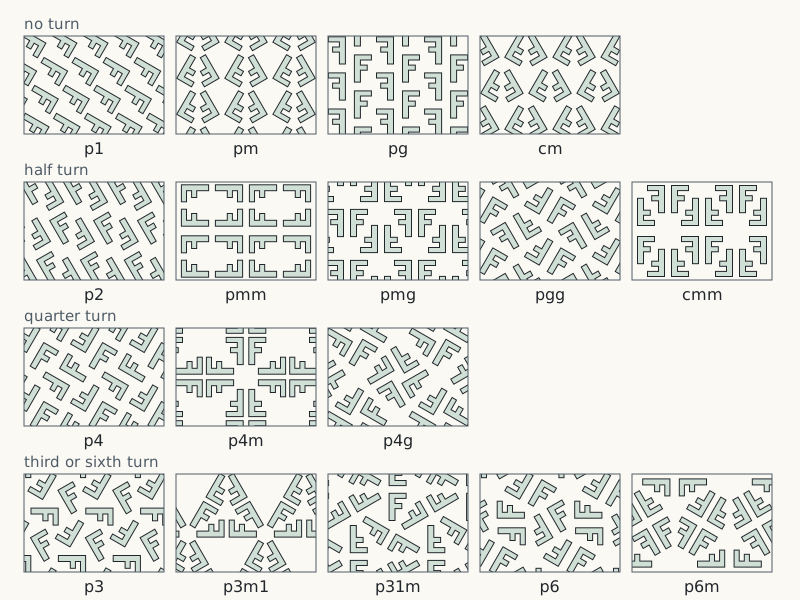
Narrow screen? Scroll the drawing sideways, or open it full size.
Full credit to copy
"The 17 wallpaper groups drawn from one F" by Drawn Mathematics, https://drawnmathematics.com/symmetry/wallpaper-groups/, licensed under CC BY 4.0, https://creativecommons.org/licenses/by/4.0/
What counts as a wallpaper pattern?
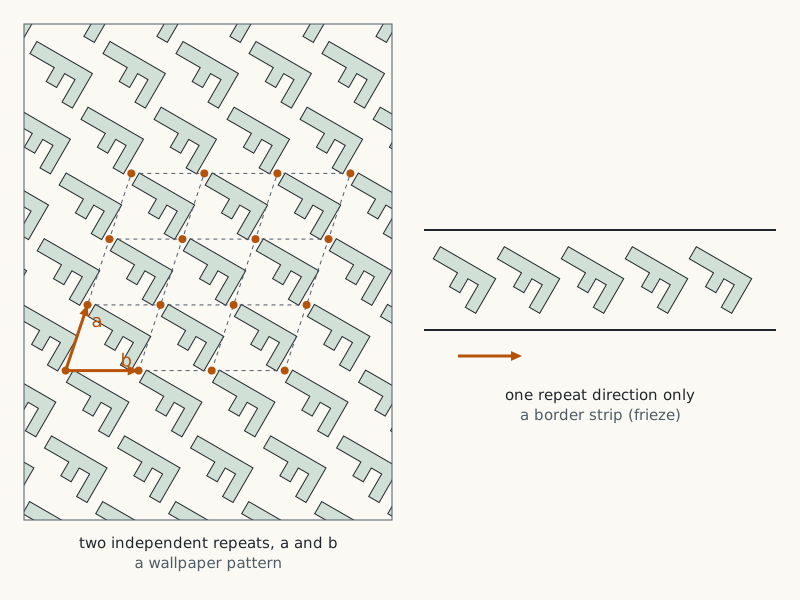
A wallpaper pattern is a flat design that you can slide onto itself in two directions that are not parallel. A slide that leaves the pattern looking exactly the same is called a repeat, and two repeats that point different ways, like the arrows a and b below, fill the whole plane with copies of one cell. This follows the definition in Pavel Etingof's notes Groups Around Us, which also set aside designs such as plain stripes that stay the same under any shift along them.
Narrow screen? Scroll the drawing sideways, or open it full size.
Full credit to copy
"Two repeat directions versus one" by Drawn Mathematics, https://drawnmathematics.com/symmetry/wallpaper-groups/, licensed under CC BY 4.0, https://creativecommons.org/licenses/by/4.0/
A symmetry is any move that leaves the pattern looking as it did: a slide, a turn, a mirror flip or a glide. The full set of these moves is the pattern's wallpaper group, its symmetry type. Etingof gives a proof sketch that there are exactly 17 wallpaper groups, and Wolfram MathWorld lists the same 17 and the short symbols this page uses, such as p4m and pmg.
We call this hard limit the seventeen ceiling: anyone who makes a pattern that repeats in two independent directions works under the same ceiling of 17 symmetry types, in any culture or century. The ceiling is a figure of speech, and the limit itself is a theorem. The 17 is a finished list, like the 13 convex tangram shapes in Tangram: Seven Pieces Make Only 13 Convex Shapes.
A type is not a single pattern. Endless different designs share each type, because the type records only which moves leave a design unchanged, not what the motif looks like.
Two kinds of design sit outside the list. A border strip that repeats along one line only is a frieze pattern, and MathWorld counts exactly 7 frieze types. Penrose tilings, built from two tile shapes, cover the plane without ever repeating, so they fit neither list.
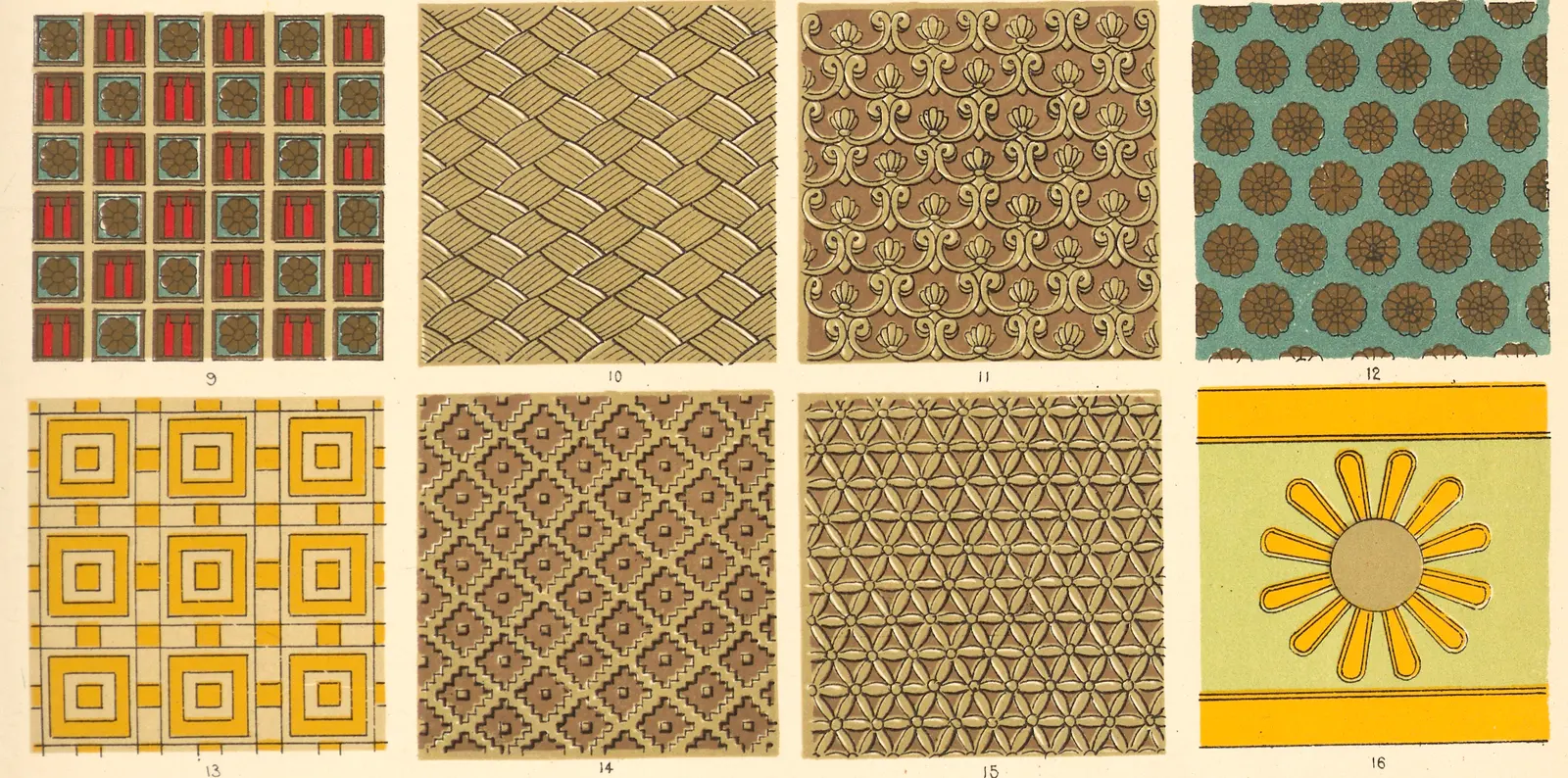
The historical examples on this page come from a scan of Owen Jones's The Grammar of Ornament, catalogued as published in London by Bernard Quaritch in 1910, with 112 plates. This page quotes the English line of the plates' three-language headings, such as “Nineveh & Persia No 2”, and does not say where any design came from.
Full credit to copy
"Nineveh & Persia No 2, Plate XIII, images 9 to 16 (detail)" by Owen Jones — https://commons.wikimedia.org/wiki/File:The_grammar_of_ornament_1910_(139551113).jpg — Public domain (Owen Jones d. 1874; plates first published 1856 (Day & Son), lithographers died before 1956 or are anonymous; this copy London: Bernard Quaritch, 1910; PD worldwide); modified: cropped to the third and fourth rows of the plate (images 9 to 16 with their printed numbers); colours not altered
Only half, third, quarter and sixth turns
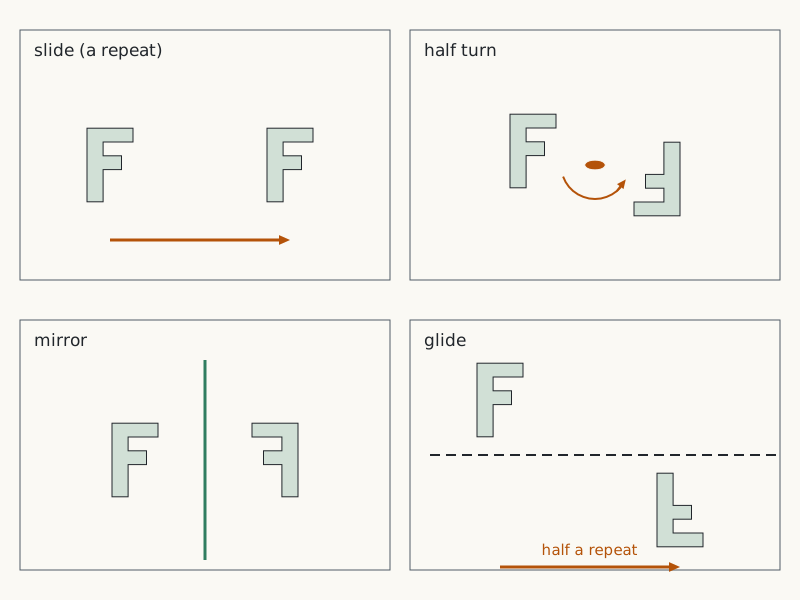
Besides slides, three moves can leave a pattern unchanged. A turn spins the pattern about a fixed point, called the turn centre. A mirror flips it across a line. A glide flips it across a line and then slides it half a repeat along that same line.
Narrow screen? Scroll the drawing sideways, or open it full size.
Full credit to copy
"Slide, turn, mirror and glide on one F" by Drawn Mathematics, https://drawnmathematics.com/symmetry/wallpaper-groups/, licensed under CC BY 4.0, https://creativecommons.org/licenses/by/4.0/
In a wallpaper pattern the smallest turn can only be a half turn (180°), a third turn (120°), a quarter turn (90°) or a sixth turn (60°).
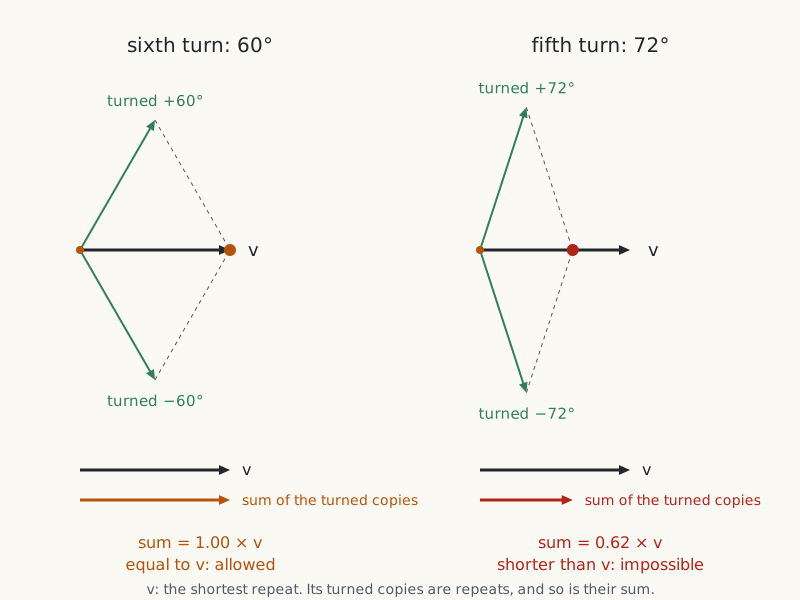
A pattern that repeats in two directions never comes back onto itself after a fifth of a turn (72°). The drawing follows Etingof's proof sketch.
Narrow screen? Scroll the drawing sideways, or open it full size.
Full credit to copy
"Why a repeating pattern cannot turn by a fifth" by Drawn Mathematics, https://drawnmathematics.com/symmetry/wallpaper-groups/, licensed under CC BY 4.0, https://creativecommons.org/licenses/by/4.0/
Take v, the shortest repeat. Turn it forward by the smallest turn, then back by the same amount. Both turned arrows are repeats, so their sum is one too, and it points along v. A repeat along v must be a whole number of v's long, or a repeat shorter than v would exist.
The sum is 2 × cos(turn) times v, so with 60° it is exactly v, while with 72° it is about 0.62 times v, which is impossible.
A seventh of a turn gives about 1.25 and an eighth gives about 1.41, so they fail too. Only turns of 180°, 120°, 90° and 60° (and the full turn) give whole numbers.
Etingof adds that quarter turns need a square grid of repeats, and third or sixth turns need a hexagonal grid of equilateral triangles. The rest of his sketch adds mirrors and glides to each kind of turn. His count stops at 17. Sorted by smallest turn, that is 4 types with no turn, 5 with half turns, 3 with third turns, 3 with quarter turns and 2 with sixth turns.
A 2025 paper in the Journal of Vision by Rachel Moreau and colleagues cites two early papers and a 2010 one for the list of 17. The early two are E. Fedorov's 1891 paper on symmetry in the plane, written in Russian, and G. Pólya's 1924 paper in Zeitschrift für Kristallographie, “Über die Analogie der Kristallsymmetrie in der Ebene”.
How the old examples were checked
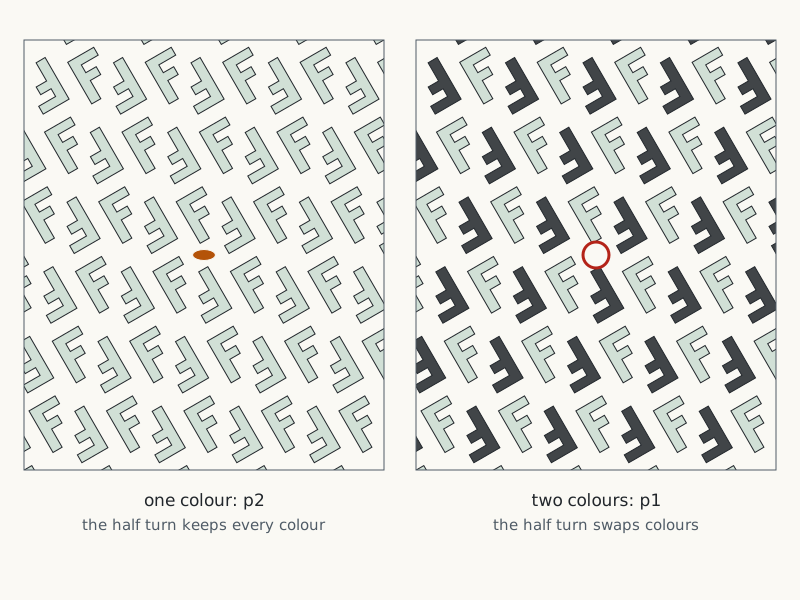
This page counts colour: a move counts as a symmetry only if it sends every colour onto the same colour, so a turn that swaps red and green does not count.
Narrow screen? Scroll the drawing sideways, or open it full size.
Full credit to copy
"Colour counts: a half turn that swaps colours is not a symmetry" by Drawn Mathematics, https://drawnmathematics.com/symmetry/wallpaper-groups/, licensed under CC BY 4.0, https://creativecommons.org/licenses/by/4.0/
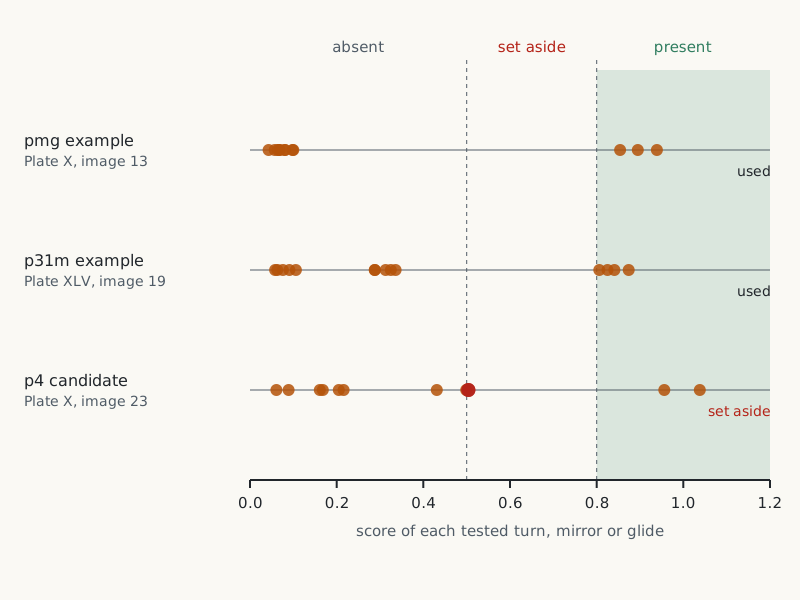
To match old plates to groups, we ran a short program on 1,024 crops cut from the plates of the 1910 copy. It sorts each crop's printed colours into a few levels and finds the two shortest repeats. Then it tests every turn, mirror and glide, scoring each move near 1 if it maps every colour onto itself and near 0 if not. A score of 0.80 or more counts as present and 0.50 or less as absent; a single score in between sets the whole crop aside, and so does a crop smaller than 2 × 2 repeat cells.
Narrow screen? Scroll the drawing sideways, or open it full size.
Full credit to copy
"Score bands of the classification program" by Drawn Mathematics, https://drawnmathematics.com/symmetry/wallpaper-groups/, licensed under CC BY 4.0, https://creativecommons.org/licenses/by/4.0/
Only 36 of the 1,024 crops passed every rule. In 616 of them the program could not find two independent repeats at all: many were borders or single motifs, and in others the hand-drawn rows did not line up closely enough. The program was also run on 34 test patterns of known type, two for each group, and it named 32 correctly, set 2 aside and named none wrongly.
Colour can mislead in an old print, so a type also had to show in the design itself. One crop read p1 only because of shading along one edge of each shape, and a pm crop leaned on a white highlight down one side of its leaves. Neither is used here.
The best crop for each group then got a second, independent classification, made from the crop alone before the program's marks were shown. Eight groups passed both checks: p2, cm, pmg, cmm, p4m, p4g, p31m and p6m. The second check did not confirm the program's picks for p1 and p3, and for the other seven groups no crop passed the program in a usable form. For those 9 groups, no historical example is confirmed: our search of one book found none that passed, which does not mean none exist.
No turns: p1, pm, pg, cm
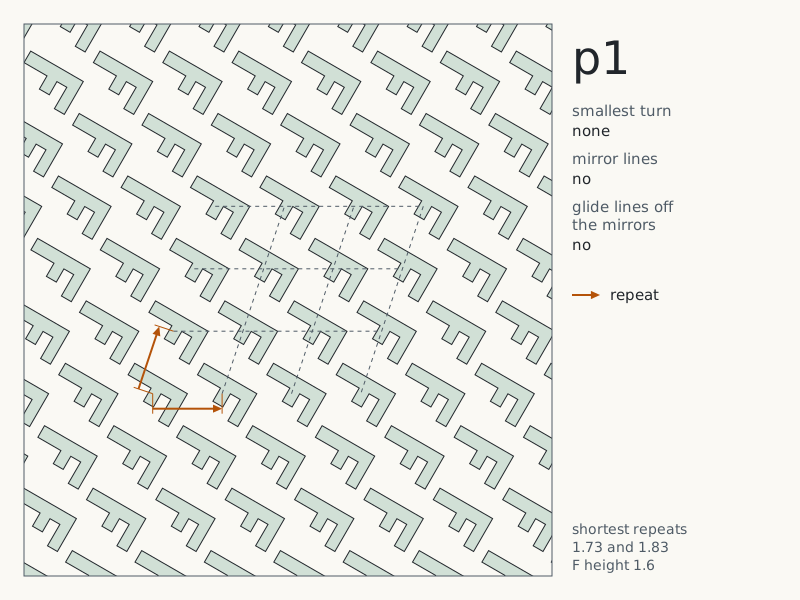
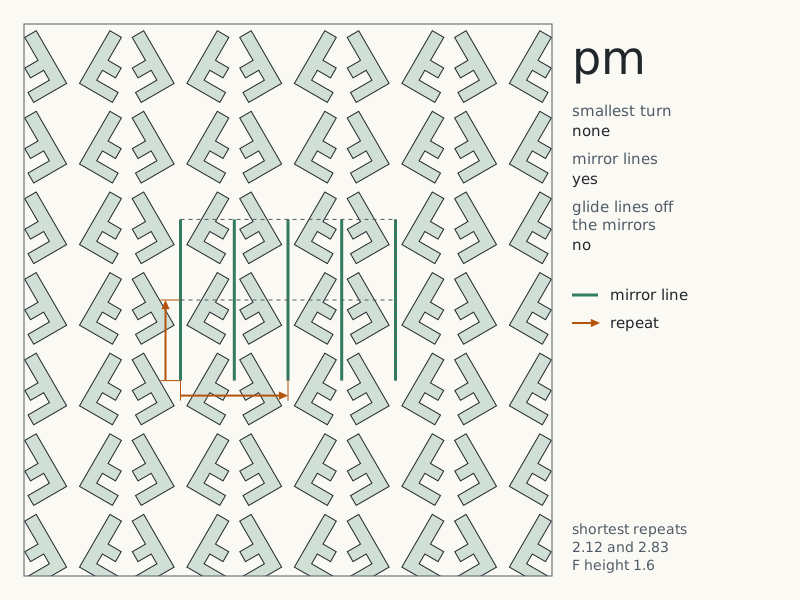
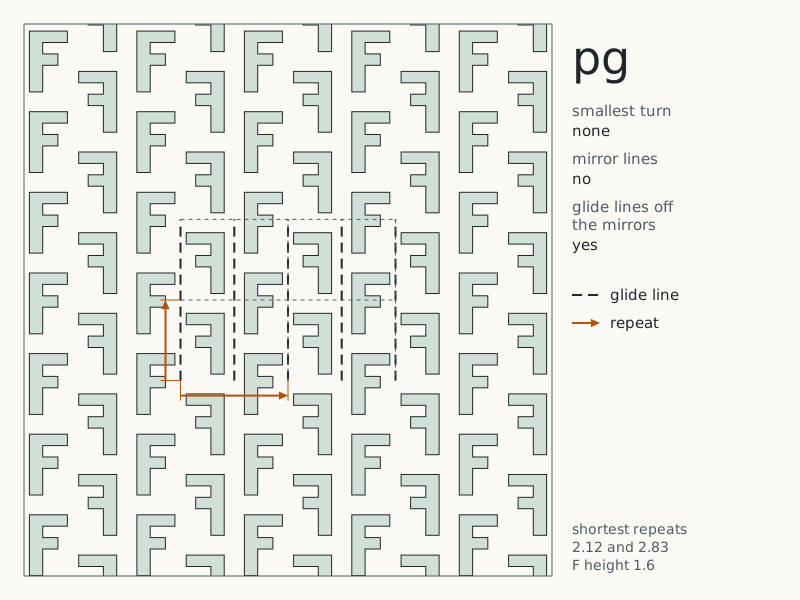
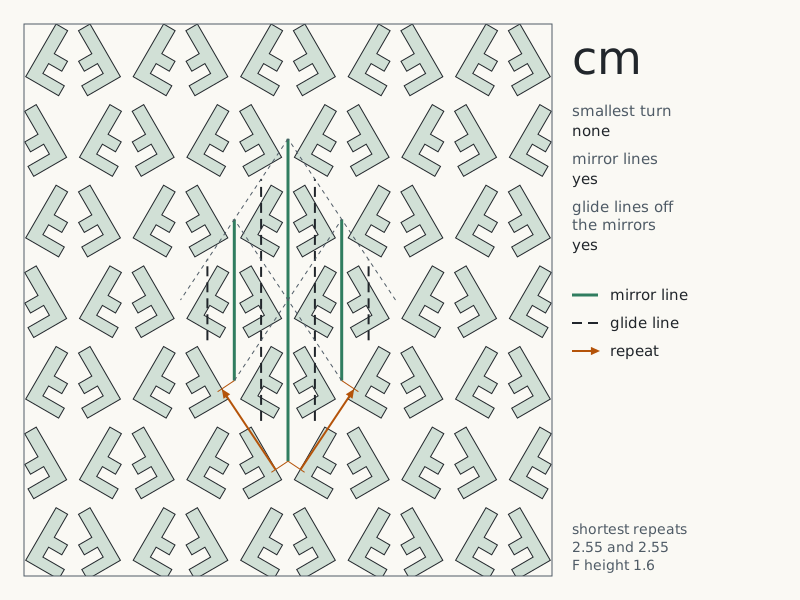
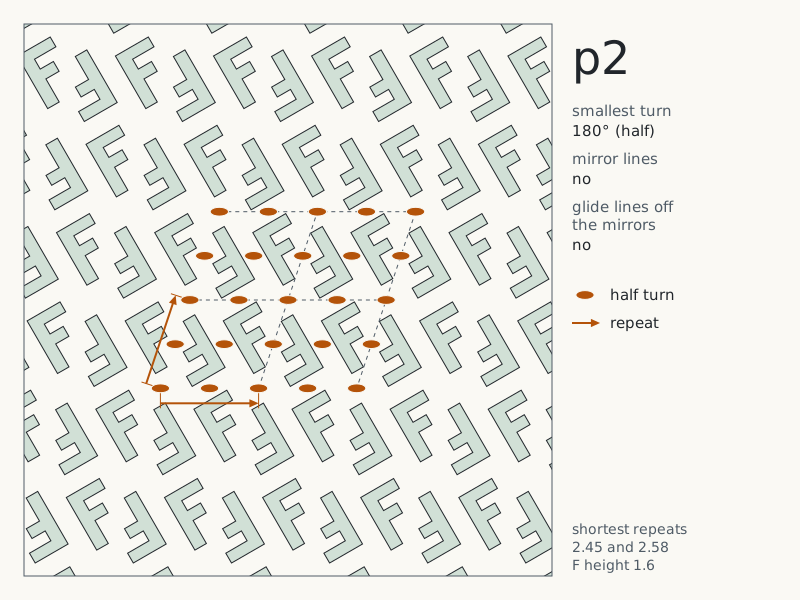
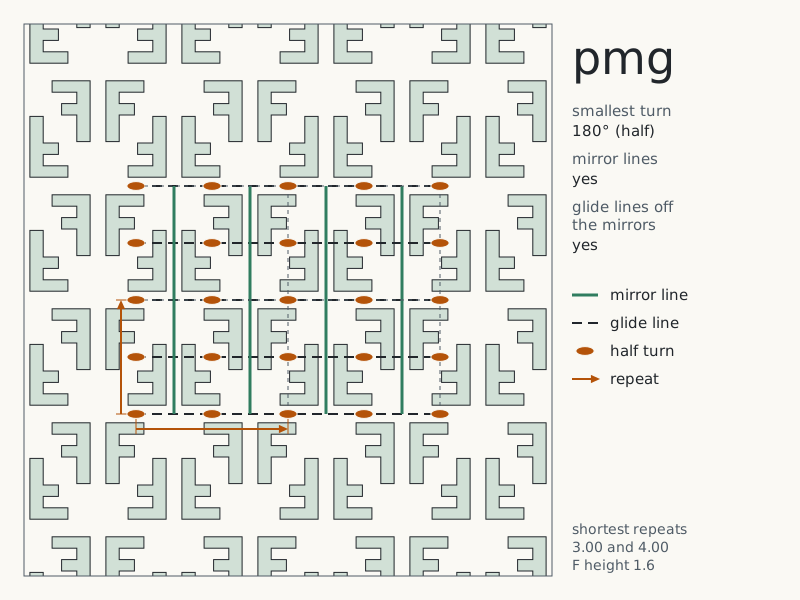
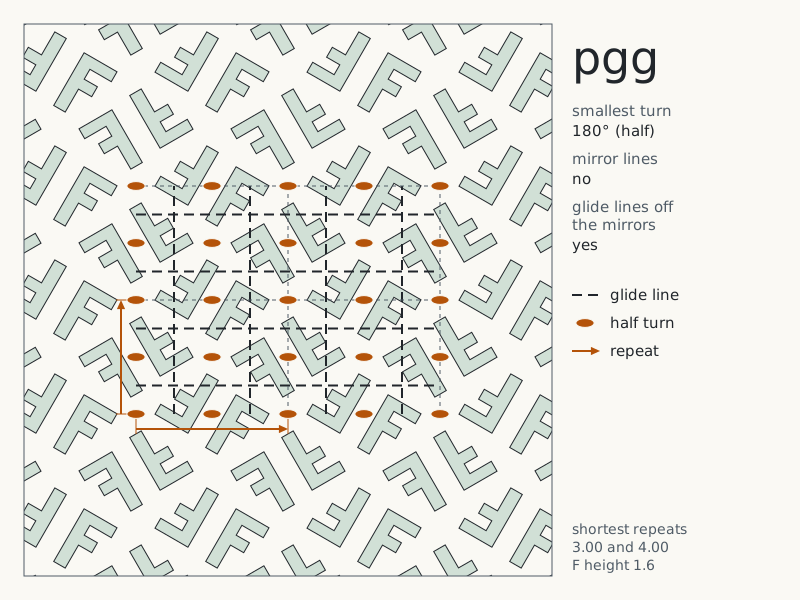
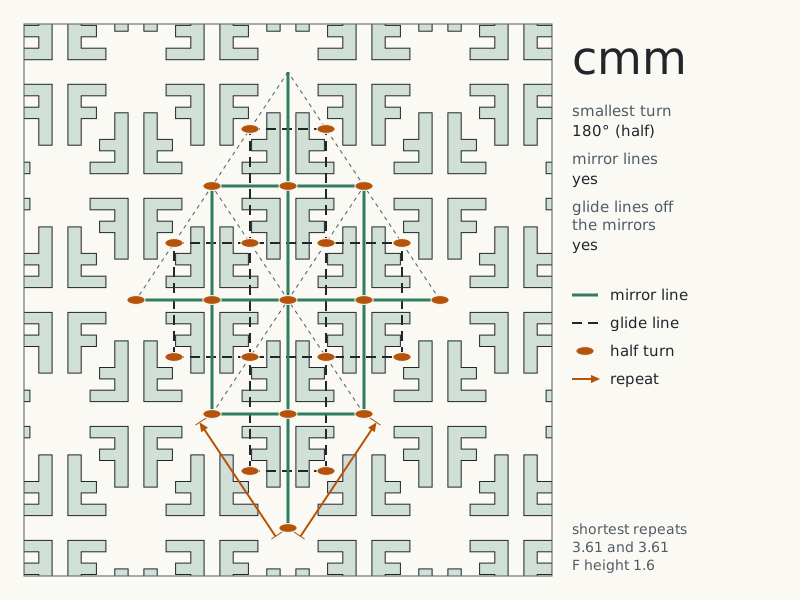
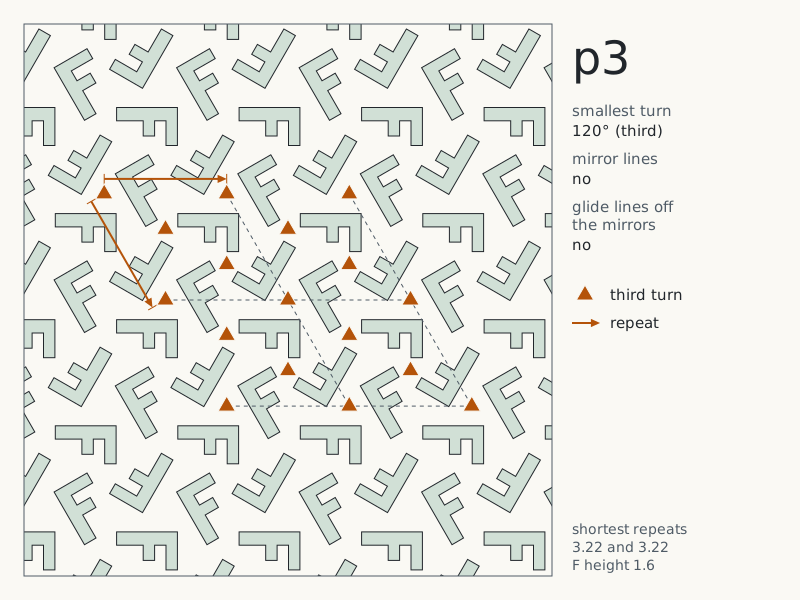
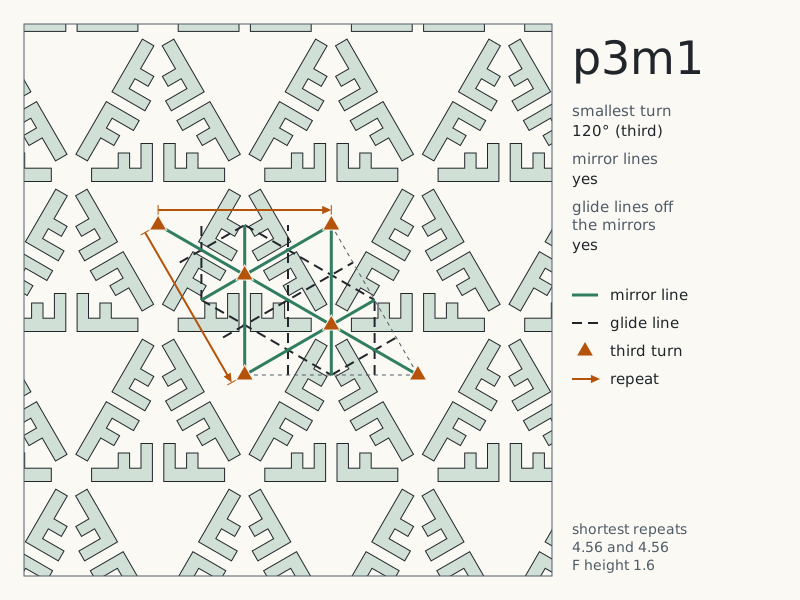
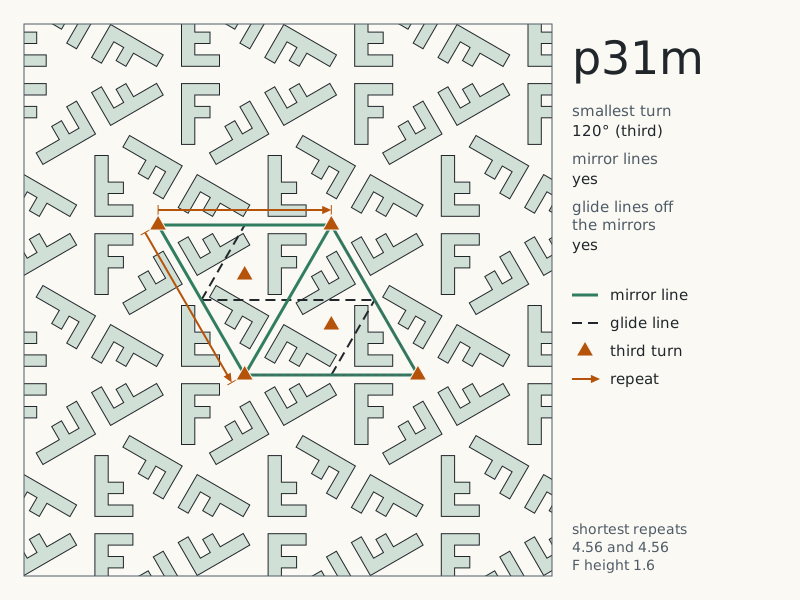
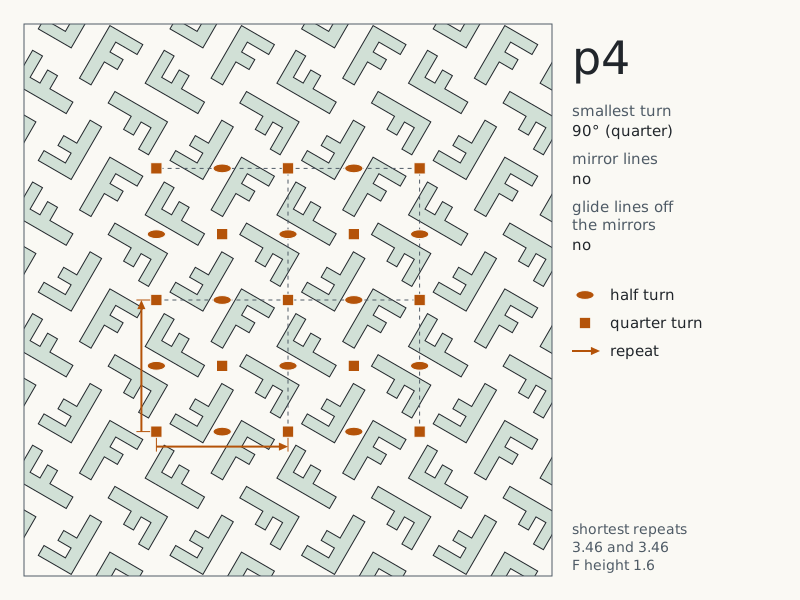
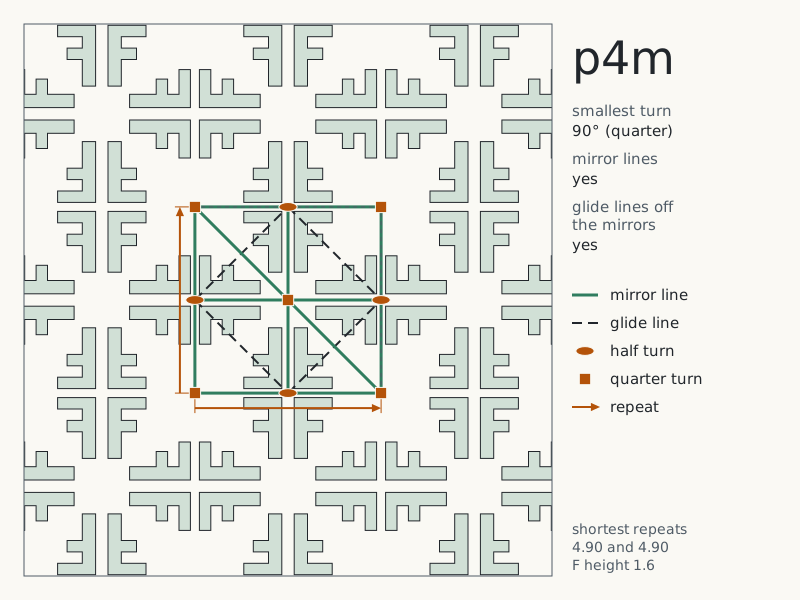
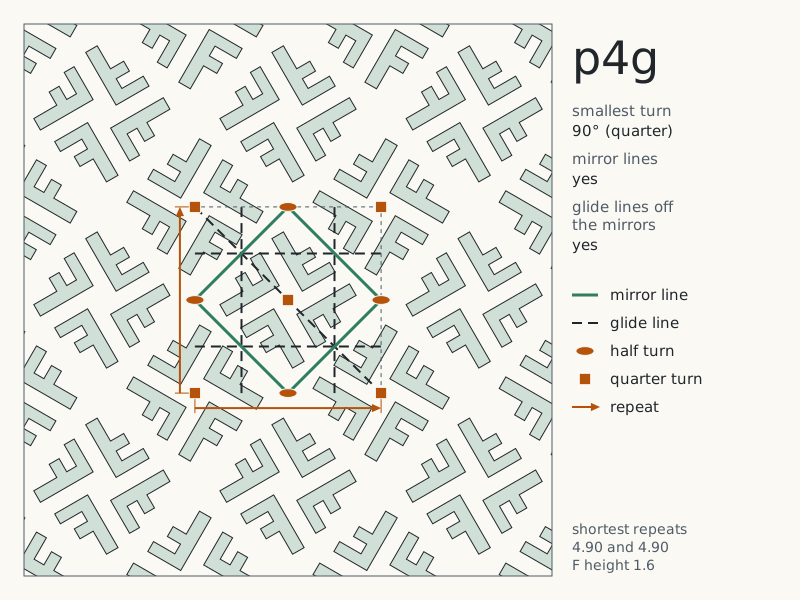
Each drawing below repeats the same F by the moves of one group, so read it as the rule, caught in the act. Green lines are mirrors, dashed lines are glides, brass marks are turn centres, and brass arrows are the two shortest repeats.
p1 has the two repeats and nothing else, so every F faces the same way.
Narrow screen? Scroll the drawing sideways, or open it full size.
Full credit to copy
"Wallpaper group p1 drawn from one F" by Drawn Mathematics, https://drawnmathematics.com/symmetry/wallpaper-groups/, licensed under CC BY 4.0, https://creativecommons.org/licenses/by/4.0/
pm adds parallel mirror lines, so each F sits beside its own reflection.
Narrow screen? Scroll the drawing sideways, or open it full size.
Full credit to copy
"Wallpaper group pm drawn from one F" by Drawn Mathematics, https://drawnmathematics.com/symmetry/wallpaper-groups/, licensed under CC BY 4.0, https://creativecommons.org/licenses/by/4.0/
pg has no mirrors, only glides: each F is the mirror image of the next one, shifted half a repeat along the line.
Narrow screen? Scroll the drawing sideways, or open it full size.
Full credit to copy
"Wallpaper group pg drawn from one F" by Drawn Mathematics, https://drawnmathematics.com/symmetry/wallpaper-groups/, licensed under CC BY 4.0, https://creativecommons.org/licenses/by/4.0/
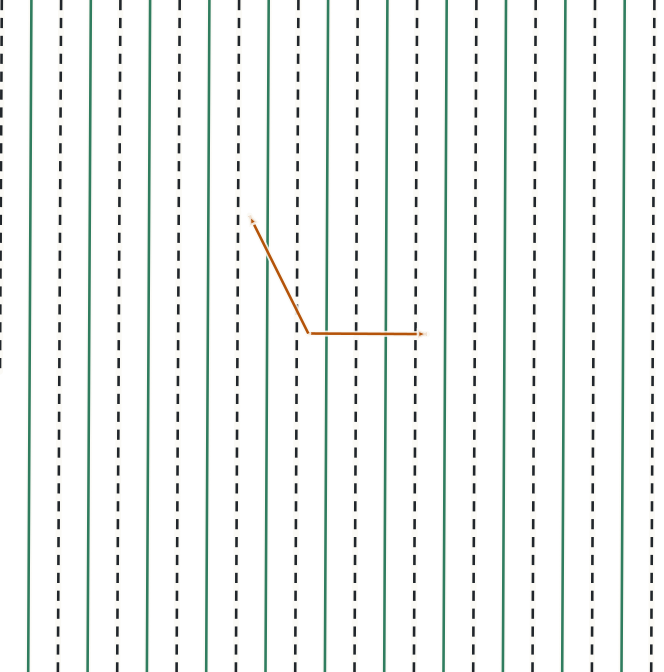
cm has mirror lines with glide lines halfway between them, which comes from rows that are staggered by half a repeat.
Narrow screen? Scroll the drawing sideways, or open it full size.
Full credit to copy
"Wallpaper group cm drawn from one F" by Drawn Mathematics, https://drawnmathematics.com/symmetry/wallpaper-groups/, licensed under CC BY 4.0, https://creativecommons.org/licenses/by/4.0/
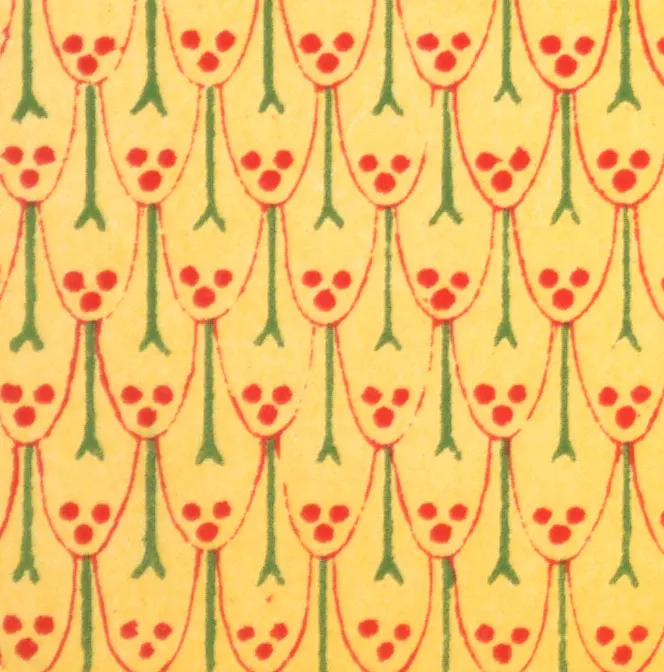
The cm example is image 21 on Plate XI, “Egyptian No 8”: scale shapes with a stem and a cluster of red dots. A mirror runs down the middle of each scale, and the glides run halfway between the mirrors.
Full credit to copy
"Egyptian No 8, Plate XI, image 21 (detail)" by Owen Jones — https://commons.wikimedia.org/wiki/File:The_grammar_of_ornament_1910_(139551101).jpg — Public domain (Owen Jones d. 1874; plates first published 1856 (Day & Son), lithographers died before 1956 or are anonymous; this copy London: Bernard Quaritch, 1910; PD worldwide); modified: cropped from the full-page scan; colours not altered
Full credit to copy
"Symmetry elements of the cm example" by Drawn Mathematics, https://drawnmathematics.com/symmetry/wallpaper-groups/, licensed under CC BY 4.0, https://creativecommons.org/licenses/by/4.0/. The license covers the overlay only. Base image: "Egyptian No 8, Plate XI, image 21 (detail)" by Owen Jones — https://commons.wikimedia.org/wiki/File:The_grammar_of_ornament_1910_(139551101).jpg — Public domain (Owen Jones d. 1874; plates first published 1856 (Day & Son), lithographers died before 1956 or are anonymous; this copy London: Bernard Quaritch, 1910; PD worldwide); modified: cropped from the full-page scan; colours not altered, symmetry elements located by this site's program and drawn over the crop.
Half turns: p2, pmm, pmg, pgg, cmm
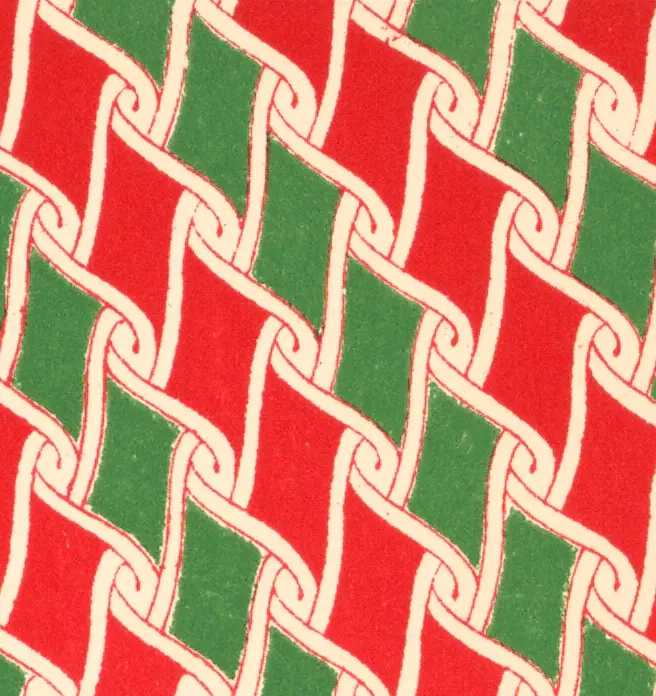
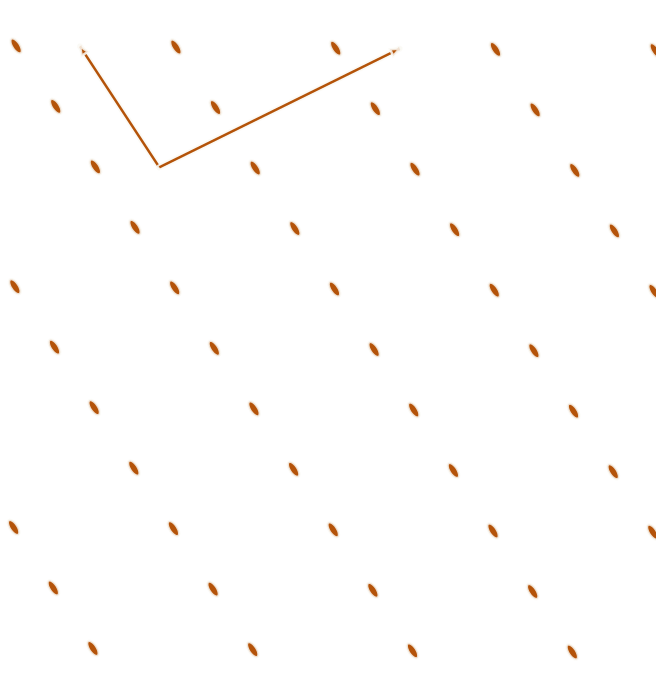
p2 has half turns and no mirrors or glides. Its example is image 4 on Plate XI, “Egyptian No 8”, where red and green panels sit between interlaced bands.
Narrow screen? Scroll the drawing sideways, or open it full size.
Full credit to copy
"Wallpaper group p2 drawn from one F" by Drawn Mathematics, https://drawnmathematics.com/symmetry/wallpaper-groups/, licensed under CC BY 4.0, https://creativecommons.org/licenses/by/4.0/
Full credit to copy
"Egyptian No 8, Plate XI, image 4 (detail)" by Owen Jones — https://commons.wikimedia.org/wiki/File:The_grammar_of_ornament_1910_(139551101).jpg — Public domain (Owen Jones d. 1874; plates first published 1856 (Day & Son), lithographers died before 1956 or are anonymous; this copy London: Bernard Quaritch, 1910; PD worldwide); modified: cropped from the full-page scan; colours not altered
Full credit to copy
"Symmetry elements of the p2 example" by Drawn Mathematics, https://drawnmathematics.com/symmetry/wallpaper-groups/, licensed under CC BY 4.0, https://creativecommons.org/licenses/by/4.0/. The license covers the overlay only. Base image: "Egyptian No 8, Plate XI, image 4 (detail)" by Owen Jones — https://commons.wikimedia.org/wiki/File:The_grammar_of_ornament_1910_(139551101).jpg — Public domain (Owen Jones d. 1874; plates first published 1856 (Day & Son), lithographers died before 1956 or are anonymous; this copy London: Bernard Quaritch, 1910; PD worldwide); modified: cropped from the full-page scan; colours not altered, symmetry elements located by this site's program and drawn over the crop.
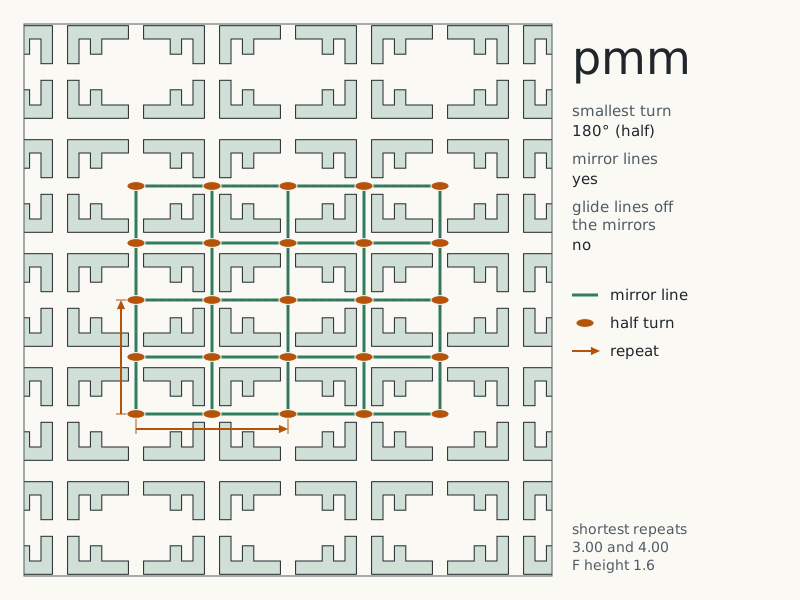
pmm has mirrors in two directions, and every half-turn centre sits where two mirrors cross.
Narrow screen? Scroll the drawing sideways, or open it full size.
Full credit to copy
"Wallpaper group pmm drawn from one F" by Drawn Mathematics, https://drawnmathematics.com/symmetry/wallpaper-groups/, licensed under CC BY 4.0, https://creativecommons.org/licenses/by/4.0/
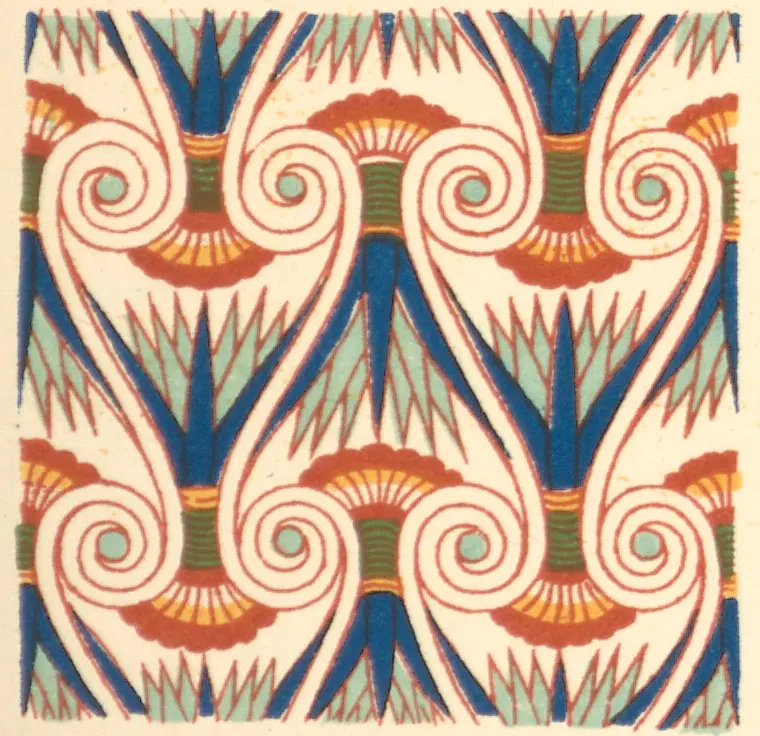
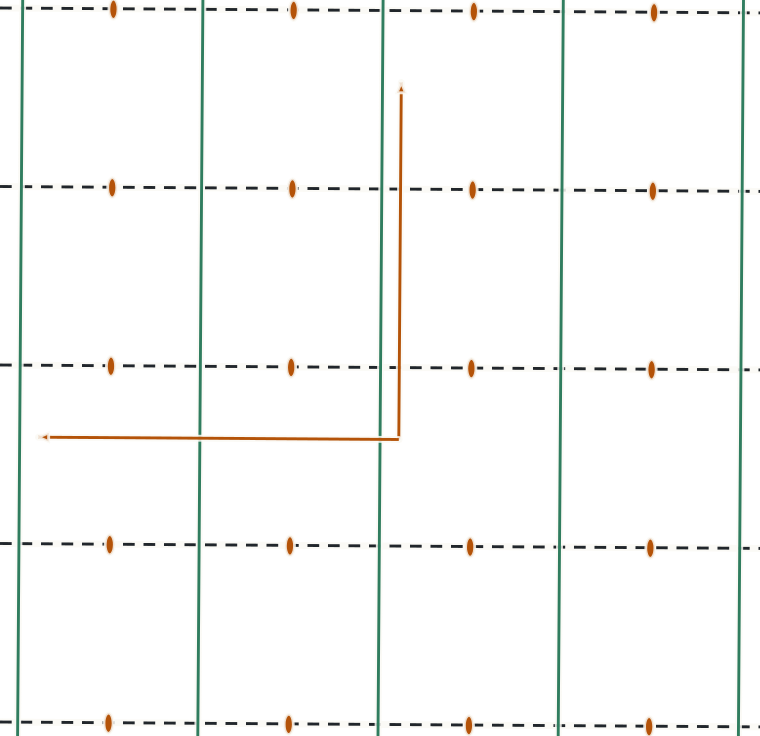
pmg has mirrors in one direction and glides in the other, with the half-turn centres between the mirrors. In its example, image 13 on Plate X, “Egyptian No 7”, pairs of spirals face each other across each mirror line.
Narrow screen? Scroll the drawing sideways, or open it full size.
Full credit to copy
"Wallpaper group pmg drawn from one F" by Drawn Mathematics, https://drawnmathematics.com/symmetry/wallpaper-groups/, licensed under CC BY 4.0, https://creativecommons.org/licenses/by/4.0/
Full credit to copy
"Egyptian No 7, Plate X, image 13 (detail)" by Owen Jones — https://commons.wikimedia.org/wiki/File:The_grammar_of_ornament_1910_(139551097).jpg — Public domain (Owen Jones d. 1874; plates first published 1856 (Day & Son), lithographers died before 1956 or are anonymous; this copy London: Bernard Quaritch, 1910; PD worldwide); modified: cropped from the full-page scan; colours not altered
Full credit to copy
"Symmetry elements of the pmg example" by Drawn Mathematics, https://drawnmathematics.com/symmetry/wallpaper-groups/, licensed under CC BY 4.0, https://creativecommons.org/licenses/by/4.0/. The license covers the overlay only. Base image: "Egyptian No 7, Plate X, image 13 (detail)" by Owen Jones — https://commons.wikimedia.org/wiki/File:The_grammar_of_ornament_1910_(139551097).jpg — Public domain (Owen Jones d. 1874; plates first published 1856 (Day & Son), lithographers died before 1956 or are anonymous; this copy London: Bernard Quaritch, 1910; PD worldwide); modified: cropped from the full-page scan; colours not altered, symmetry elements located by this site's program and drawn over the crop.
pgg has glides in two directions and half turns, but no mirror at all.
Narrow screen? Scroll the drawing sideways, or open it full size.
Full credit to copy
"Wallpaper group pgg drawn from one F" by Drawn Mathematics, https://drawnmathematics.com/symmetry/wallpaper-groups/, licensed under CC BY 4.0, https://creativecommons.org/licenses/by/4.0/
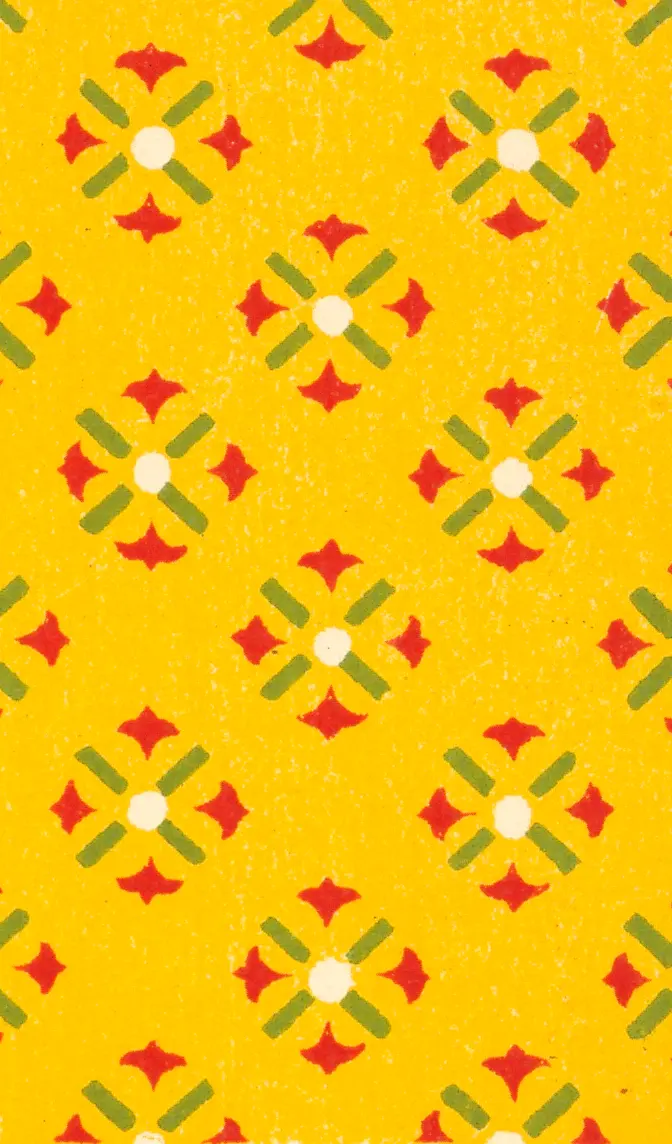
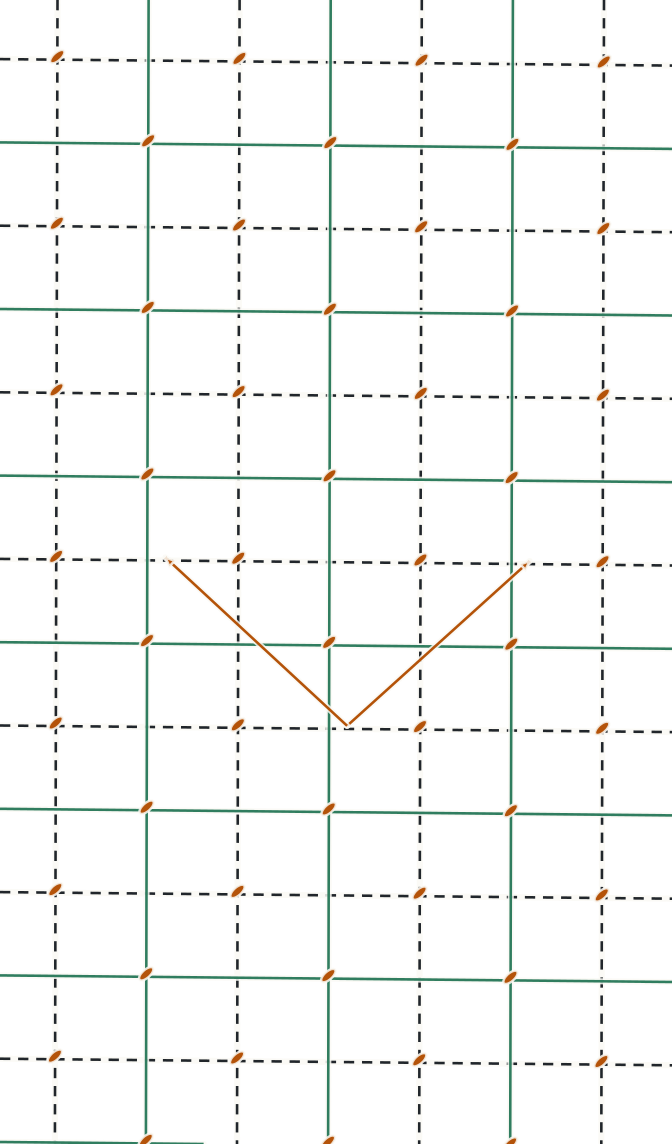
cmm has mirrors in two directions, like pmm, but some half-turn centres sit off the mirrors. Its example is image 9 on Plate XLIV, “Persian No 1”. As printed, its rosettes repeat about 9% farther apart across than down. Stretched back to square, the design would read p4m, so this page labels it cmm as printed.
Narrow screen? Scroll the drawing sideways, or open it full size.
Full credit to copy
"Wallpaper group cmm drawn from one F" by Drawn Mathematics, https://drawnmathematics.com/symmetry/wallpaper-groups/, licensed under CC BY 4.0, https://creativecommons.org/licenses/by/4.0/
Full credit to copy
"Persian No 1, Plate XLIV, image 9 (detail)" by Owen Jones — https://commons.wikimedia.org/wiki/File:The_grammar_of_ornament_1910_(139551297).jpg — Public domain (Owen Jones d. 1874; plates first published 1856 (Day & Son), lithographers died before 1956 or are anonymous; this copy London: Bernard Quaritch, 1910; PD worldwide); modified: cropped from the full-page scan; colours not altered
Full credit to copy
"Symmetry elements of the cmm example" by Drawn Mathematics, https://drawnmathematics.com/symmetry/wallpaper-groups/, licensed under CC BY 4.0, https://creativecommons.org/licenses/by/4.0/. The license covers the overlay only. Base image: "Persian No 1, Plate XLIV, image 9 (detail)" by Owen Jones — https://commons.wikimedia.org/wiki/File:The_grammar_of_ornament_1910_(139551297).jpg — Public domain (Owen Jones d. 1874; plates first published 1856 (Day & Son), lithographers died before 1956 or are anonymous; this copy London: Bernard Quaritch, 1910; PD worldwide); modified: cropped from the full-page scan; colours not altered, symmetry elements located by this site's program and drawn over the crop.
Third turns: p3, p3m1, p31m
p3 has third turns and no mirrors, so its Fs sit in threes around each turn centre.
Narrow screen? Scroll the drawing sideways, or open it full size.
Full credit to copy
"Wallpaper group p3 drawn from one F" by Drawn Mathematics, https://drawnmathematics.com/symmetry/wallpaper-groups/, licensed under CC BY 4.0, https://creativecommons.org/licenses/by/4.0/
p3m1 adds mirrors, and every third-turn centre lies on one.
Narrow screen? Scroll the drawing sideways, or open it full size.
Full credit to copy
"Wallpaper group p3m1 drawn from one F" by Drawn Mathematics, https://drawnmathematics.com/symmetry/wallpaper-groups/, licensed under CC BY 4.0, https://creativecommons.org/licenses/by/4.0/
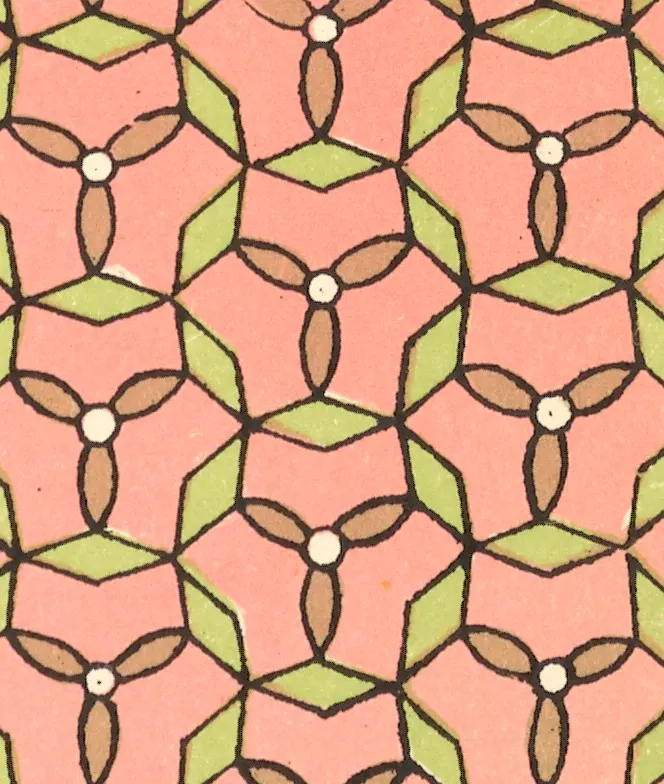
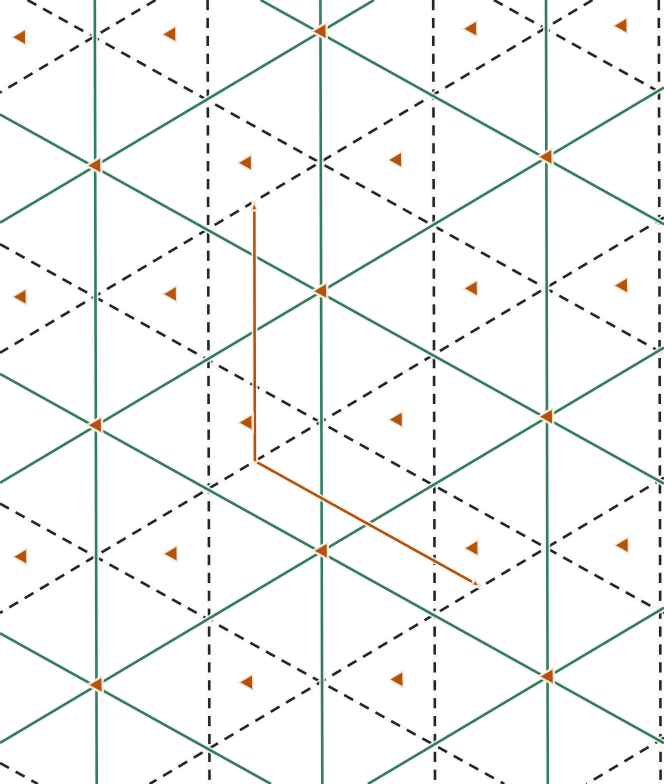
p31m also has mirrors, but some third-turn centres lie off them. Its example is image 19 on Plate XLV, “Persian No 2”. Two of its program scores, 0.825 and 0.806, sat just above the 0.80 line, and the independent check agreed with p31m.
Narrow screen? Scroll the drawing sideways, or open it full size.
Full credit to copy
"Wallpaper group p31m drawn from one F" by Drawn Mathematics, https://drawnmathematics.com/symmetry/wallpaper-groups/, licensed under CC BY 4.0, https://creativecommons.org/licenses/by/4.0/
Full credit to copy
"Persian No 2, Plate XLV, image 19 (detail)" by Owen Jones — https://commons.wikimedia.org/wiki/File:The_grammar_of_ornament_1910_(139551301).jpg — Public domain (Owen Jones d. 1874; plates first published 1856 (Day & Son), lithographers died before 1956 or are anonymous; this copy London: Bernard Quaritch, 1910; PD worldwide); modified: cropped from the full-page scan; colours not altered
Full credit to copy
"Symmetry elements of the p31m example" by Drawn Mathematics, https://drawnmathematics.com/symmetry/wallpaper-groups/, licensed under CC BY 4.0, https://creativecommons.org/licenses/by/4.0/. The license covers the overlay only. Base image: "Persian No 2, Plate XLV, image 19 (detail)" by Owen Jones — https://commons.wikimedia.org/wiki/File:The_grammar_of_ornament_1910_(139551301).jpg — Public domain (Owen Jones d. 1874; plates first published 1856 (Day & Son), lithographers died before 1956 or are anonymous; this copy London: Bernard Quaritch, 1910; PD worldwide); modified: cropped from the full-page scan; colours not altered, symmetry elements located by this site's program and drawn over the crop.
Quarter turns: p4, p4m, p4g
p4 has quarter turns and no mirrors, so its Fs sit in fours around each quarter-turn centre.
Narrow screen? Scroll the drawing sideways, or open it full size.
Full credit to copy
"Wallpaper group p4 drawn from one F" by Drawn Mathematics, https://drawnmathematics.com/symmetry/wallpaper-groups/, licensed under CC BY 4.0, https://creativecommons.org/licenses/by/4.0/
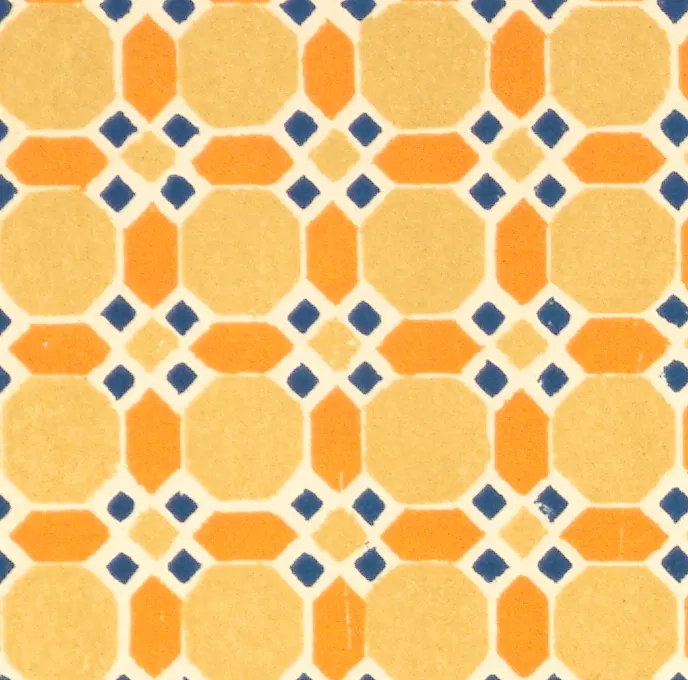
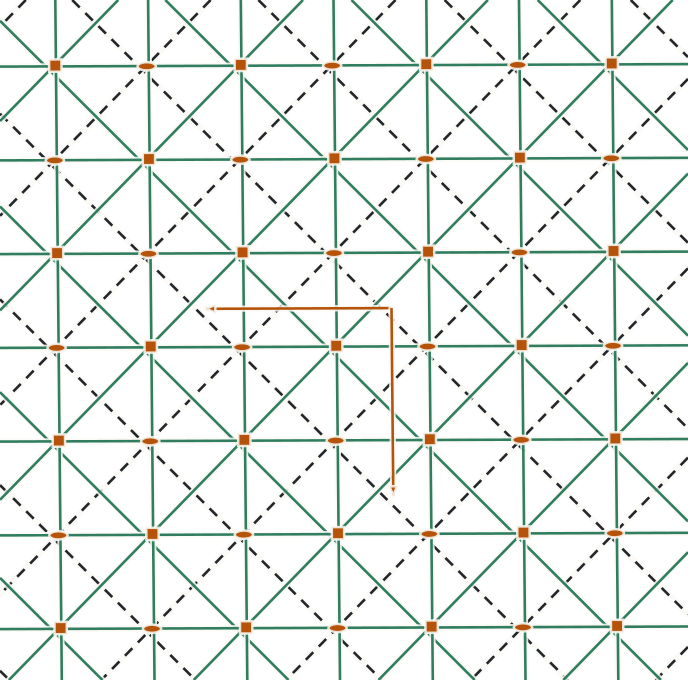
p4m adds mirrors in four directions, and every quarter-turn centre lies on them. Image 2 on Plate XLIII, “Moresque No 5”, is its example: a grid of octagons with small blue squares between them.
Narrow screen? Scroll the drawing sideways, or open it full size.
Full credit to copy
"Wallpaper group p4m drawn from one F" by Drawn Mathematics, https://drawnmathematics.com/symmetry/wallpaper-groups/, licensed under CC BY 4.0, https://creativecommons.org/licenses/by/4.0/
Full credit to copy
"Moresque No 5, Plate XLIII, image 2 (detail)" by Owen Jones — https://commons.wikimedia.org/wiki/File:The_grammar_of_ornament_1910_(139551291).jpg — Public domain (Owen Jones d. 1874; plates first published 1856 (Day & Son), lithographers died before 1956 or are anonymous; this copy London: Bernard Quaritch, 1910; PD worldwide); modified: cropped from the full-page scan; colours not altered
Full credit to copy
"Symmetry elements of the p4m example" by Drawn Mathematics, https://drawnmathematics.com/symmetry/wallpaper-groups/, licensed under CC BY 4.0, https://creativecommons.org/licenses/by/4.0/. The license covers the overlay only. Base image: "Moresque No 5, Plate XLIII, image 2 (detail)" by Owen Jones — https://commons.wikimedia.org/wiki/File:The_grammar_of_ornament_1910_(139551291).jpg — Public domain (Owen Jones d. 1874; plates first published 1856 (Day & Son), lithographers died before 1956 or are anonymous; this copy London: Bernard Quaritch, 1910; PD worldwide); modified: cropped from the full-page scan; colours not altered, symmetry elements located by this site's program and drawn over the crop.
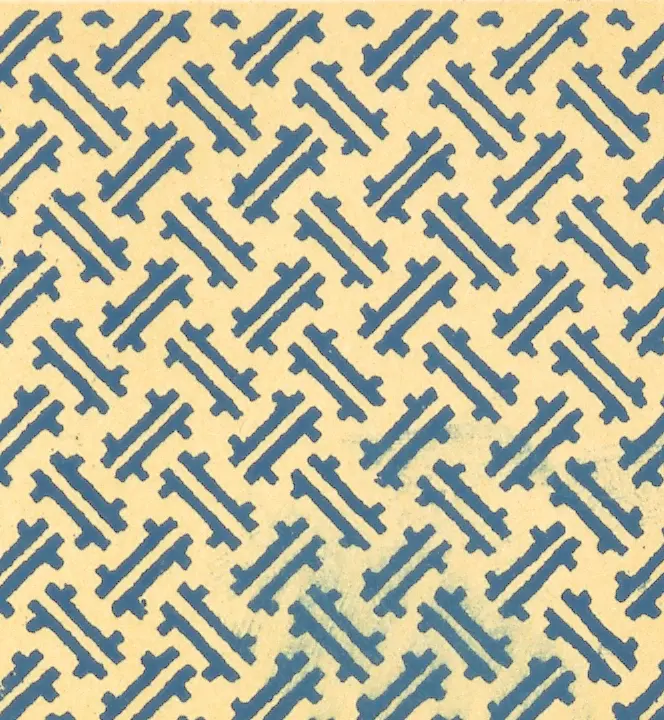
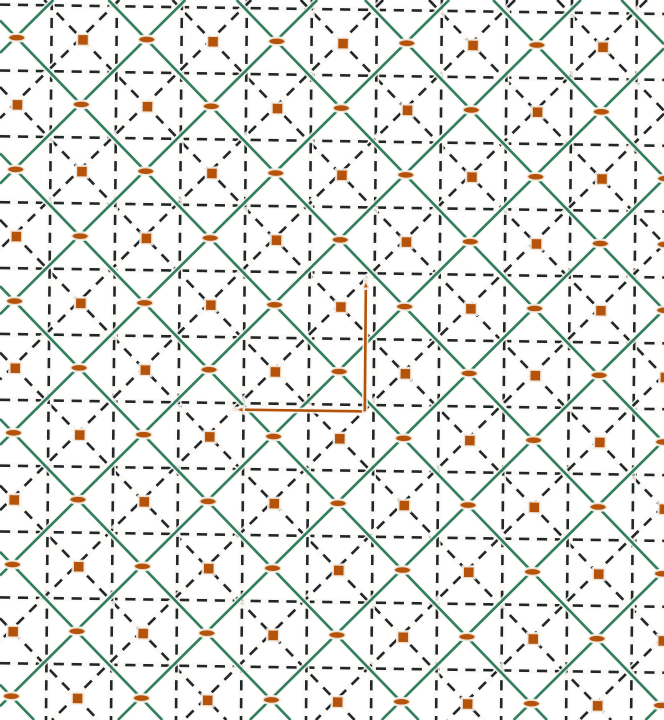
p4g has mirrors too, but its quarter-turn centres sit off them, inside the diamonds the mirrors form. Its example is image 8 on Plate LIX, “Chinese No 1”, where short bars turn like a pinwheel.
Narrow screen? Scroll the drawing sideways, or open it full size.
Full credit to copy
"Wallpaper group p4g drawn from one F" by Drawn Mathematics, https://drawnmathematics.com/symmetry/wallpaper-groups/, licensed under CC BY 4.0, https://creativecommons.org/licenses/by/4.0/
Full credit to copy
"Chinese No 1, Plate LIX, image 8 (detail)" by Owen Jones — https://commons.wikimedia.org/wiki/File:The_grammar_of_ornament_1910_(139551437).jpg — Public domain (Owen Jones d. 1874; plates first published 1856 (Day & Son), lithographers died before 1956 or are anonymous; this copy London: Bernard Quaritch, 1910; PD worldwide); modified: cropped from the full-page scan; colours not altered
Full credit to copy
"Symmetry elements of the p4g example" by Drawn Mathematics, https://drawnmathematics.com/symmetry/wallpaper-groups/, licensed under CC BY 4.0, https://creativecommons.org/licenses/by/4.0/. The license covers the overlay only. Base image: "Chinese No 1, Plate LIX, image 8 (detail)" by Owen Jones — https://commons.wikimedia.org/wiki/File:The_grammar_of_ornament_1910_(139551437).jpg — Public domain (Owen Jones d. 1874; plates first published 1856 (Day & Son), lithographers died before 1956 or are anonymous; this copy London: Bernard Quaritch, 1910; PD worldwide); modified: cropped from the full-page scan; colours not altered, symmetry elements located by this site's program and drawn over the crop.
Sixth turns: p6, p6m
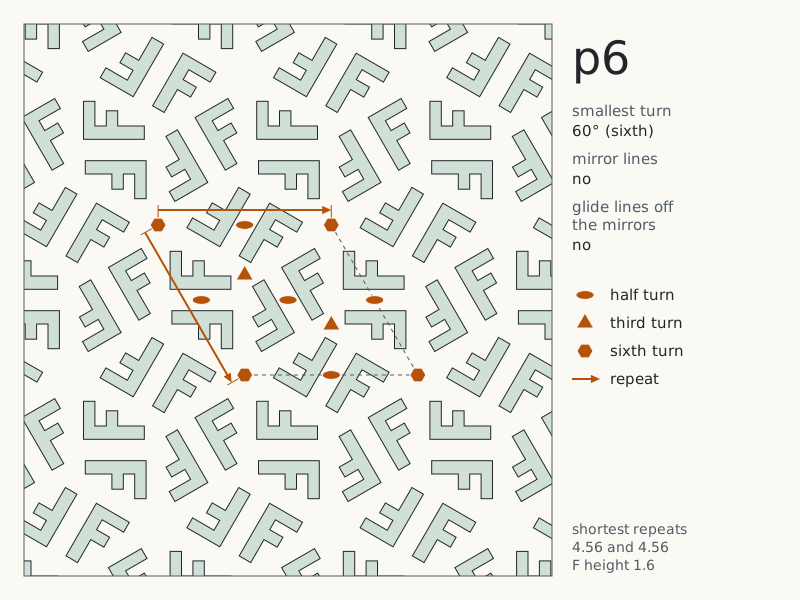
p6 has sixth turns and no mirrors, so its Fs spin in rings of six.
Narrow screen? Scroll the drawing sideways, or open it full size.
Full credit to copy
"Wallpaper group p6 drawn from one F" by Drawn Mathematics, https://drawnmathematics.com/symmetry/wallpaper-groups/, licensed under CC BY 4.0, https://creativecommons.org/licenses/by/4.0/
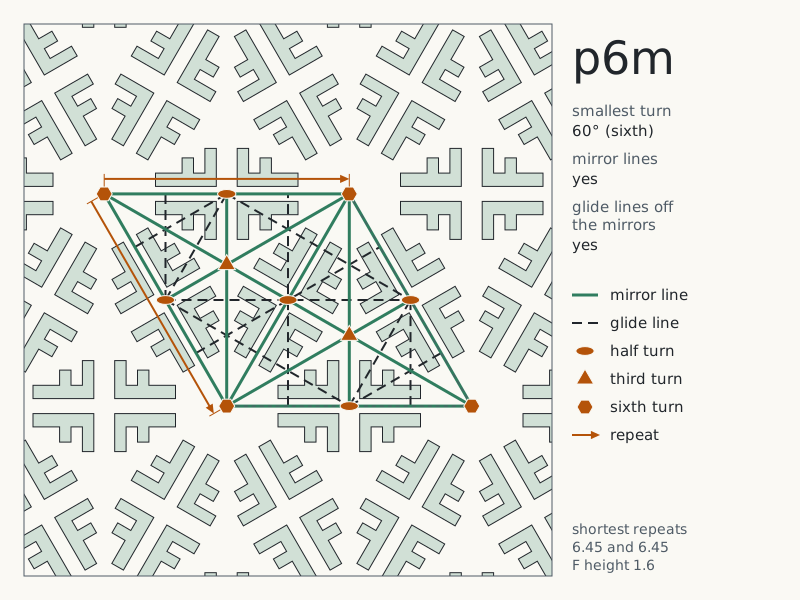
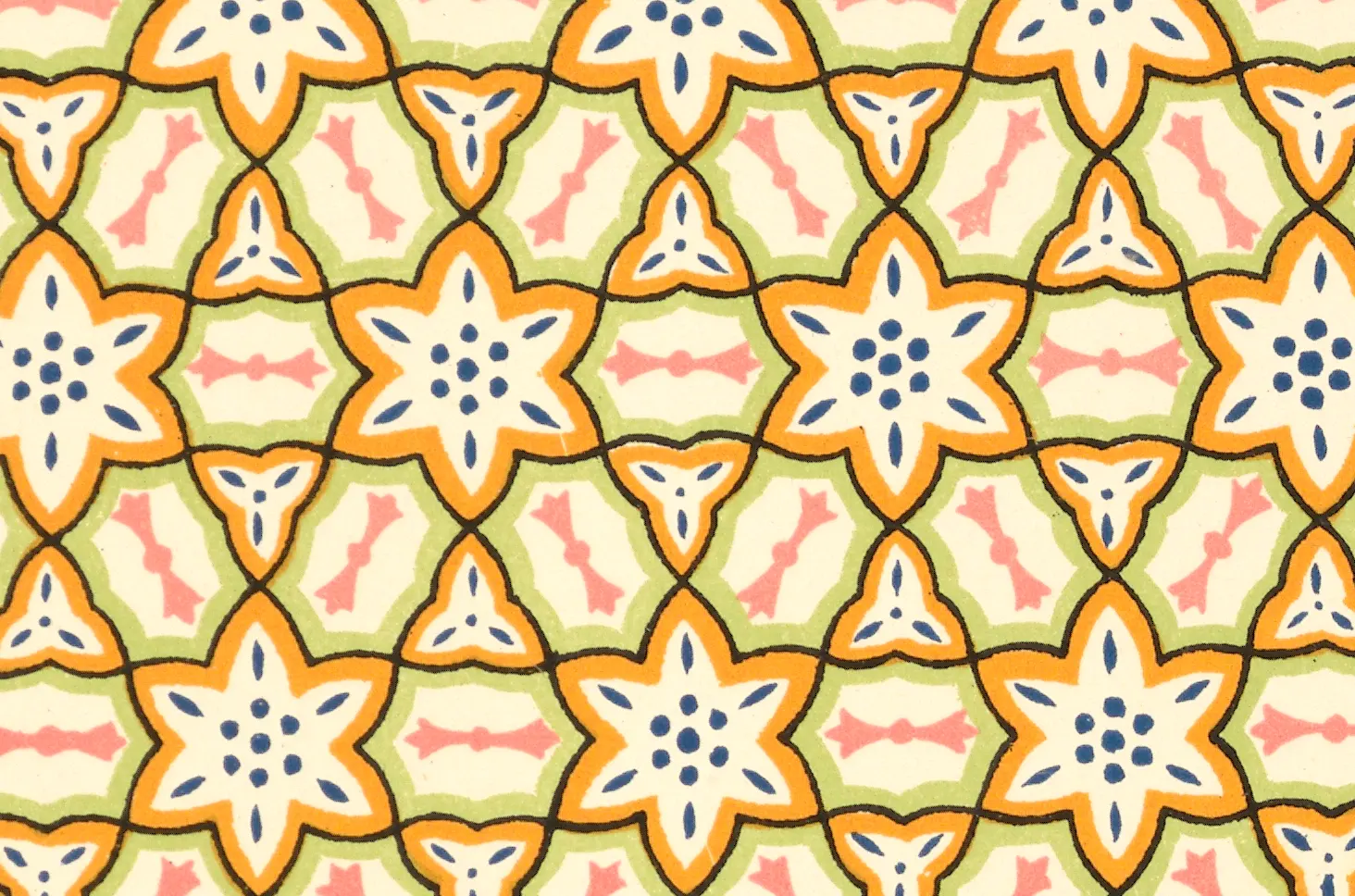
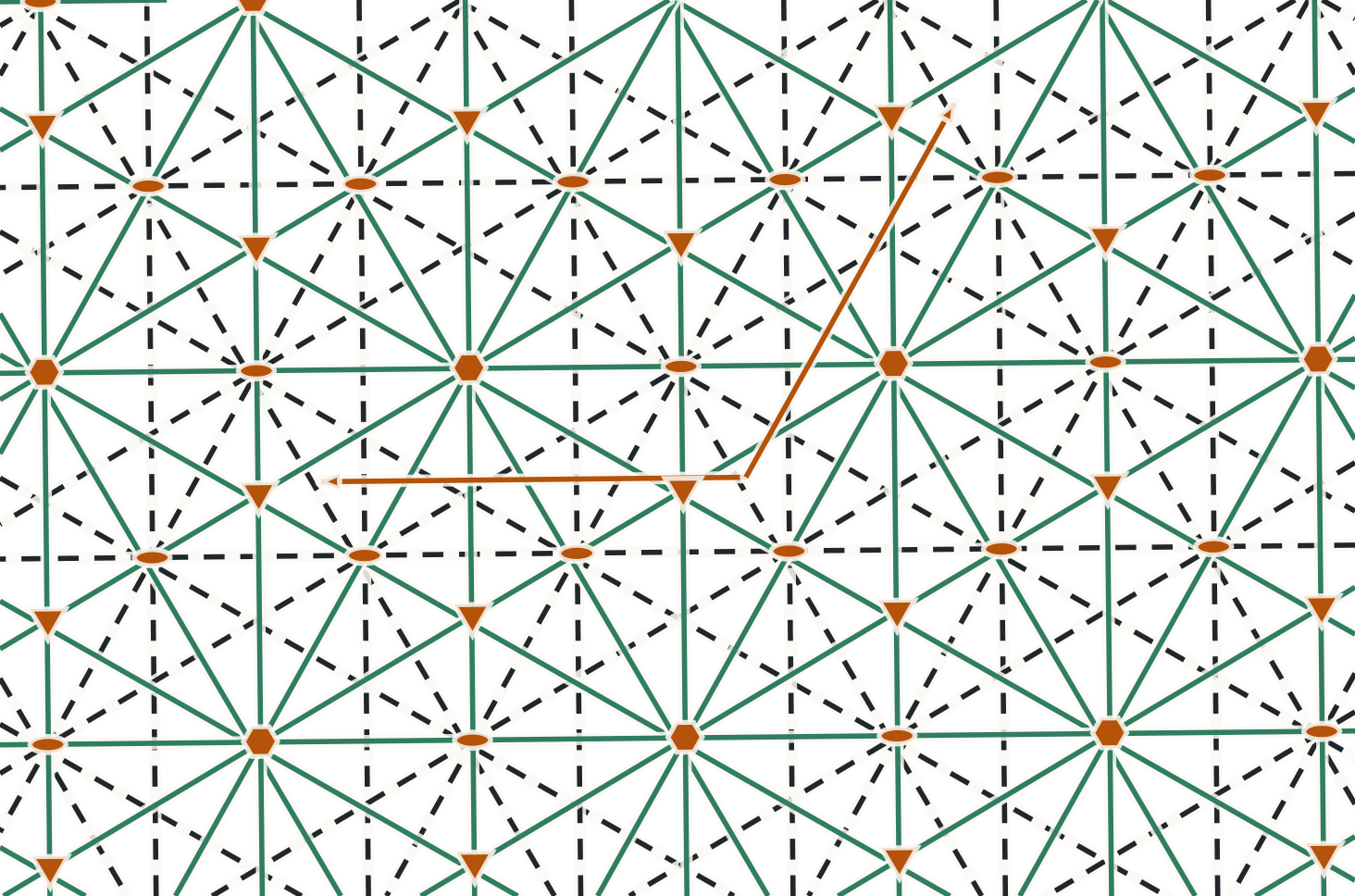
p6m has the most symmetry of all 17: sixth turns and mirrors in six directions. Its example is image 8 on Plate XLV, “Persian No 2”, a field of six-pointed stars.
Narrow screen? Scroll the drawing sideways, or open it full size.
Full credit to copy
"Wallpaper group p6m drawn from one F" by Drawn Mathematics, https://drawnmathematics.com/symmetry/wallpaper-groups/, licensed under CC BY 4.0, https://creativecommons.org/licenses/by/4.0/
Full credit to copy
"Persian No 2, Plate XLV, image 8 (detail)" by Owen Jones — https://commons.wikimedia.org/wiki/File:The_grammar_of_ornament_1910_(139551301).jpg — Public domain (Owen Jones d. 1874; plates first published 1856 (Day & Son), lithographers died before 1956 or are anonymous; this copy London: Bernard Quaritch, 1910; PD worldwide); modified: cropped from the full-page scan; colours not altered
Full credit to copy
"Symmetry elements of the p6m example" by Drawn Mathematics, https://drawnmathematics.com/symmetry/wallpaper-groups/, licensed under CC BY 4.0, https://creativecommons.org/licenses/by/4.0/. The license covers the overlay only. Base image: "Persian No 2, Plate XLV, image 8 (detail)" by Owen Jones — https://commons.wikimedia.org/wiki/File:The_grammar_of_ornament_1910_(139551301).jpg — Public domain (Owen Jones d. 1874; plates first published 1856 (Day & Son), lithographers died before 1956 or are anonymous; this copy London: Bernard Quaritch, 1910; PD worldwide); modified: cropped from the full-page scan; colours not altered, symmetry elements located by this site's program and drawn over the crop.
A printed label does not fix a symmetry type. “Persian No 2” holds both the p31m and the p6m example, and “Egyptian No 8” holds both p2 and cm, so the types cut across the labels. This site's view is that a history of ornament should give each two-way repeat its symmetry type next to its style and date, since patterns from any place or century can share a type.
How to name the group of any pattern
Ask the questions in order: first the smallest turn, then mirrors, then glides or where the turn centres sit. Use a tracing at every step. Trace a patch onto thin paper, pin it at a point and turn it to test a turn, or flip it over a line to test a mirror. A glide shows up as a shape and its mirror image on opposite sides of a line, shifted half a repeat along it.
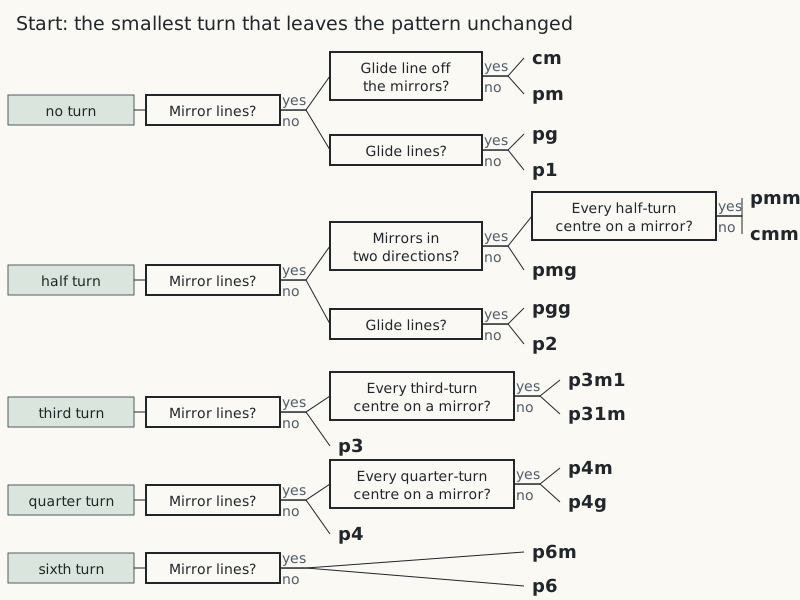
Narrow screen? Scroll the drawing sideways, or open it full size.
Full credit to copy
"Flowchart: naming the wallpaper group of a pattern" by Drawn Mathematics, https://drawnmathematics.com/symmetry/wallpaper-groups/, licensed under CC BY 4.0, https://creativecommons.org/licenses/by/4.0/
- Find the smallest turn that leaves the pattern unchanged: none, half (180°), third (120°), quarter (90°) or sixth (60°).
- With no turn: if there are mirror lines, look for a glide line that is not also a mirror line (yes: cm, no: pm). With no mirrors, look for glide lines (yes: pg, no: p1).
- With a half turn: if there are mirrors in only one direction, it is pmg. With mirrors in two directions, check whether every half-turn centre lies on a mirror (yes: pmm, no: cmm). With no mirrors, look for glide lines (yes: pgg, no: p2).
- With a third turn: no mirrors gives p3. With mirrors, check whether every third-turn centre lies on one (yes: p3m1, no: p31m).
- With a quarter turn: no mirrors gives p4. With mirrors, check whether every quarter-turn centre lies on one (yes: p4m, no: p4g).
- With a sixth turn: mirrors give p6m, and no mirrors give p6.
A short program ran these questions on the 17 patterns above and named every one correctly. By the same questions a two-colour chessboard is p4m, so the tiled floor in One-Point Perspective: Lines Straight Back Meet at One Dot is a p4m pattern seen at a slant.
| Group | Smallest turn | Mirror lines | Glide lines that are not mirrors | Confirmed example here |
|---|---|---|---|---|
| p1 | none | no | no | none |
| pm | none | yes | no | none |
| pg | none | no | yes | none |
| cm | none | yes | yes | Plate XI, image 21 |
| p2 | 180° | no | no | Plate XI, image 4 |
| pmm | 180° | yes | no | none |
| pmg | 180° | yes | yes | Plate X, image 13 |
| pgg | 180° | no | yes | none |
| cmm | 180° | yes | yes | Plate XLIV, image 9 (as printed) |
| p3 | 120° | no | no | none |
| p3m1 | 120° | yes | yes | none |
| p31m | 120° | yes | yes | Plate XLV, image 19 |
| p4 | 90° | no | no | none |
| p4m | 90° | yes | yes | Plate XLIII, image 2 |
| p4g | 90° | yes | yes | Plate LIX, image 8 |
| p6 | 60° | no | no | none |
| p6m | 60° | yes | yes | Plate XLV, image 8 |
The CSV has one row per group: the turn orders, the details of each example and a lattice column (the repeat-cell shape of this page's drawing): wallpaper-groups.csv (CSV; where this file comes from: source, version and license, JSON) Source data: Computed for this page from 17 generated patterns, each checked by exact computation; Historical examples: Owen Jones, The Grammar of Ornament (London: Bernard Quaritch, 1910), Polona scan, National Library, Warsaw (accession 1.028.021), public domain; group names are this site’s classification
Draw it yourself:
With paper and a few simple tools
- Draw a square 4 cells wide on graph paper. Draw a small F inside its bottom-left 2 × 2 quarter, not touching that quarter's edges.
- Reflect the F across the square's vertical midline: fold the paper along that line, hold it to a window and trace the F onto the other half. Then reflect both Fs across the horizontal midline the same way.
- Copy the finished square into a 3 × 3 block of squares, edge to edge.
- Mark every mirror line, then every point where a half turn leaves the pattern unchanged. Each one sits where two mirrors cross.
- Run the six questions above: a half turn, mirrors in two directions, every half-turn centre on a mirror. The answer is pmm.
Next: Islamic Geometric Patterns: The 8-Point Star Is Two Squares · Kaleidoscope: Lopsided Drawings Close Up at 60°, Not at 50°
Sources
- [1] Pavel Etingof, Groups Around Us, notes of a group-theory mini-course for high school students given in the summer of 2009, section 11, "The wallpaper groups." https://math.mit.edu/~etingof/groups.pdf Read: full text; paraphrased.
- [2] Weisstein, Eric W. "Wallpaper Groups." From MathWorld--A Wolfram Resource. https://mathworld.wolfram.com/WallpaperGroups.html Read: used to check facts only; no text, figures or tables reproduced.
- [3] Weisstein, Eric W. "Frieze Group." From MathWorld--A Wolfram Resource. https://mathworld.wolfram.com/FriezeGroup.html Read: used to check facts only; no text, figures or tables reproduced.
- [4] Weisstein, Eric W. "Penrose Tiles." From MathWorld--A Wolfram Resource. https://mathworld.wolfram.com/PenroseTiles.html Read: used to check facts only; no text, figures or tables reproduced.
- [5] Rachel Moreau, Nihan Alp, Alasdair D. F. Clarke, Erez Freud and Peter J. Kohler, "Visual search efficiency is modulated by symmetry type and texture regularity," Journal of Vision 25(6): 7 (2025). https://doi.org/10.1167/jov.25.6.7 Read: full text; paraphrased.
- [6] G. Pólya, "XII. Über die Analogie der Kristallsymmetrie in der Ebene," Zeitschrift für Kristallographie 60: 278–282 (1924). https://doi.org/10.1524/zkri.1924.60.1.278 Read: bibliographic record only.
- [7] Owen Jones, The Grammar of Ornament (London: Bernard Quaritch, 1910): scan of the copy in the National Library, Warsaw (Polona, accession 1.028.021), on Wikimedia Commons. https://commons.wikimedia.org/wiki/File:The_grammar_of_ornament_1910_(139551113).jpg Read: catalogue record on the file page (publisher, year, number of plates); the plates themselves are the images on this page.
- [8] Original data for this page: 17 patterns generated from one motif and checked by exact computation, and this site's colour-by-colour classification of 1,024 crops from the scanned 1910 plates, with an independent blind check of the chosen crops (method in the text); results in the CSV download. https://drawnmathematics.com/symmetry/wallpaper-groups/wallpaper-groups.csv Read: this page's own computation; method in the text, data in the CSV download.

Cite this page
Drawn Mathematics. “Wallpaper Groups: Only 17 Symmetry Types for Two-Way Repeats.” Drawn Mathematics. Published 2026-10-26. https://drawnmathematics.com/symmetry/wallpaper-groups/ (accessed: add the date you read it).
How each drawing is checked: Checking the constructionCorrections and redrawsHow to reach us