Tangram: Seven Pieces Make Only 13 Convex Shapes
TL;DR: The seven tangram pieces form exactly 13 convex shapes, and that list was proved complete in 1942. Allow dents, and even six-sided outlines come in infinitely many shapes.
Rule: Sixteen equal right triangles, locked into seven pieces, must fill a dent-free outline.
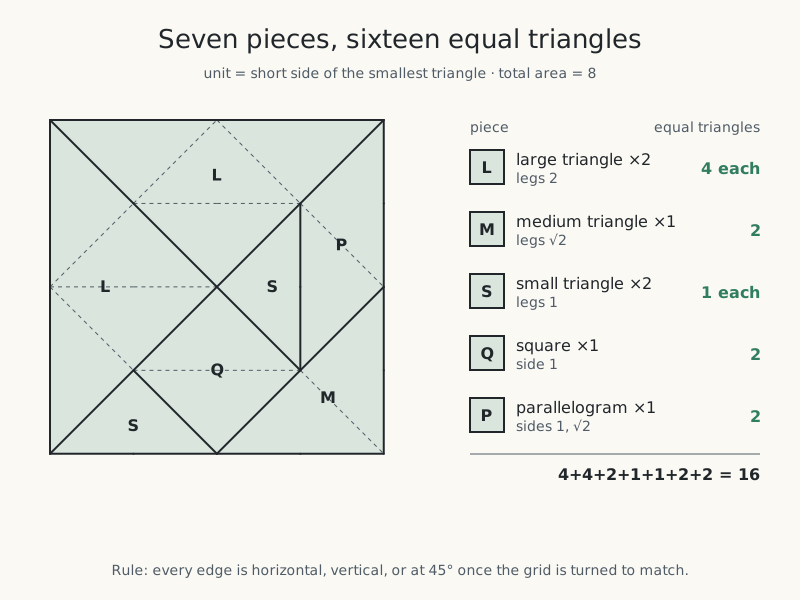
Narrow screen? Scroll the drawing sideways, or open it full size.
Full credit to copy
"The seven tangram pieces on a grid of sixteen equal triangles" by Drawn Mathematics, https://drawnmathematics.com/puzzles/tangram/, licensed under CC BY 4.0, https://creativecommons.org/licenses/by/4.0/
What is a tangram?
A tangram is a square cut into seven pieces. They are two large triangles, one medium triangle, two small triangles, a square, and a parallelogram. A puzzle gives you only an outline, and you fill it with all seven pieces, with no overlaps. You may turn any piece and flip it over.
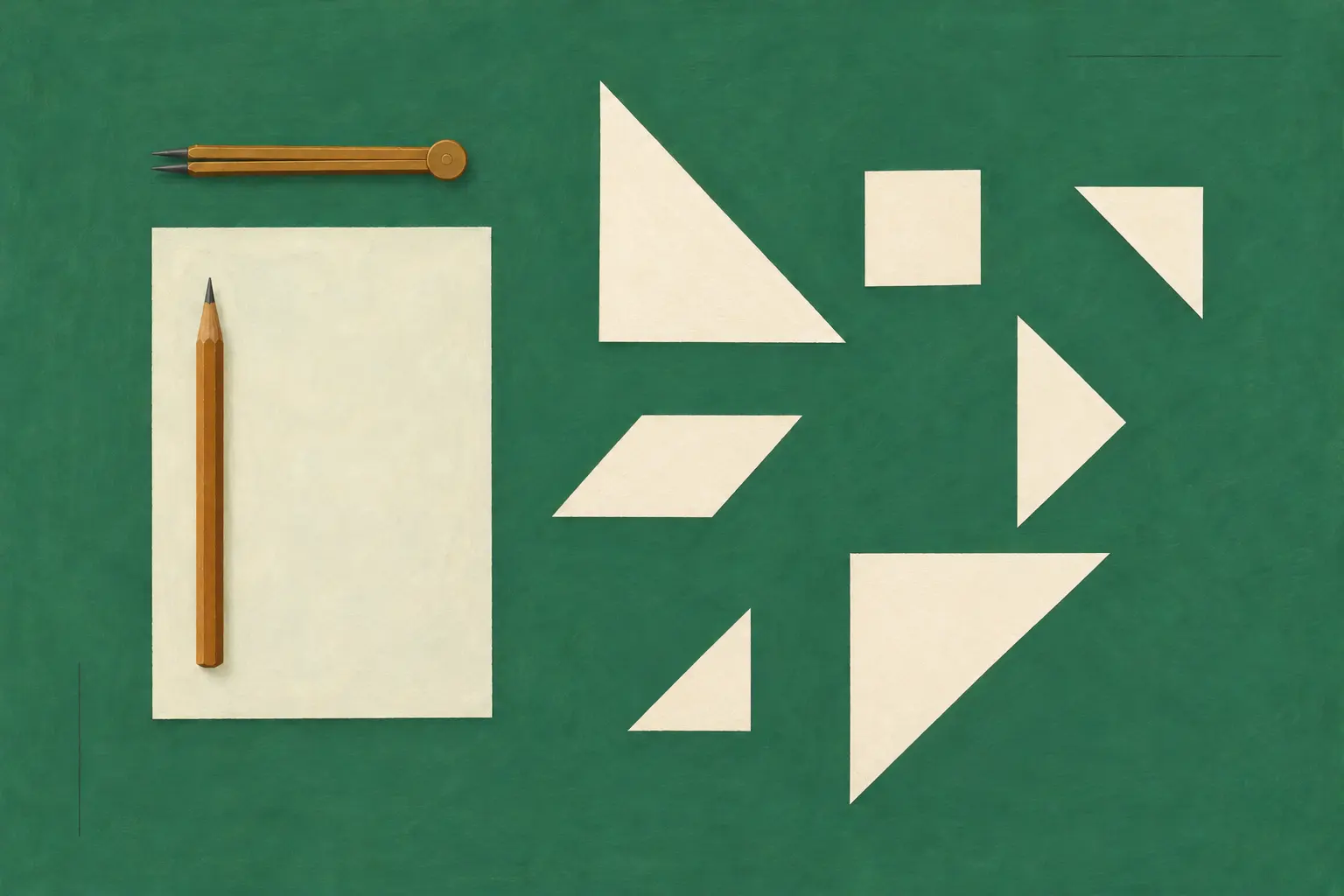
Measure every length with the short side of a small triangle as 1. The large triangles then have short sides of 2, the medium triangle has short sides of √2 (about 1.41), the square has sides of 1, and the parallelogram has sides of 1 and √2. The seven pieces cover an area of exactly 8, and every corner of a tangram outline without holes measures a multiple of 45°.
Look at Figure 1 again, and you will see every piece split into copies of the small triangle: 4 in each large triangle, 2 in the medium triangle, 2 in the square, 2 in the parallelogram, and 1 in each small triangle. That makes 16 identical right isosceles triangles, which are triangles with one square corner and two equal sides.
How many shapes can a tangram make?
The answer depends on one word: convex. If the outline may have dents, there is no limit. Fox-Epstein and Uehara count over 2,000 tangram and related puzzles, citing books by Jerry Slocum and Martin Gardner. Pohl and Richter point out that sliding part of one arrangement a little gives a continuum of different six-sided outlines.
Convex means no dents: if you pick any two points inside the shape, the straight line between them stays inside. Squares and triangles pass this test; a star fails it.
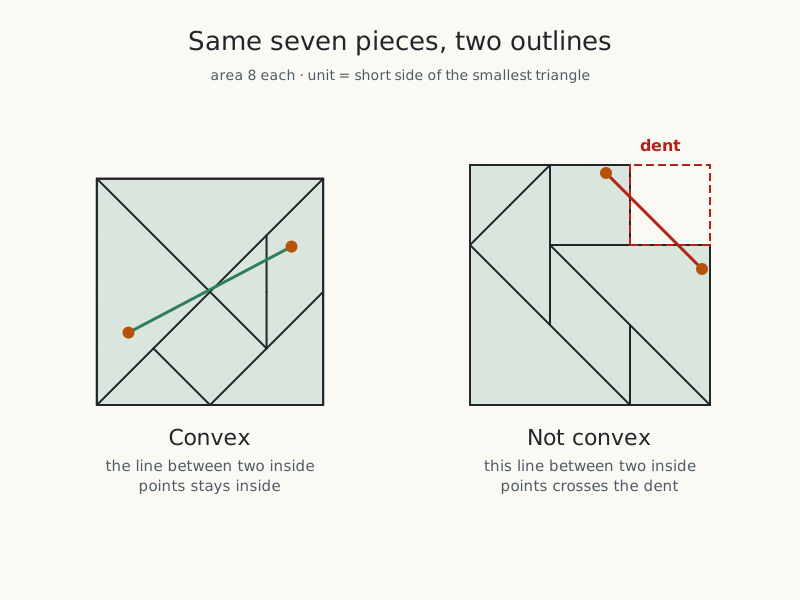
Narrow screen? Scroll the drawing sideways, or open it full size.
Full credit to copy
"The same seven tangram pieces fill a convex square and an outline with a dent" by Drawn Mathematics, https://drawnmathematics.com/puzzles/tangram/, licensed under CC BY 4.0, https://creativecommons.org/licenses/by/4.0/
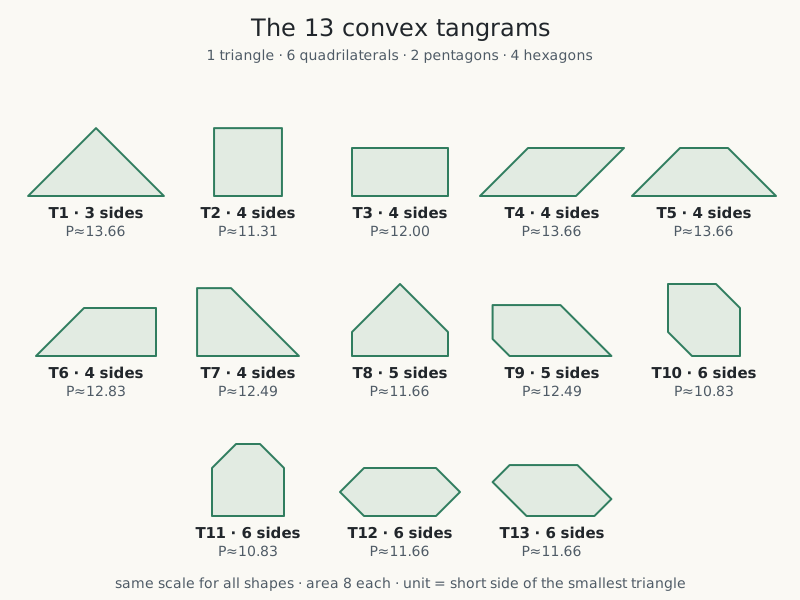
Add that rule and the count drops to 13. Fu Traing Wang and Chuan-Chih Hsiung (National University of Chekiang, Kweichow, China) proved it in The American Mathematical Monthly in 1942. A shape counts once, even if you turn it or mirror it. The 13 split into 1 triangle, 6 quadrilaterals, 2 pentagons, and 4 hexagons.
Pohl and Richter add two more facts. Every three-sided and four-sided tangram is convex, so those two lists end at 1 and 6. Of the 53 five-sided tangrams, only 2 are convex.
The tangram is not the only flat design with a hard limit. Patterns that repeat in two independent directions have only 17 symmetry types, the limit we call the seventeen ceiling (Wallpaper Groups: Only 17 Symmetry Types for Two-Way Repeats). For convex tangrams, the ceiling is 13.
All 13 convex tangrams, drawn to scale
Narrow screen? Scroll the drawing sideways, or open it full size.
Full credit to copy
"The 13 convex shapes the seven tangram pieces can fill" by Drawn Mathematics, https://drawnmathematics.com/puzzles/tangram/, licensed under CC BY 4.0, https://creativecommons.org/licenses/by/4.0/
Read each outline as the rule, caught in the act: sixteen triangles, seven fixed groups, no dents. The table gives exact side lengths so you can redraw any of them.
| ID | Shape | Sides | Perimeter |
|---|---|---|---|
| T1 | Right isosceles triangle, short sides 4 | 3 | 8 + 4√2 ≈ 13.66 |
| T2 | Square, side 2√2 (the starting square) | 4 | 8√2 ≈ 11.31 |
| T3 | Rectangle, 2 × 4 | 4 | 12 |
| T4 | Parallelogram, sides 4 and 2√2 | 4 | 8 + 4√2 ≈ 13.66 |
| T5 | Isosceles trapezoid, parallel sides 2 and 6 | 4 | 8 + 4√2 ≈ 13.66 |
| T6 | Right trapezoid, parallel sides 3 and 5 | 4 | 10 + 2√2 ≈ 12.83 |
| T7 | Right trapezoid, parallel sides √2 and 3√2 | 4 | 4 + 6√2 ≈ 12.49 |
| T8 | Pentagon with one mirror line (house shape) | 5 | 6 + 4√2 ≈ 11.66 |
| T9 | Pentagon with no symmetry | 5 | 4 + 6√2 ≈ 12.49 |
| T10 | Hexagon: 3 × 3 square, two opposite corners cut | 6 | 8 + 2√2 ≈ 10.83 |
| T11 | Hexagon: 3 × 3 square, two neighboring corners cut | 6 | 8 + 2√2 ≈ 10.83 |
| T12 | Hexagon: 2 × 3 rectangle with a point at each end | 6 | 6 + 4√2 ≈ 11.66 |
| T13 | Hexagon with a center of symmetry, no mirror line | 6 | 6 + 4√2 ≈ 11.66 |
The square the set is cut from is not the most compact shape on the list. T10 and T11 enclose the same area with a perimeter of 8 + 2√2 ≈ 10.83, about 4% less than the square's 11.31. Three shapes tie for the longest outline at 13.66: the triangle, the parallelogram, and the isosceles trapezoid.
How many ways can you fill each shape?
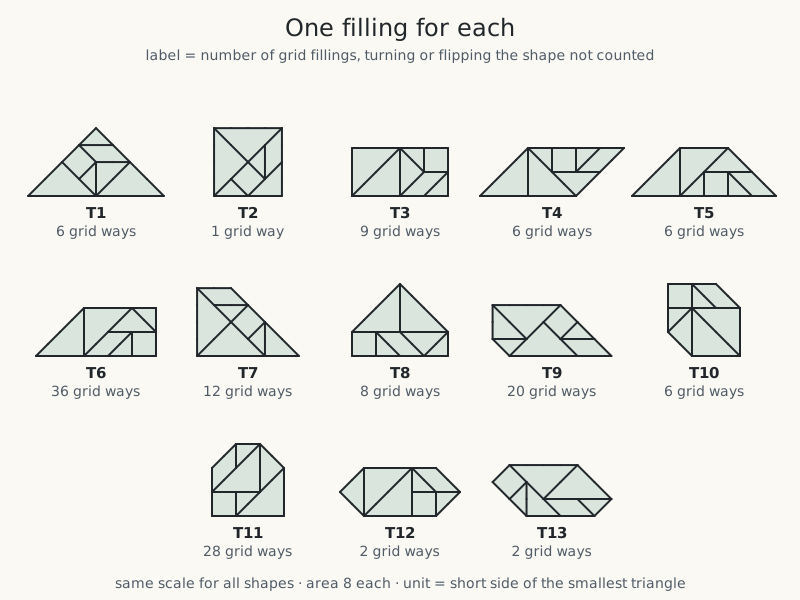
Narrow screen? Scroll the drawing sideways, or open it full size.
Full credit to copy
"One way to fill each of the 13 convex tangrams" by Drawn Mathematics, https://drawnmathematics.com/puzzles/tangram/, licensed under CC BY 4.0, https://creativecommons.org/licenses/by/4.0/
The diagram above shows one filling for each outline, and the label under each one counts every filling our search found with the pieces placed on the grid. Turning or flipping the whole shape does not make a new filling. Swapping the two large triangles, or the two small ones, does not either.
On the grid, the square has exactly one filling: the layout in Figure 1. T6, the right trapezoid with parallel sides 3 and 5, has 36, the most on the list. All 13 outlines together have 142.
These counts come from our own exhaustive search. Beelen and Verhoeff cite a 2018 report by T.G.J. Beelen that works out every essentially different filling of the 13 shapes; we have not been able to read that report, so we have not compared our numbers with it. The search places pieces only at grid positions, and rerunning it on a grid twice as fine gave the same counts. We still call them grid counts, because the search never tries a piece off the grid.
Why does the list stop at 13?
Fox-Epstein and Uehara's summary of Wang and Hsiung's argument breaks into four steps. You can repeat steps 1, 3 and 4 yourself, but step 2 is the hard part.
- Count the triangles. The pieces are made of small triangles, 16 in all, so every convex tangram is a convex shape built from those 16.
- Line up the grid. Wang and Hsiung showed that in any convex tangram, the long sides of the 16 triangles can be lined up so that each is parallel or at right angles to every other. Then every corner lands on a square grid.
- List the grid shapes. On that grid, exactly 20 convex shapes have area 8.
- Try the pieces. The seven pieces fill 13 of the 20.
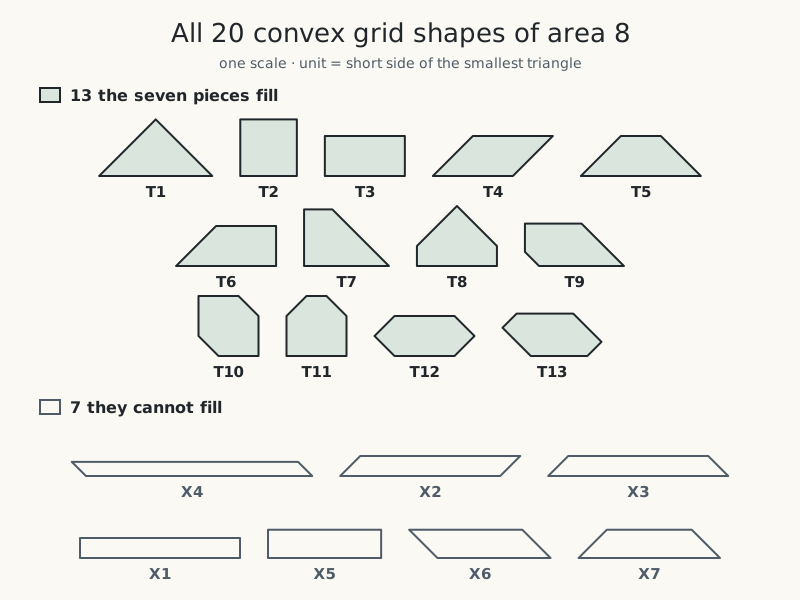
Narrow screen? Scroll the drawing sideways, or open it full size.
Full credit to copy
"All 20 convex grid shapes of area 8" by Drawn Mathematics, https://drawnmathematics.com/puzzles/tangram/, licensed under CC BY 4.0, https://creativecommons.org/licenses/by/4.0/
We reran steps 3 and 4 with a short program. It lists every convex outline whose edges run horizontal, vertical, or at 45°, and it finds exactly 20 with area 8. Pick's theorem, which links a grid shape's area to the grid points on and inside it, caps how long the edges can get, so the search is finite.
The CSV file lists all 20 candidates with their vertices, side lengths, perimeters, narrowest widths and grid filling counts: tangram-convex-candidates.csv (CSV; where this file comes from: source, version and license, JSON) Source data: Computed for this page from the definitions of the seven tangram pieces; the 20 candidates and the 13 tangram shapes agree with Fox-Epstein and Uehara, arXiv:1407.1923 (2014)
The same code reproduces the small cases Fox-Epstein and Uehara report: 1 convex shape from one triangle, 3 from two, and 2 from three. A search that tries every grid placement of the seven pieces then finds 13 outlines that work, and they split 1, 6, 2 and 4 by number of sides, the same split Pohl and Richter give for the theorem.
The program checks the grid case only, so it demonstrates the count rather than proving it. Step 2, the reason the grid case is the only case, is Wang and Hsiung's work.
The 7 shapes the tangram cannot make
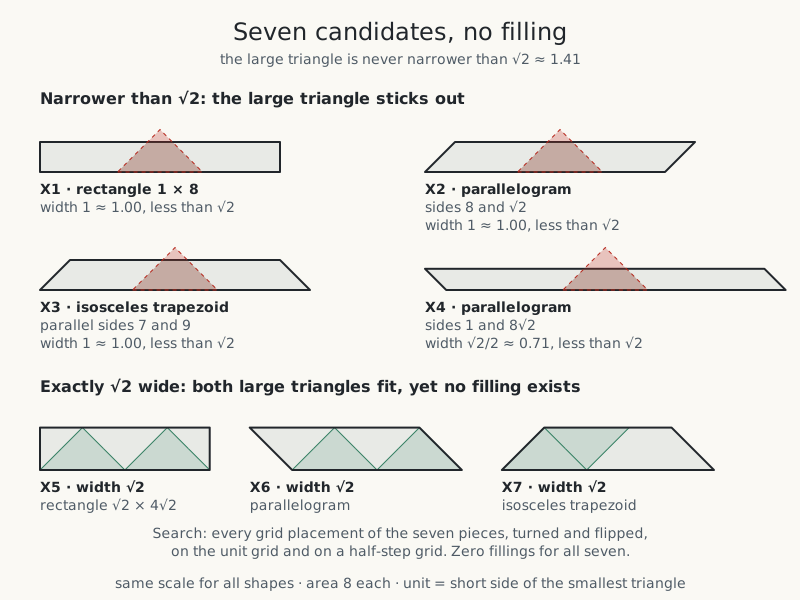
Narrow screen? Scroll the drawing sideways, or open it full size.
Full credit to copy
"The seven convex candidates the tangram cannot fill" by Drawn Mathematics, https://drawnmathematics.com/puzzles/tangram/, licensed under CC BY 4.0, https://creativecommons.org/licenses/by/4.0/
All seven misses are four-sided. Four of them fail for a reason you can check with a ruler. Stand the large triangle on its long side and it is √2 tall, about 1.41; stand it on a short side and it is 2 tall. It needs a strip at least √2 wide, and shapes X1 to X4 are only 1 or 0.71 wide.
The other three, X5 to X7, are exactly √2 wide, and both large triangles fit inside each one, lying on their long sides. The search still finds no way to complete the filling.
Measure the narrowest width of all 20 candidates and a clean split appears. Every candidate √2 wide or narrower fails, and every candidate at least 2 wide works. That split is an observation about these 20 shapes. It is not a theorem about other puzzles.
Could seven different pieces make more convex shapes?
Yes, up to 6 more, as long as the new pieces are still cut from the same 16 small triangles. Sei Shōnagon Chie no Ita is a Japanese set of seven pieces, also built from 16 equal small triangles, and Fox-Epstein and Uehara proved it can form 16 of the 20 grid candidates, 3 more than the tangram.
They also designed a seven-piece set that forms 19 of the 20 and proved that no seven-piece set made from those 16 triangles can form all 20. Forming all 20 takes 11 pieces, and 11 are enough.
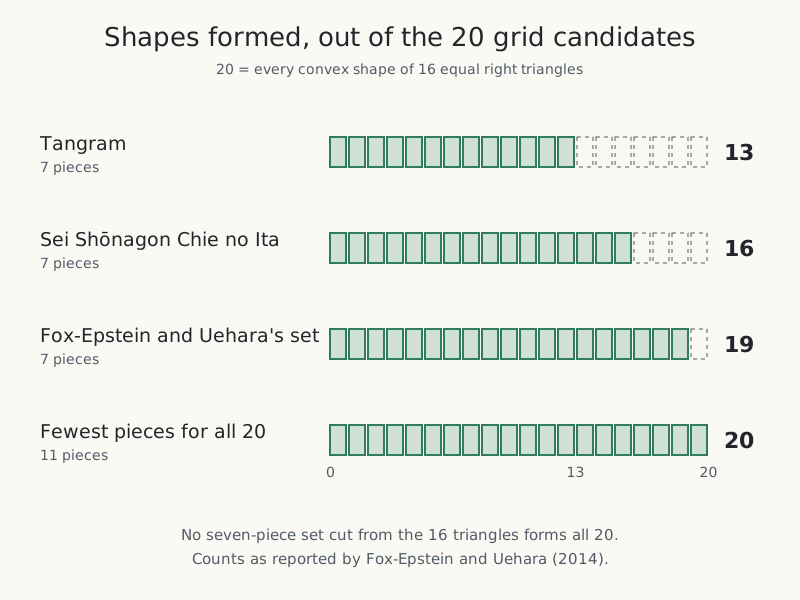
Narrow screen? Scroll the drawing sideways, or open it full size.
Full credit to copy
"Convex grid shapes formed by four piece sets, out of 20" by Drawn Mathematics, https://drawnmathematics.com/puzzles/tangram/, licensed under CC BY 4.0, https://creativecommons.org/licenses/by/4.0/
| Piece set | Pieces | Grid candidates it forms (of 20) | Who showed it |
|---|---|---|---|
| Tangram | 7 | 13 | Wang and Hsiung (1942), as reported by Fox-Epstein and Uehara and by Pohl and Richter; this page's grid search agrees |
| Sei Shōnagon Chie no Ita | 7 | 16 | Fox-Epstein and Uehara (2014) |
| Fox-Epstein and Uehara's seven-piece set | 7 | 19 | Fox-Epstein and Uehara (2014) |
| Fewest pieces that form all 20 | 11 | 20 | Fox-Epstein and Uehara (2014), who also proved no seven-piece set reaches 20 |
Fox-Epstein and Uehara call these dissection puzzles: one set of pieces, cut so it rebuilds more than one shape. For a triangle cut into four pieces that rebuild a square, see Haberdasher's Puzzle: Four Hinged Pieces, Triangle to Square.
Where people get stuck
How many shapes can you make with a tangram?
As many as you like, if the outline may have dents. Published books count over 2,000 tangram and related puzzles, and sliding part of an arrangement a little gives a continuum of new six-sided outlines. Only 13 outlines have no dents at all. Fu Traing Wang and Chuan-Chih Hsiung proved that count in 1942: one triangle, six quadrilaterals, two pentagons and four hexagons.
Can you flip the parallelogram over?
Yes, standard rules let you turn pieces and flip them over. The parallelogram is the only piece where flipping changes anything, because turning alone can never produce its mirror image. On a square grid, flipping lets the parallelogram sit in 4 directions instead of 2. Every count on this page allows flipping.
How many ways can you make the tangram square?
On the grid, one. Our exhaustive search found exactly one way to fill the square with all seven pieces, the layout in Figure 1. Turning or flipping the whole square does not count as new, and neither does swapping the two identical large or small triangles. Among the 13 convex shapes, the right trapezoid T6 has the most fillings: 36.
How old is the tangram?
The first known reference in literature is from China in 1813, according to Jerry Slocum's The Tangram Book as cited by Fox-Epstein and Uehara. The Japanese set Sei Shōnagon Chie no Ita first appears in literature earlier, in 1742. Wang and Hsiung's theorem on convex shapes came in 1942, 129 years after that first tangram reference.
Draw it yourself:
With paper and a few simple tools
- Draw a square 4 cells wide on graph paper. Rule a diagonal from the bottom-left corner to the top-right corner.
- Rule the other diagonal from the top-left corner. Stop at the grid point 1 cell left of the right edge and 1 cell above the bottom edge.
- Join the middle of the bottom edge to the middle of the right edge. Rule a short 45° line from the middle of the bottom edge up and left to the first diagonal. Rule a vertical line from where step 2 stopped up to the first diagonal.
- Cut along every line with scissors. If you use a craft knife, press a ruler on the line and pull the blade away from your hand. Children should cut with an adult present.
- Build T10 from the outlines diagram (All 13 convex tangrams, drawn to scale), then the square. Wrap a string around each outline and compare the lengths.
Next: Missing Square Puzzle: Neither Shape Is Really a Triangle · Fold a square along 45° lines instead of cutting it: Flat Origami: Mountains and Valleys Differ by 2 at Inner Points
Sources
- [1] Eli Fox-Epstein and Ryuhei Uehara, "The Convex Configurations of 'Sei Shōnagon Chie no Ita' and Other Dissection Puzzles," arXiv:1407.1923 (2014). https://arxiv.org/abs/1407.1923 Read: full text; paraphrased.
- [2] Sarah Sophie Pohl and Christian Richter, "The Complete Characterization of Tangram Pentagons," arXiv:2006.09698 (2020). https://arxiv.org/abs/2006.09698 Read: full text; paraphrased.
- [3] T.G.J. Beelen and T. Verhoeff, "Determining the essentially different partitions of all Japanese convex tangrams," arXiv:1812.00746 (2018). https://arxiv.org/abs/1812.00746 Read: full text; paraphrased. The 2018 CASA report by T.G.J. Beelen that it cites (Eindhoven University of Technology, CASA-report 18-02) could not be read.
- [4] Fu Traing Wang and Chuan-Chih Hsiung, "A Theorem on the Tangram," The American Mathematical Monthly 49(9): 596–599 (November 1942). https://doi.org/10.1080/00029890.1942.11991289 Read: bibliographic record only; the paper could not be read, and its content is cited as reported by sources 1 and 2.
- [5] Weisstein, Eric W. "Tangram." From MathWorld--A Wolfram Resource. https://mathworld.wolfram.com/Tangram.html Read: used to check facts only; no text, figures or tables reproduced.
- [6] Weisstein, Eric W. "Wallpaper Groups." From MathWorld--A Wolfram Resource. https://mathworld.wolfram.com/WallpaperGroups.html Read: used to check facts only; no text, figures or tables reproduced.
- [7] Weisstein, Eric W. "Pick's Theorem." From MathWorld--A Wolfram Resource. https://mathworld.wolfram.com/PicksTheorem.html Read: used to check facts only; no text, figures or tables reproduced.
- [8] Original data for this page: an exhaustive enumeration of convex grid shapes of area 8 and an exact-cover search over grid placements of the seven pieces (method in the text); all 20 candidates are in the CSV download. https://drawnmathematics.com/puzzles/tangram/tangram-convex-candidates.csv Read: this page's own computation; method in the text, data in the CSV download.
Cite this page
Drawn Mathematics. “Tangram: Seven Pieces Make Only 13 Convex Shapes.” Drawn Mathematics. Published 2026-10-26. https://drawnmathematics.com/puzzles/tangram/ (accessed: add the date you read it).
How each drawing is checked: Checking the constructionCorrections and redrawsHow to reach us