Haberdasher's Puzzle: Four Hinged Pieces, Triangle to Square
TL;DR: Four hinged pieces turn an equilateral triangle into a square of exactly the same area. A proof first posted in 2024 by Erik Demaine, Tonan Kamata and Ryuhei Uehara rules out three straight-edged pieces if none is flipped over; flipped or curved pieces remain an open question in their paper.
Rule: Cut an equilateral triangle into four hinged pieces; swing them into a square.
Narrow screen? Scroll the drawing sideways, or open it full size.
Full credit to copy
"An equilateral triangle and a square of the same area" by Drawn Mathematics, https://drawnmathematics.com/puzzles/haberdashers-puzzle/, licensed under CC BY 4.0, https://creativecommons.org/licenses/by/4.0/
Field-guide card
- Name
- Haberdasher's puzzle
- Classification
- Visual Puzzles · hinged dissection
- Generating rule
- Four pieces, hinged in a chain at three points, close one way into an equilateral triangle and the other way into a square of the same area
- First recorded
- Posed by Henry Dudeney in the Weekly Dispatch on 6 April 1902; a four-piece answer was printed on 4 May 1902
- Diagram
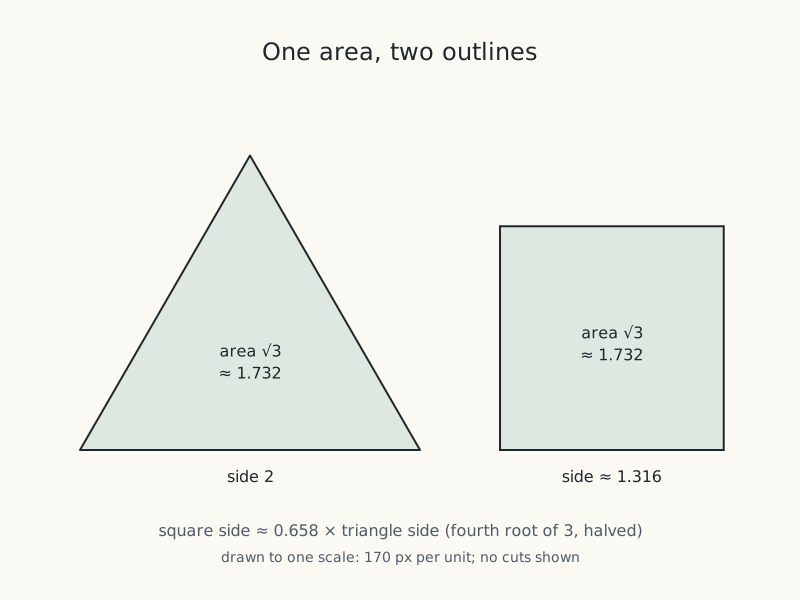
- Figure 1: the triangle (side 2) and the square (side about 1.316) at one scale of 170 px per unit, outlines only
- How it was checked
- Exact square-root arithmetic for every corner, the four areas, both outlines and the no-overlap test in both states; the hinged swing sampled every 1° with no overlap How checks are done
These fields as CSV (haberdashers-puzzle-card.csv)Where this file comes from: source, version and license (JSON)
Source data: Computed for this page from Dudeney's construction; first record as given by Demaine, Kamata and Uehara, arXiv:2412.03865 v4 (2025), and Dudeney, The Canterbury Puzzles (1919 edition)
The puzzle
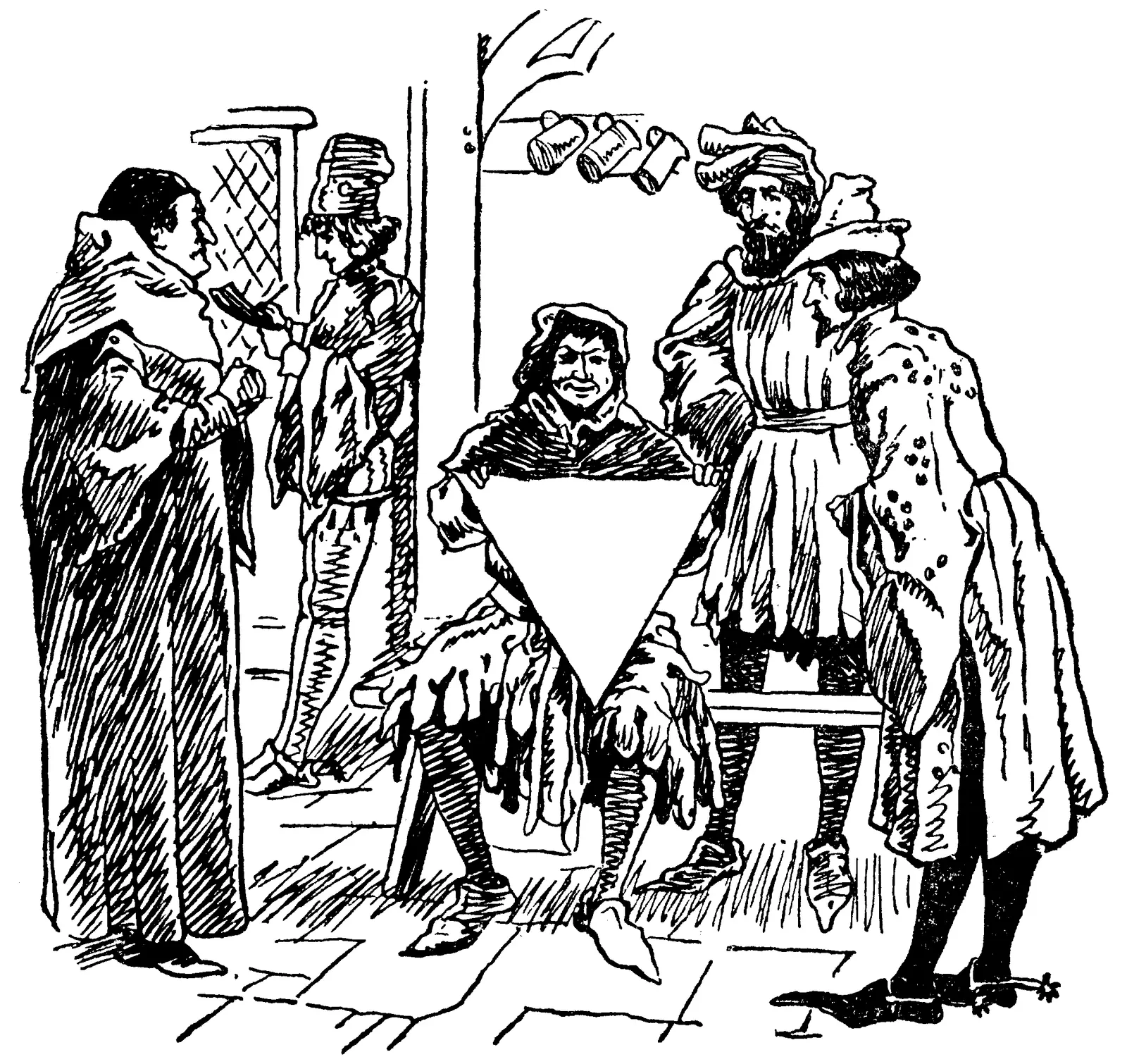
The haberdasher's puzzle is a dissection puzzle (one set of pieces, cut so it rebuilds more than one shape) that turns an equilateral triangle into a square. In Henry Dudeney's The Canterbury Puzzles (1919 edition), a haberdasher holds up a triangle of cloth and asks how "this piece of cloth may be cut into four several pieces that may be put together to make a perfect square."
Full credit to copy
"The Haberdasher's Puzzle (illustration to No. 26, The Canterbury Puzzles, 1919 edition, page 49)" by an unnamed illustrator, in Henry Ernest Dudeney's The Canterbury Puzzles (London: T. Nelson, 1919) — https://commons.wikimedia.org/wiki/File:The_Canterbury_puzzles,_and_other_curious_problems_(IA_ahk6307.0001.001.umich.edu).pdf — Public domain (Henry Ernest Dudeney d. 1930; unsigned illustration treated as anonymous; this edition London: T. Nelson and Sons, 1919; PD worldwide (US: published before 1930; EU: more than 70 years since the author's death and since publication)); modified: cropped to the illustration on page 49 (scan page 47 of the PDF); the surrounding text removed; not scaled; tones not altered
Dudeney adds that it works "without turning over any piece." Compare the missing square puzzle, where two outlines built from the same pieces differ in area by one square (Missing Square Puzzle: Neither Shape Is Really a Triangle).
Show the solution
Where the cuts go
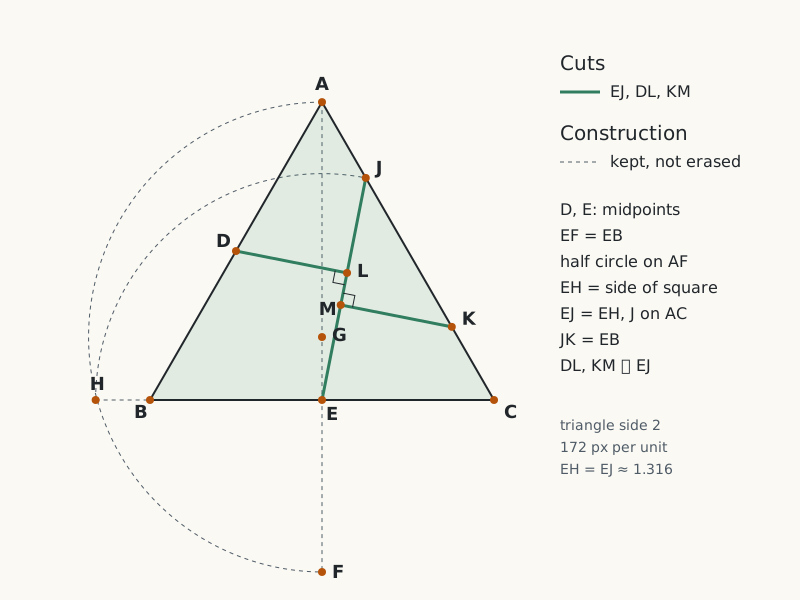
The 1919 edition's solution uses a ruler and compass. Put A at the top, B at the bottom left and C at the bottom right.
- Mark D and E, the midpoints of AB and BC.
- Extend AE past E to F, making EF equal to EB.
- Draw a half circle on AF, and extend EB past B to meet it at H. EH is the square's side.
- Swing an arc about E from H to AC, and call that point J. Mark K on JC with JK equal to EB.
- Drop perpendiculars from D and K to EJ, meeting it at L and M.
- Cut along EJ, DL and KM.
Narrow screen? Scroll the drawing sideways, or open it full size.
Full credit to copy
"Dudeney's construction for the haberdasher's puzzle" by Drawn Mathematics, https://drawnmathematics.com/puzzles/haberdashers-puzzle/, licensed under CC BY 4.0, https://creativecommons.org/licenses/by/4.0/
Step 3 works because EH × EH equals AE × EF, the triangle's height times half its base, which is its area.
We reran the construction with a short program that keeps every square root exact. The four areas add up to exactly √3, the triangle's area for sides of 2. No pieces overlap in either shape. Every corner is in the CSV file: haberdashers-puzzle-pieces.csv (CSV; where this file comes from: source, version and license, JSON) Source data: Computed for this page from Dudeney's construction (The Canterbury Puzzles, 1919 edition, solution 26), with exact square roots
Swing the chain
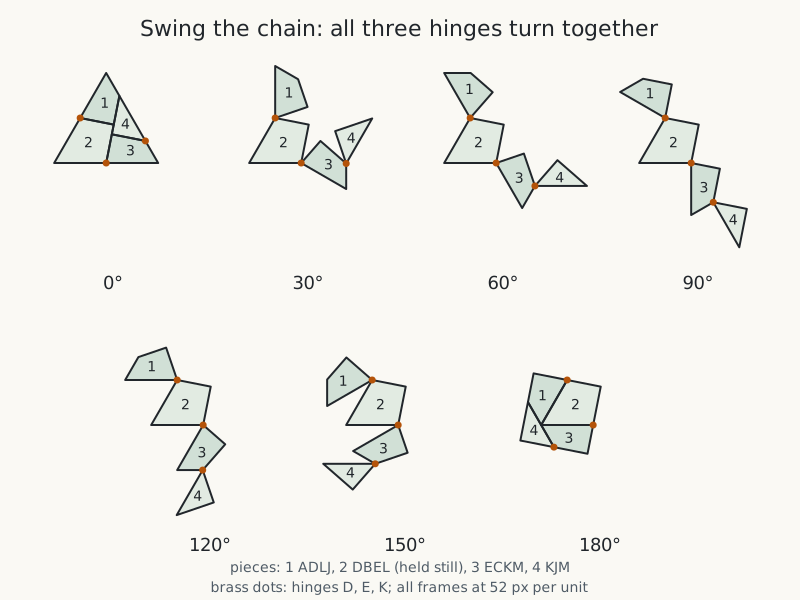
Hold DBEL still. Give ADLJ a half turn about D, so A lands on B, and give ECKM a half turn about E, so C lands on B. KJM rides along with ECKM, then makes its own half turn about K. A half turn never turns a piece over.
Narrow screen? Scroll the drawing sideways, or open it full size.
Full credit to copy
"The four hinged pieces swinging from triangle to square" by Drawn Mathematics, https://drawnmathematics.com/puzzles/haberdashers-puzzle/, licensed under CC BY 4.0, https://creativecommons.org/licenses/by/4.0/
Dudeney describes a model "in polished mahogany with brass hinges" that closes one way into the triangle and the other way into the square. Our program turned the hinges at D, E and K together, checking every 1°: nothing overlaps if D turns counterclockwise while E and K turn clockwise. That is one path, checked at sampled angles, not a proof.
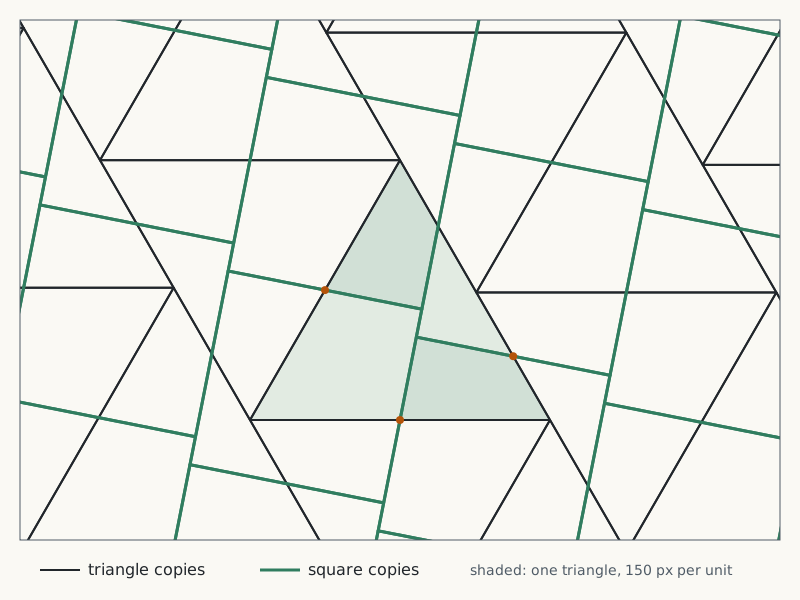
Repeat the triangle across the plane with half turns about D, E and K. Then do the same with the square. Each tiling repeats in two directions, like the patterns in Wallpaper Groups: Only 17 Symmetry Types for Two-Way Repeats. Laid together, the square copies cut every triangle along EJ, DL and KM.
Narrow screen? Scroll the drawing sideways, or open it full size.
Full credit to copy
"A triangle tiling and a square tiling laid over each other" by Drawn Mathematics, https://drawnmathematics.com/puzzles/haberdashers-puzzle/, licensed under CC BY 4.0, https://creativecommons.org/licenses/by/4.0/
Who solved it first?
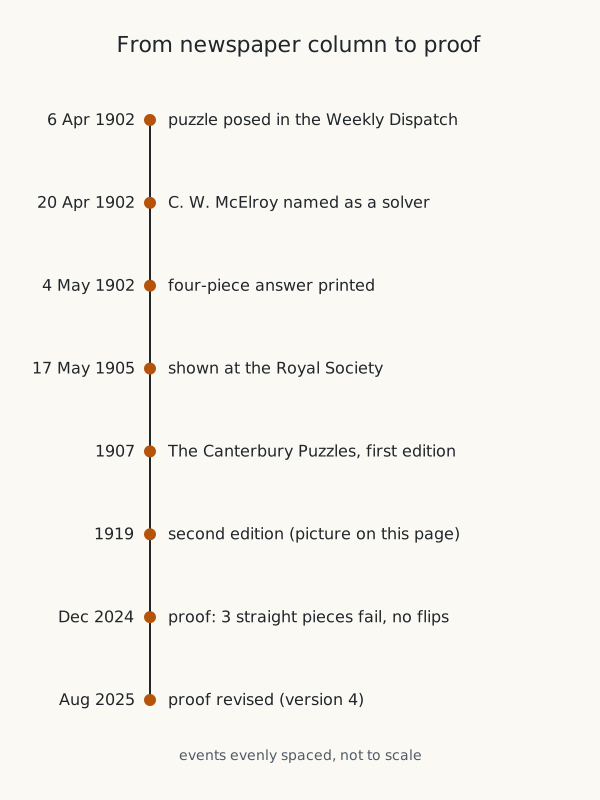
Dudeney posed the puzzle in his Weekly Dispatch column on 6 April 1902, according to Demaine, Kamata and Uehara. On 20 April he named C. W. McElroy of Manchester as a solver, and on 4 May he printed the four-piece answer. The three authors call it unclear whether Dudeney or McElroy found it first. Dudeney's 1919 text credits "Mr. C. W. M'Elroy" as the only reader who sent the correct solution.
Narrow screen? Scroll the drawing sideways, or open it full size.
Full credit to copy
"Haberdasher's puzzle timeline, 1902 to 2025" by Drawn Mathematics, https://drawnmathematics.com/puzzles/haberdashers-puzzle/, licensed under CC BY 4.0, https://creativecommons.org/licenses/by/4.0/
In his own account, Dudeney showed the problem to the Royal Society on 17 May 1905. The Canterbury Puzzles first appeared in 1907, and a second edition followed in 1919. The three-piece proof was first posted in December 2024 and revised in August 2025.
Why not three pieces?
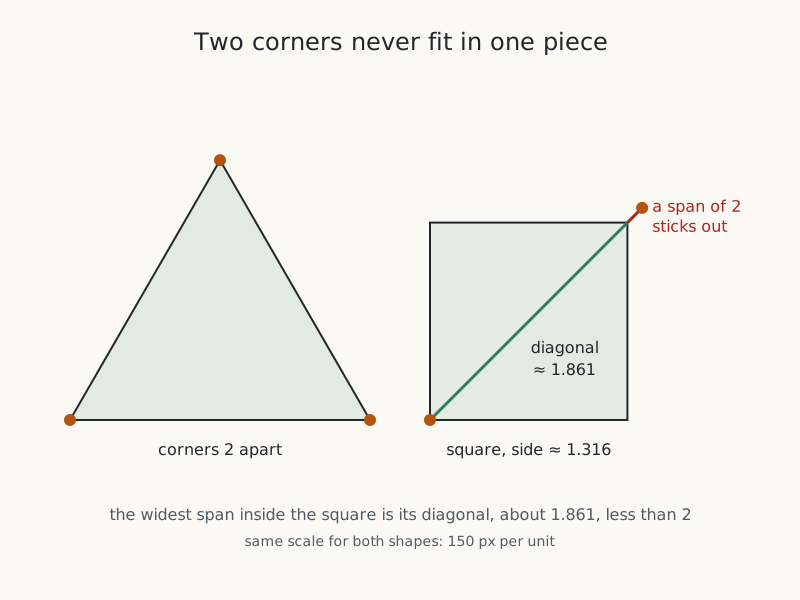
Two pieces never work. Each piece must fit inside the square, whose widest span is its diagonal: about 1.861 when the triangle's sides are 2. The triangle's corners are 2 apart, so no piece can hold two of them, and two pieces cannot hold three corners. The 2024 proof's first step (Lemma 5.1) is the same argument for straight-edged pieces; it uses only distances, so this page extends it to flipped or curved pieces.
Narrow screen? Scroll the drawing sideways, or open it full size.
Full credit to copy
"Two corners of the triangle never fit in one piece" by Drawn Mathematics, https://drawnmathematics.com/puzzles/haberdashers-puzzle/, licensed under CC BY 4.0, https://creativecommons.org/licenses/by/4.0/
Three pieces are the hard case. Theorem 1.1 of the paper reads: "There is no dissection with three or fewer polygonal pieces between a square and an equilateral triangle, when we forbid flipping pieces." Polygonal pieces have straight edges. The paper lists flipped and curved pieces as open problems, though the authors suspect the answer is still no.
| Pieces | Rules | Status | Basis |
|---|---|---|---|
| 2 | any cuts, flipped or not | Impossible | Distance argument above; Lemma 5.1 (2024 proof) covers straight cuts |
| 3 | straight cuts, no flipping | Impossible | Theorem 1.1 of the 2024 proof by Demaine, Kamata and Uehara |
| 3 | straight cuts, flipping allowed | Open | Listed as open in the 2024 proof (version 4, 2025) |
| 3 | curved cuts | Open | Listed as open in the 2024 proof (version 4, 2025) |
| 4 | straight cuts, no flipping | Possible | Dudeney's construction, checked on this page |
Where people get stuck
How big should the square be?
Its side is about 0.658 times the triangle's side (the fourth root of 3, halved), so the areas match. A triangle with 12 cm sides needs a square with sides of about 7.9 cm.
Do any pieces get flipped over?
No. Dudeney's four pieces only slide and turn, and every move in this page's check is a half turn, which keeps a piece face up.
Can it be done in three pieces?
Not with straight cuts if no piece is flipped: Demaine, Kamata and Uehara proved that in a paper first posted in 2024. Flipped or curved pieces are an open question in that paper.
Draw it yourself:
With paper and a few simple tools
- Draw an equilateral triangle with 12 cm sides on A4: rule the base, then swing a compass set to 12 cm from each end.
- Follow the steps in the solution above to mark D, E, J, K, L and M.
- Rule EJ, DL and KM, and check that EJ is about 7.9 cm long.
- Cut out the four pieces with scissors (children should cut with an adult present).
- Hold DBEL still and turn the other three pieces about D, E and K into a square.
Next: Tangram: Seven Pieces Make Only 13 Convex Shapes · Wallpaper Groups: Only 17 Symmetry Types for Two-Way Repeats
Sources
- [1] Erik D. Demaine, Tonan Kamata and Ryuhei Uehara, "Dudeney's Dissection is Optimal," arXiv:2412.03865 (version 1, December 2024; version 4, August 2025). https://arxiv.org/abs/2412.03865 Read: full text of version 4; paraphrased, with short quotes. Text license: CC BY 4.0.
- [2] Henry Ernest Dudeney, The Canterbury Puzzles and Other Curious Problems, second edition (London: Thomas Nelson and Sons, 1919; first edition 1907), puzzle and solution No. 26, "The Haberdasher's Puzzle." https://www.gutenberg.org/ebooks/27635 Read: full text of puzzle and solution No. 26; quoted (public domain).
- [3] Original data for this page: Dudeney's construction recomputed with exact square roots (a triangle of side 2), the four piece areas, both outlines and a no-overlap test in each shape, a hinged swing checked every 1°, and two overlaid tilings (method in the text); every corner is in the CSV download. https://drawnmathematics.com/puzzles/haberdashers-puzzle/haberdashers-puzzle-pieces.csv Read: this page's own computation; method in the text, data in the CSV download.
Cite this page
Drawn Mathematics. “Haberdasher's Puzzle: Four Hinged Pieces, Triangle to Square.” Drawn Mathematics. Published 2026-10-26. https://drawnmathematics.com/puzzles/haberdashers-puzzle/ (accessed: add the date you read it).
How each drawing is checked: Checking the constructionCorrections and redrawsHow to reach us