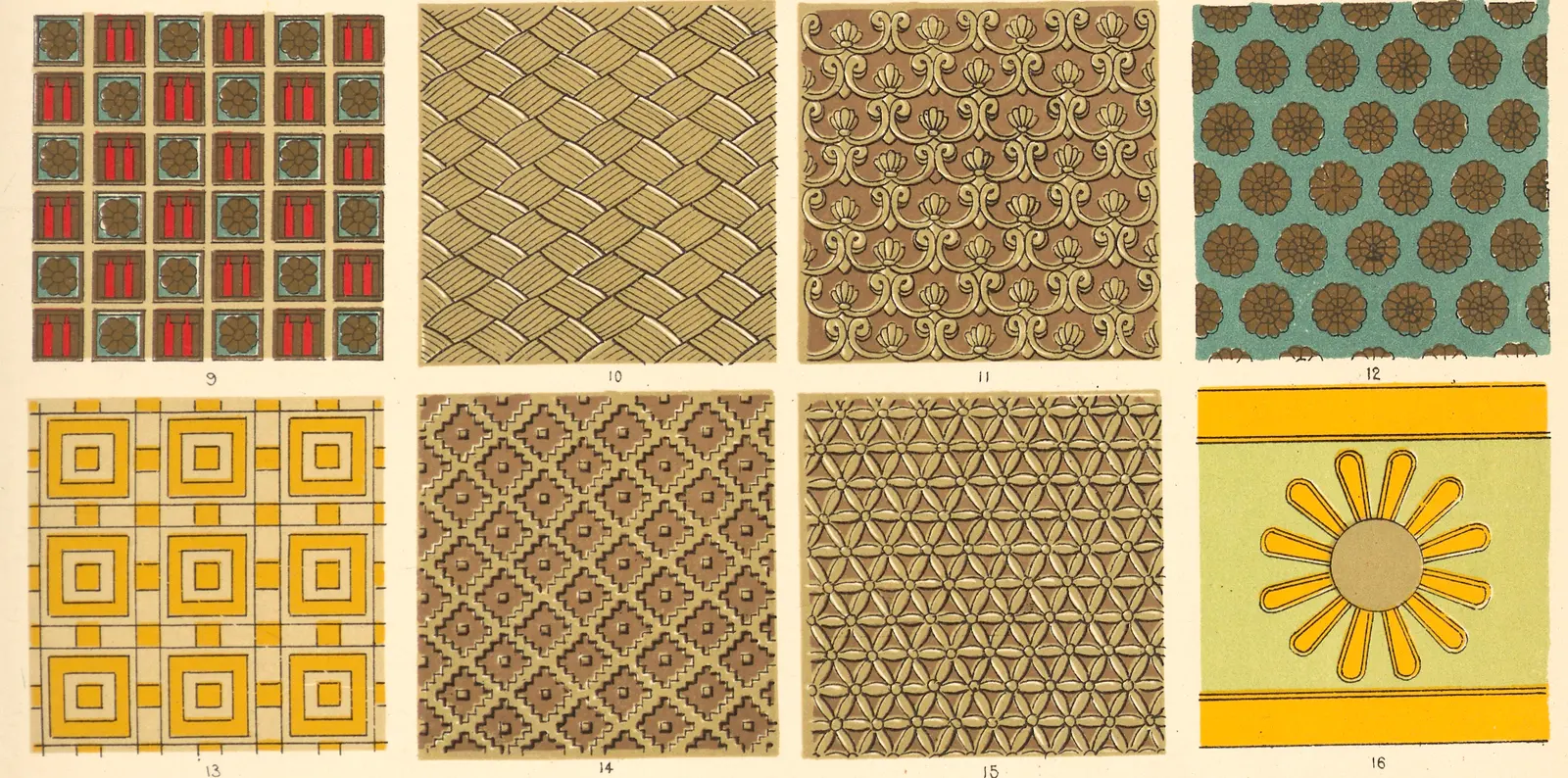
Wallpaper groups, kaleidoscopes and star patterns drawn from their symmetry rules; examples are described by geometry, and any cultural origin is cited.
Any flat pattern that repeats in two independent directions has one of 17 symmetry types. See all 17 drawn from one F, plate examples and a naming flowchart.
Image credit
"Nineveh & Persia No 2, Plate XIII, images 9 to 16 (detail)" by Owen Jones — https://commons.wikimedia.org/wiki/File:The_grammar_of_ornament_1910_(139551113).jpg — Public domain (Owen Jones d. 1874; plates first published 1856 (Day & Son), lithographers died before 1956 or are anonymous; this copy London: Bernard Quaritch, 1910; PD worldwide); modified: cropped to the third and fourth rows of the plate (images 9 to 16 with their printed numbers); colours not altered
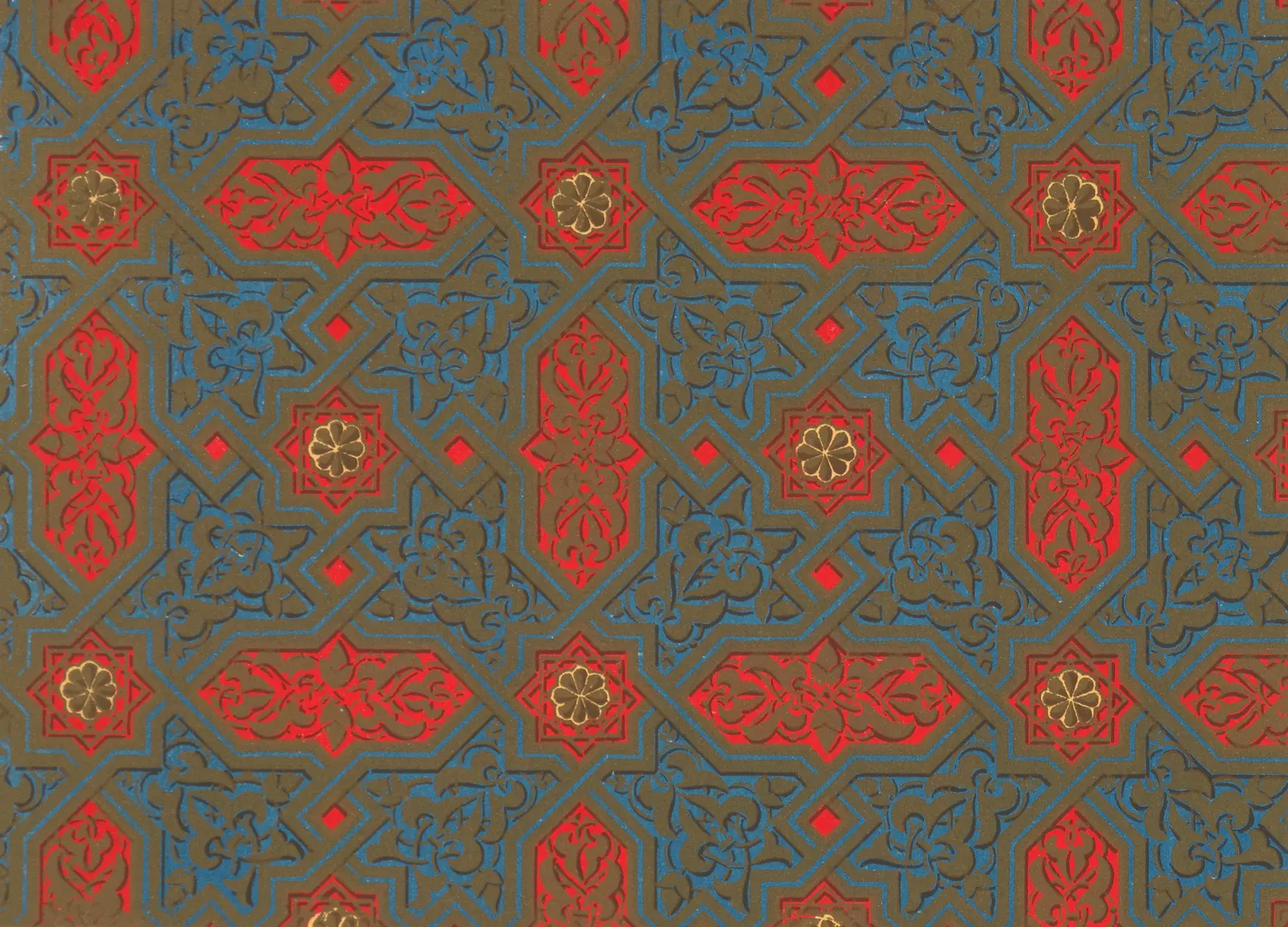
Draw an eight-point star from one circle with a compass and straightedge, repeat it every 4 grid cells, and see why the pattern is p4m, or p4 once woven.
Image credit
"Moresque No 4, Plate XLII, image 2 (upper panel)" by Owen Jones — https://commons.wikimedia.org/wiki/File:The_grammar_of_ornament_1910_(139551279).jpg — Public domain (Owen Jones d. 1874; plates first published 1856 (Day & Son), lithographers died before 1956 or are anonymous; this copy London: Bernard Quaritch, 1910; PD worldwide); modified: cropped to the upper panel of the plate (printed image 2), without the heading, the printed number or the lower panel; colours not altered
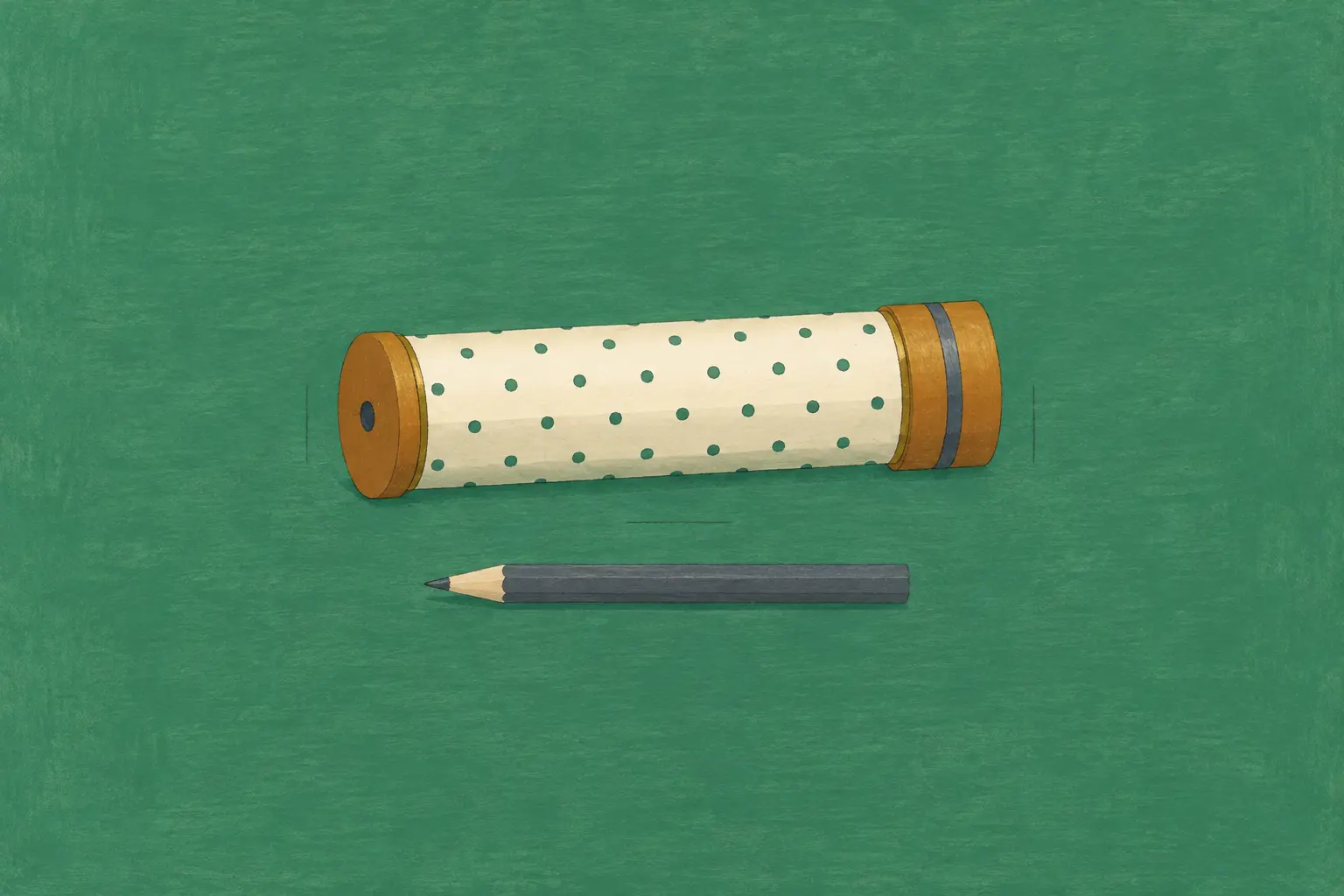
How a kaleidoscope works: a lopsided drawing repeats with no seam only if the mirror angle is 180° divided by a whole number: 60° works, while 50° and 72° fail.
Image credit
Illustration: Drawn Mathematics. Generated scene illustration — not a photograph, historical image or researched reconstruction. Use terms: may be reused with credit to "Drawn Mathematics"; provided without any claim of historical accuracy.
May this site count your visit with Google Analytics? It sets cookies only if you allow it. Cloudflare Web Analytics, which sets no cookies, counts page views either way, and there are no ads. Details: Privacy practices.