Kaleidoscope: Lopsided Drawings Close Up at 60°, Not at 50°
TL;DR: Two flat mirrors meeting at 60° show six copies of the wedge between them, the real one included. A lopsided drawing closes up with no seam only when 180° divided by the mirror angle is a whole number, so 50° and even 72° leave a seam; with three mirrors, only 60-60-60, 45-45-90 and 30-60-90 triangles pass that test.
Rule: Two mirrors at 180°/n, n a whole number, repeat one wedge into 2n copies.
Narrow screen? Scroll the drawing sideways, or open it full size.
Full credit to copy
"Two mirrors at 60°: one wedge repeated six times" by Drawn Mathematics, https://drawnmathematics.com/symmetry/kaleidoscope/, licensed under CC BY 4.0, https://creativecommons.org/licenses/by/4.0/
Field-guide card
- Name
- Kaleidoscope
- Classification
- Ornamental Symmetry; reflections: two mirrors at 180°/n give 2n copies around one point; three mirrors in a 60-60-60, 45-45-90 or 30-60-90 triangle give the wallpaper types p3m1, p4m or p6m; four mirrors in a rectangle give pmm
- Generating rule
- Two mirrors at 180°/n, n a whole number, repeat one wedge into 2n copies
- Diagram
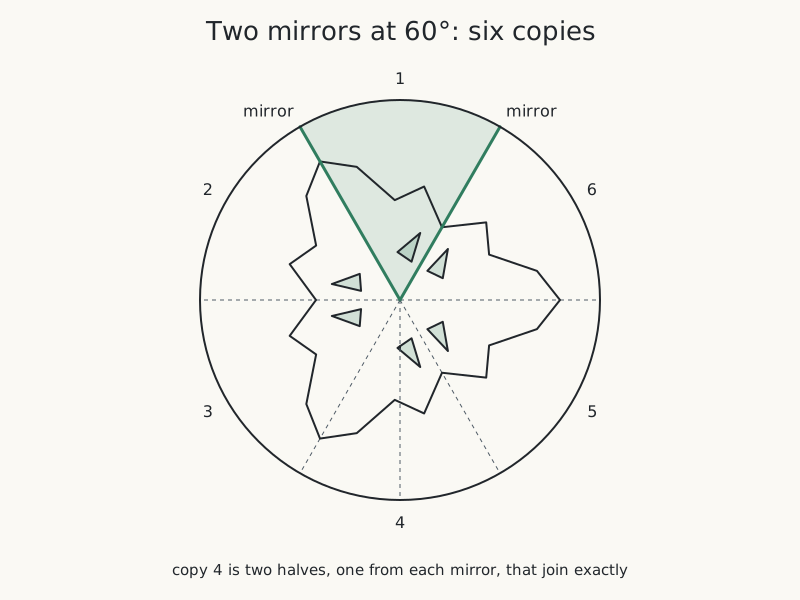
- Figure 1: two mirrors at 60° with a lopsided drawing in the wedge between them, repeated into 6 copies
- How it was checked
- Reflections composed exactly by program at 30°, 36°, 40°, 45°, 50°, 60°, 72°, 90°: a lopsided drawing breaks along the line opposite the wedge wherever 180° divided by the angle is not a whole number How checks are done
These fields as CSV (kaleidoscope-card.csv)Where this file comes from: source, version and license (JSON)
Source data: Computed for this page; name and the angle rule as given in David Brewster, The Kaleidoscope, 3rd ed. (London, 1870)
Two mirrors, one wedge
A kaleidoscope is a tube with long mirrors inside and loose bits of coloured glass in a cell at the far end. David Brewster, who named the instrument, describes that simple form in the 1870 edition of The Kaleidoscope, with the eye as close as possible to the edge where the mirrors meet. From there you see the wedge between the mirrors, plus copies of it all the way around that edge.
Each mirror shows the wedge reversed. Each also reflects the copies in the other mirror, so the copies keep going around the corner: a mirror image, then a turned copy, then a mirror image again. Brewster calls the parts "alternately direct and inverted". At 60°, the copy opposite the drawing is two halves, one from each mirror, and they join exactly, so you see the drawing plus five reflections.
Narrow screen? Scroll the drawing sideways, or open it full size.
Full credit to copy
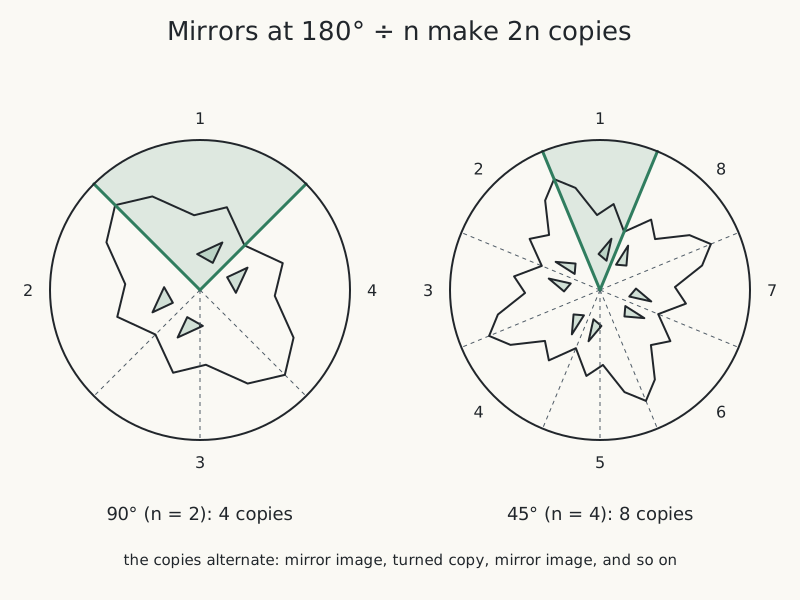
"Mirrors at 90° and 45°: four and eight copies" by Drawn Mathematics, https://drawnmathematics.com/symmetry/kaleidoscope/, licensed under CC BY 4.0, https://creativecommons.org/licenses/by/4.0/
The same count works at other angles. Mirrors at 90° make 4 copies, and mirrors at 45° make 8. In general, mirrors at 180° ÷ n make 2n copies. At 45°, the circle around the corner splits into the same 8 equal parts that start the 8-point star in Islamic Geometric Patterns: The 8-Point Star Is Two Squares.
When the angle does not divide 180°
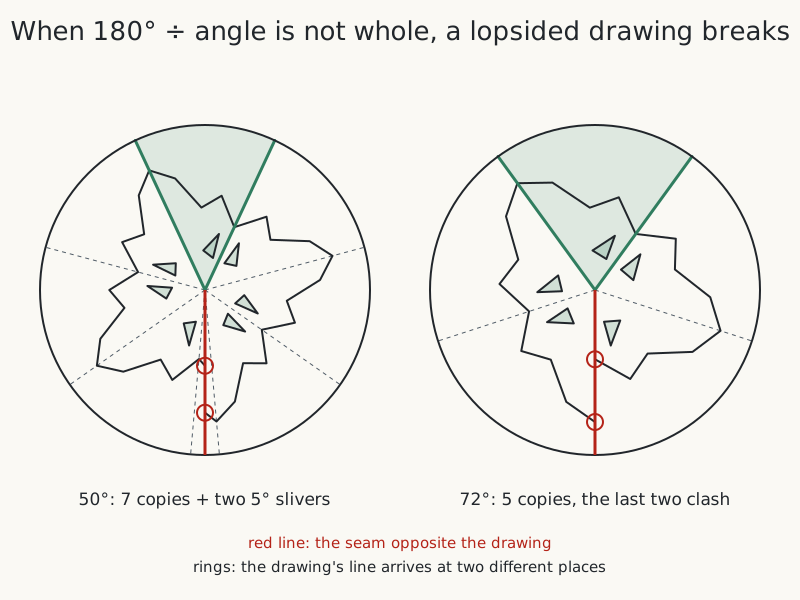
Now open the mirrors to 50°. Then 180 ÷ 50 = 3.6, which is not a whole number. Seven whole copies fit around the corner and leave 10°, filled by two slivers of 5°, one from each mirror. The slivers show different parts of the drawing, so a lopsided drawing breaks where they meet, opposite the middle of the wedge.
Narrow screen? Scroll the drawing sideways, or open it full size.
Full credit to copy
"Mirrors at 50° and 72°: the seam opposite the drawing" by Drawn Mathematics, https://drawnmathematics.com/symmetry/kaleidoscope/, licensed under CC BY 4.0, https://creativecommons.org/licenses/by/4.0/
The surprise is 72°. It goes into 360° exactly five times, so five whole copies fit. But the two copies that meet opposite the drawing are both turned copies, one built through each mirror, so a lopsided drawing still jumps there. Brewster's rule covers this case: the angle must be an "even aliquot part of a circle", meaning 360° divided by an even number, which is the same as 180° divided by a whole number.
For an odd part such as 72°, Brewster writes that the picture is complete only when the object sits the same way toward both mirrors. To set the angle, Brewster says to open or close the plates until a straight line seen through them forms a star of 8, 10 or 12 sectors. The table below comes from this page's program, which reflects the drawing across the mirrors in turn with exact angles.
| Mirror angle | 180° ÷ angle | Copies around the corner | Seam with a lopsided drawing |
|---|---|---|---|
| 90° | 2 | 4 | no |
| 72° | 2.5 | 5 | yes |
| 60° | 3 | 6 | no |
| 50° | 3.6 | 7, plus two 5° slivers | yes |
| 45° | 4 | 8 | no |
| 40° | 4.5 | 9 | yes |
| 36° | 5 | 10 | no |
| 30° | 6 | 12 | no |
Each row, with its assumptions, is in kaleidoscope-angles.csv (CSV; where this file comes from: source, version and license, JSON) Source data: Computed for this page by exact reflection; the odd-part exception for symmetric drawings and the three-mirror triangles as stated in David Brewster, The Kaleidoscope, 3rd ed. (London, 1870), Chapters II and XIII.
Three mirrors that fill the view
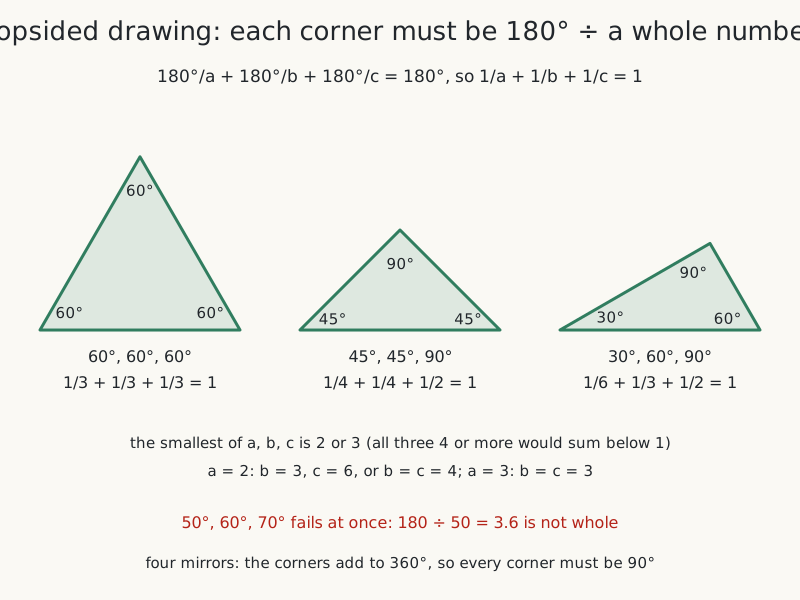
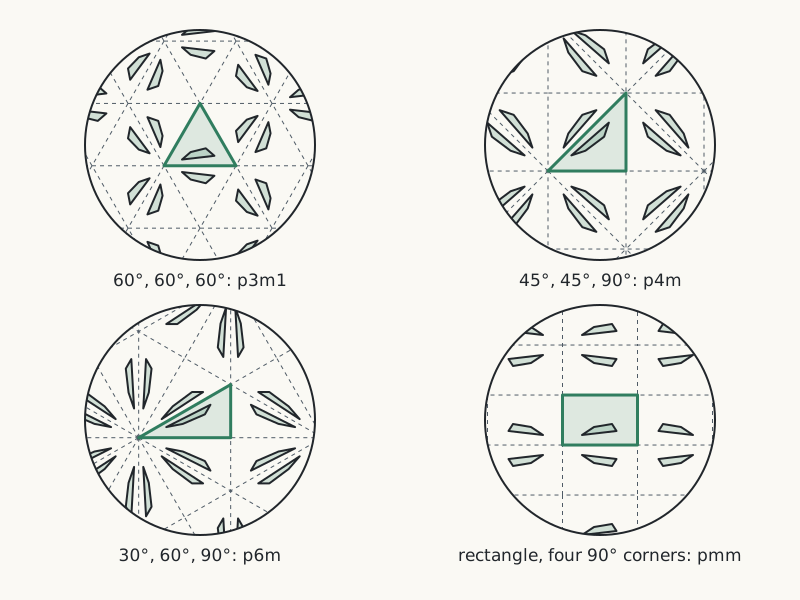
With a third mirror, the copies spread across the whole view. Brewster explains why the choice of shapes is small. Each corner of a three-mirror tube works like a two-mirror kaleidoscope, so for a lopsided drawing each corner angle must be 180° divided by a whole number, and the three corners of a triangle add up to 180°.
Narrow screen? Scroll the drawing sideways, or open it full size.
Full credit to copy
"Why a three-mirror kaleidoscope has only three triangles" by Drawn Mathematics, https://drawnmathematics.com/symmetry/kaleidoscope/, licensed under CC BY 4.0, https://creativecommons.org/licenses/by/4.0/
Write the corners as 180°/a, 180°/b and 180°/c, with a the smallest number. Then 1/a + 1/b + 1/c = 1, and each number is at least 2. If all three numbers were 4 or more, the sum would be at most 3/4, so a is 2 or 3. With a = 3, b and c are both 3; with a = 2, they are 3 and 6, or 4 and 4.
That leaves the 60-60-60, 45-45-90 and 30-60-90 triangles. Brewster lists the same three. Four mirrors must form a square or a rectangle, because four corners that each pass the test and add up to 360° must all be 90°.
Narrow screen? Scroll the drawing sideways, or open it full size.
Full credit to copy
"Three- and four-mirror kaleidoscopes and their wallpaper types" by Drawn Mathematics, https://drawnmathematics.com/symmetry/kaleidoscope/, licensed under CC BY 4.0, https://creativecommons.org/licenses/by/4.0/
In the symbols of Wallpaper Groups: Only 17 Symmetry Types for Two-Way Repeats, the three triangles make the wallpaper types p3m1, p4m and p6m, and the rectangle makes pmm. Every turn centre in these four patterns sits on a mirror, which is what separates p3m1 from p31m and p4m from p4g. This page's program reflected each mirror box out to between 108 and 540 copies and found no clashes, which demonstrates the fit rather than proving it. In his four-mirror square, Brewster notes, the pattern runs on until repeated reflections put out the light.
Brewster's kaleidoscope
By his own account in the 1870 edition, Brewster first had the idea in 1814, during experiments with light reflected back and forth between plates of glass. He built the name from the Greek words for "beautiful", "a form" and "to see". He protected the instrument with a patent.
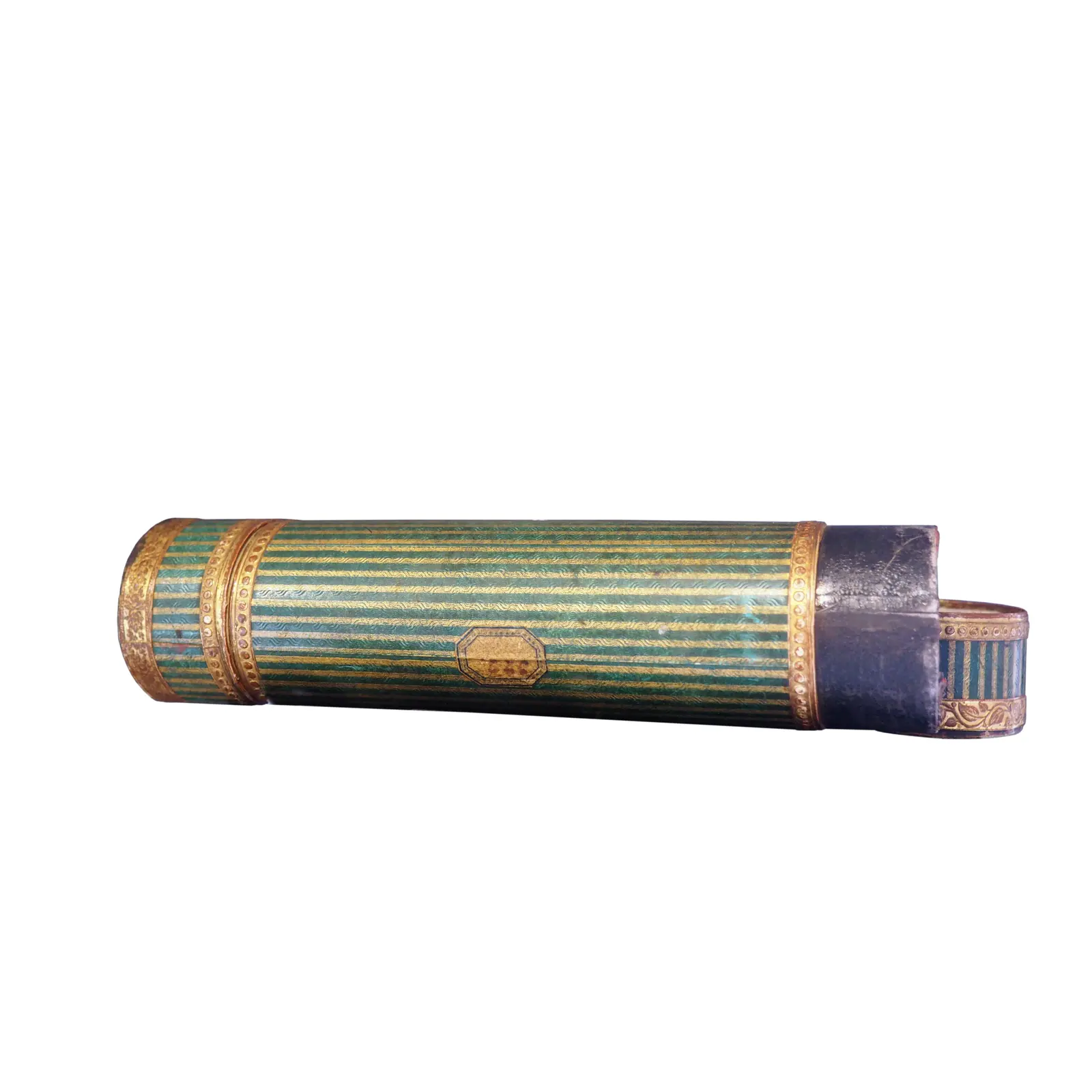
The patent did not stop copies. Brewster reports an estimate that at least 200,000 kaleidoscopes were sold in London and Paris in three months. The tube above is held by the Musée d'histoire des sciences in Geneva (inventory number MHS 563).
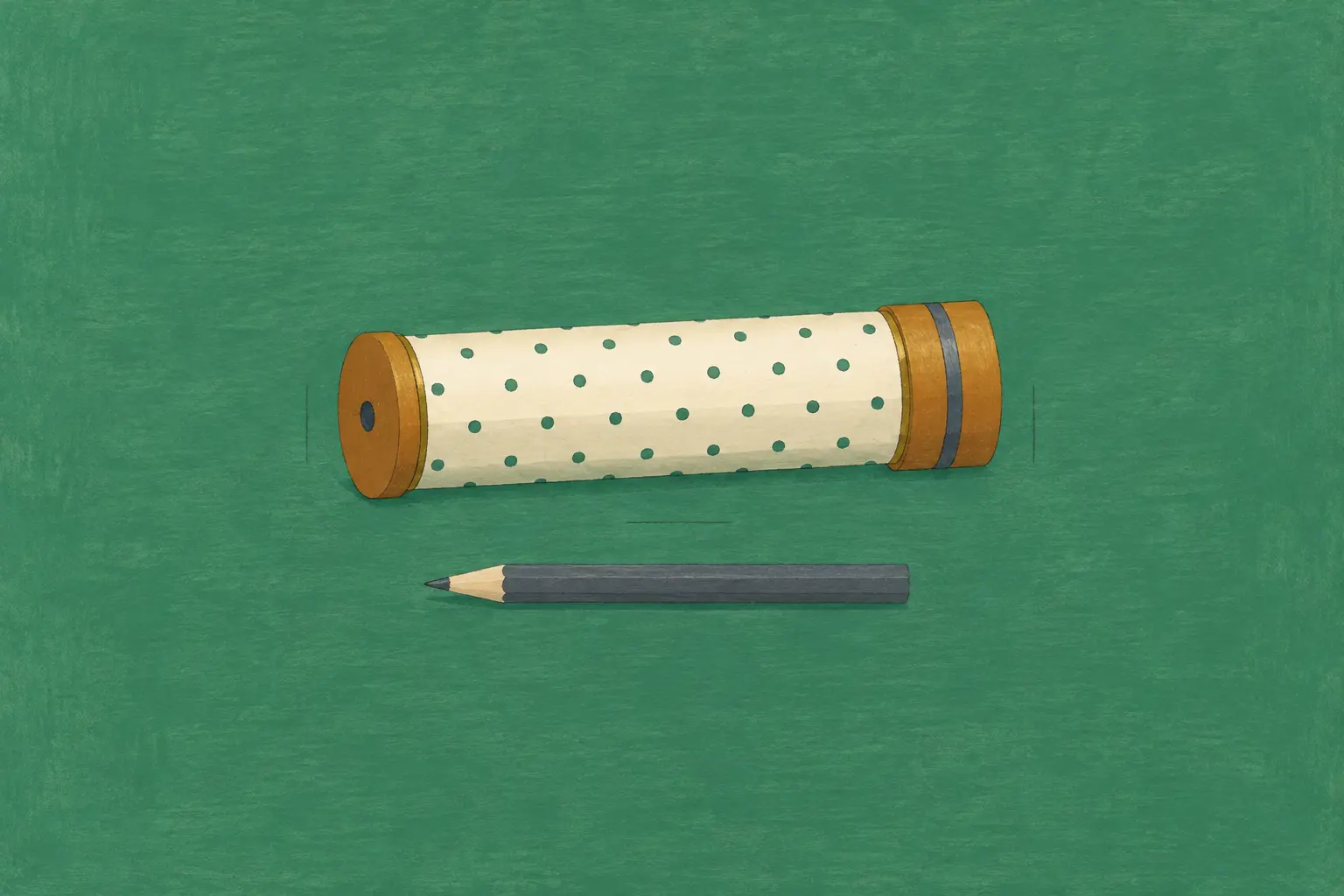
Draw it yourself:
With paper and a few simple tools
- Rule two lines from one point on tracing paper, 60° apart, and draw a lopsided squiggle between them that touches both lines.
- Fold along one line, trace the squiggle onto the layer behind, and unfold; repeat along each new line, around the point.
- Count the copies: six fill the circle, and the last one meets the first exactly.
- Start again with lines 50° apart: the eighth copy overlaps the first, and the squiggles do not line up.
- For a real view, stand two small mirrors with finished edges along the two lines; do not cut glass or acrylic yourself, and children should have an adult present.
Next: Name the pattern type: Wallpaper Groups: Only 17 Symmetry Types for Two-Way Repeats · Creases that flip paper like mirrors: Kawasaki's Theorem: A Flat Fold Splits 360° Into Two 180°s
Sources
- [1] David Brewster, The Kaleidoscope: Its History, Theory and Construction, with Its Application to the Fine and Useful Arts, third edition, greatly enlarged (London: John Camden Hotten, 1870). https://www.gutenberg.org/ebooks/74417 Read: full text; quoted and paraphrased.
- [2] Wikidata, "Kaleidoscope-MHS 563" (Q55454638): an item for a kaleidoscope in the collection of the Musée d'histoire des sciences de la Ville de Genève, inventory number MHS 563. https://www.wikidata.org/wiki/Q55454638 Read: dataset record (key facts: collection and inventory number only).
- [3] Original data for this page: the copies, leftover angle and seam for two mirrors at eight angles, and the copies, clashes and wallpaper types of five mirror boxes, all from exact reflection (method in the text); every row is in the CSV download. https://drawnmathematics.com/symmetry/kaleidoscope/kaleidoscope-angles.csv Read: this page's own computation; method in the text, data in the CSV download.
Cite this page
Drawn Mathematics. “Kaleidoscope: Lopsided Drawings Close Up at 60°, Not at 50°.” Drawn Mathematics. Published 2026-10-26. https://drawnmathematics.com/symmetry/kaleidoscope/ (accessed: add the date you read it).
How each drawing is checked: Checking the constructionCorrections and redrawsHow to reach us