Islamic Geometric Patterns: The 8-Point Star Is Two Squares
TL;DR: Split one circle into eight equal arcs, join every second mark, and two squares overlap into an eight-point star. With the circle's radius set to 2 grid cells, repeat that star every 4 cells so its tips touch its neighbours' tips, and this site's program finds the line pattern has symmetry type p4m, or p4 once its lines weave over and under.
Rule: Split a circle into eight equal arcs, join every second mark, repeat every four cells.
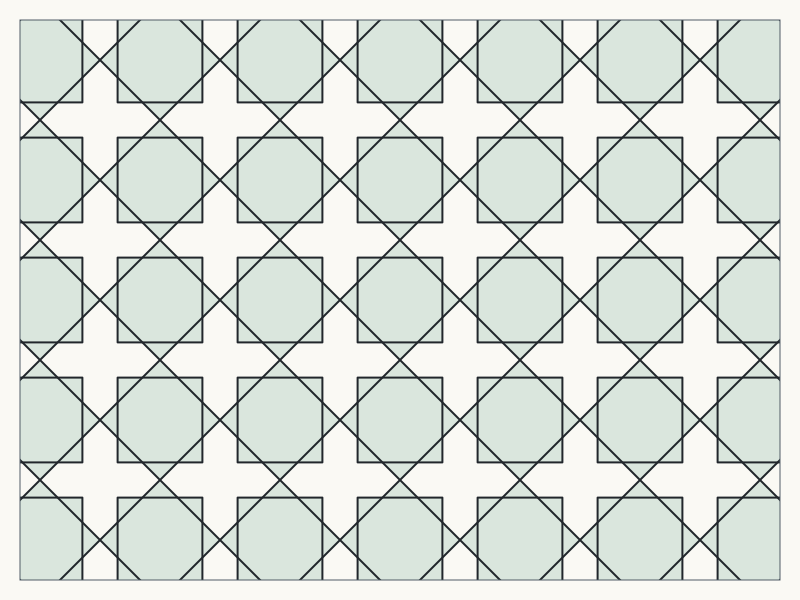
Full credit to copy
"Eight-point stars from one circle, repeated every 4 grid cells" by Drawn Mathematics, https://drawnmathematics.com/symmetry/islamic-geometric-patterns/, licensed under CC BY 4.0, https://creativecommons.org/licenses/by/4.0/
Start with one circle
You need a compass, a straightedge (a ruler used only to rule straight lines), a pencil and graph paper. Ghazal Refalian's 2024 thesis at the Universitat Politècnica de Catalunya describes Islamic geometric patterns as ornament that uses precise geometric rules to cover surfaces such as walls, floors and ceilings (abstract). This page builds one eight-point star pattern from scratch and describes its geometry only, not where or when any design was made.
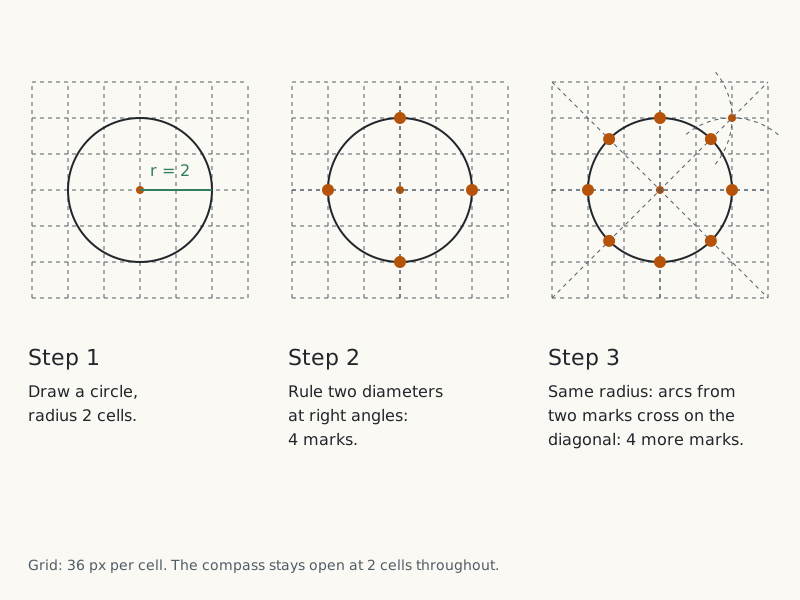
- Set the compass to 2 cells. Put the point on a grid corner and draw a circle.
- Rule the grid line that runs across through the centre and the one that runs down. They cut the circle at 4 marks, a quarter turn apart.
- Keep the same opening. Draw an arc from the right mark and another from the top mark; they cross 2 cells right of the centre and 2 cells up. Rule a line from the centre through that crossing and on across the circle, then repeat with the top and left marks. The circle now carries 8 marks, 45° apart.
Narrow screen? Scroll the drawing sideways, or open it full size.
Full credit to copy
"Steps 1 to 3: eight equal marks on one circle" by Drawn Mathematics, https://drawnmathematics.com/symmetry/islamic-geometric-patterns/, licensed under CC BY 4.0, https://creativecommons.org/licenses/by/4.0/
Step 3 works because the crossing is exactly as far from the right mark as from the top mark, and every such point lies on the line that cuts the quarter turn between them in half. On graph paper you can see the result at once: the crossing lands on a grid corner.
Two squares make the star
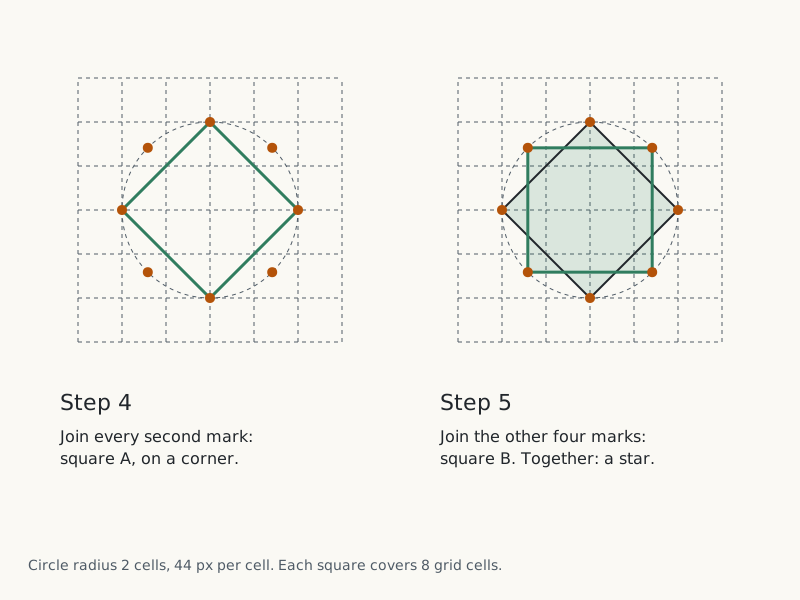
- Join every second mark, starting at the right: right, top, left, bottom. This is square A, standing on a corner.
- Join the other four marks. This is square B, with its sides parallel to the grid lines.
Narrow screen? Scroll the drawing sideways, or open it full size.
Full credit to copy
"Steps 4 and 5: two squares make an eight-point star" by Drawn Mathematics, https://drawnmathematics.com/symmetry/islamic-geometric-patterns/, licensed under CC BY 4.0, https://creativecommons.org/licenses/by/4.0/
The two squares overlap into an eight-point star. Each square has sides 2√2 cells long (about 2.83) and covers exactly 8 grid cells, and every line of the star runs across, down or at 45°. Where the squares cross, they leave a regular octagon at the centre of the star.
Joining every second mark gives two separate squares because the 8 marks fall into two sets of 4. Start anywhere, take every second mark, and you are back where you began after 4 steps.
Repeat the star every 4 cells
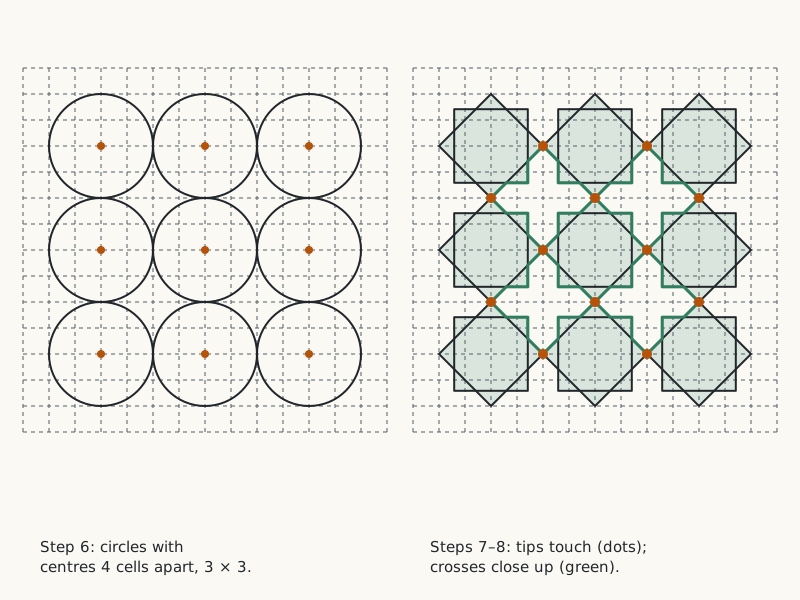
- Draw circles of radius 2 cells with centres 4 cells apart, across and down, in a 3 × 3 block.
- Build a star in each circle, as in steps 2 to 5. The corners of each square A meet the corners of the neighbouring squares A at the grid corners halfway between centres.
- Look at the space between any four stars. It closes up into a four-armed cross.
Narrow screen? Scroll the drawing sideways, or open it full size.
Full credit to copy
"Steps 6 to 8: repeating the star every 4 cells" by Drawn Mathematics, https://drawnmathematics.com/symmetry/islamic-geometric-patterns/, licensed under CC BY 4.0, https://creativecommons.org/licenses/by/4.0/
Stars and crosses now fit together with no gaps. A 4 × 4 block centred on one star holds that star and four quarters of crosses, one cross in all. Squares A and B cover 8 cells each, 16 in total, which is the whole block.
The star counts its central octagon only once, not twice. So the cross has exactly the area of that octagon: 16√2 − 16, about 6.63 cells, against about 9.37 cells for the star. A program working with exact square roots gives the same three areas.
The sides of each square A also run straight on through the touching tips. Seen as lines, the finished drawing is two sets of long diagonal lines plus one small level square per star. Figure 1 shows the finished drawing over a wider area.
A star like this on an Owen Jones plate
Plate XLII of Owen Jones's The Grammar of Ornament is headed “Moresque No 4”, with German and French headings beside it. Its upper panel is numbered 2. The scan shown here comes from a copy in the National Library in Warsaw, catalogued with the imprint London: Bernard Quaritch, 1910. Around each gold rosette in the upper panel, olive bands edged in blue close into an eight-point star, and long red panels filled with leaf scrolls sit between the stars.
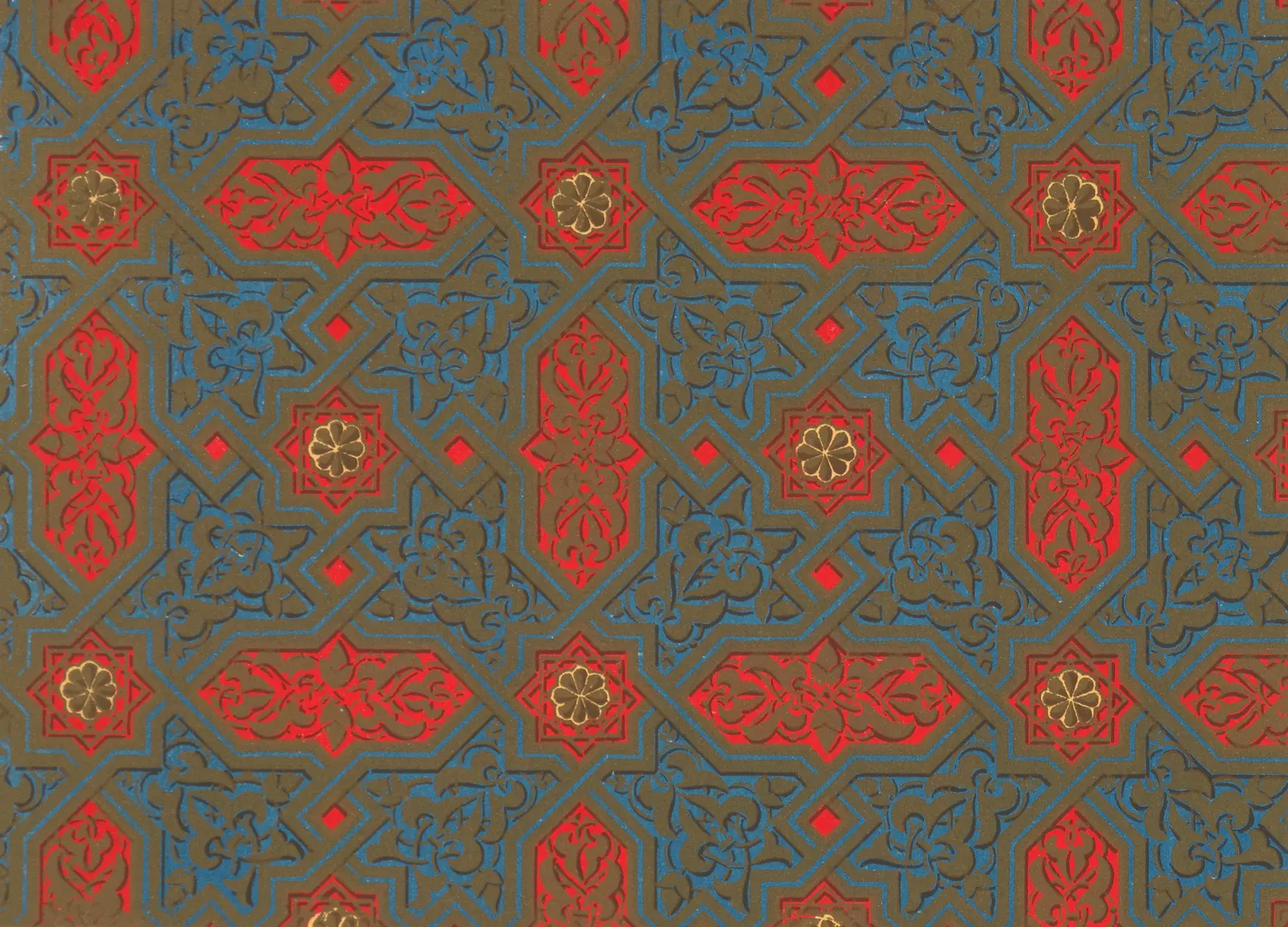
Full credit to copy
"Moresque No 4, Plate XLII, image 2 (upper panel)" by Owen Jones — https://commons.wikimedia.org/wiki/File:The_grammar_of_ornament_1910_(139551279).jpg — Public domain (Owen Jones d. 1874; plates first published 1856 (Day & Son), lithographers died before 1956 or are anonymous; this copy London: Bernard Quaritch, 1910; PD worldwide); modified: cropped to the upper panel of the plate (printed image 2), without the heading, the printed number or the lower panel; colours not altered
The plate's stars do not touch tip to tip: bands and long panels keep them apart, so the printed design is a different pattern built around an eight-point star. This page quotes the heading as printed and makes no claim about where the design came from. We have not classified the plate's symmetry type.
Which of the 17 types is it?
For a flat pattern that repeats along two independent directions, the list of symmetry types stops at 17, a hard limit this site calls the seventeen ceiling (see Wallpaper Groups: Only 17 Symmetry Types for Two-Way Repeats). That page also gives the naming questions, and three answers settle this pattern. The smallest turn that leaves it unchanged is a quarter turn, about the centre of any star or any cross. Mirror lines run across, down and along both diagonals through every star centre, and every quarter-turn centre sits on one of them.
This site's program checked each answer with exact coordinates, square roots included. It named the type p4m. The program also found half turns where tips touch, and glide lines running along the drawn diagonals.
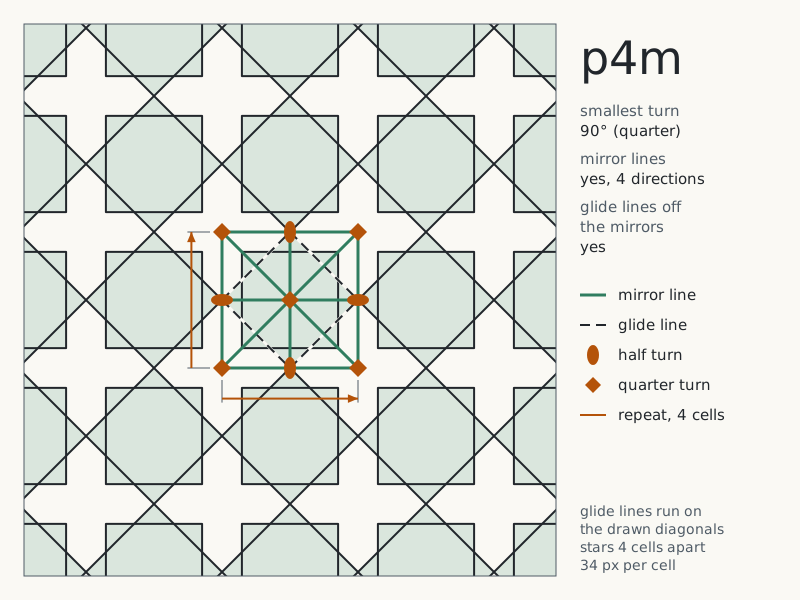
Narrow screen? Scroll the drawing sideways, or open it full size.
Full credit to copy
"Symmetry of the eight-point star pattern: p4m" by Drawn Mathematics, https://drawnmathematics.com/symmetry/islamic-geometric-patterns/, licensed under CC BY 4.0, https://creativecommons.org/licenses/by/4.0/
Now draw every straight line as a strand that passes over, under, over the lines it crosses, including where tips touch. A quarter turn about a star or cross centre still carries every top strand onto a top strand. A reflection in any of the old mirror lines does not, and neither does a glide along the drawn diagonals: at every crossing, the program finds the other strand on top. With no mirror line and no glide line left, the woven pattern is type p4.
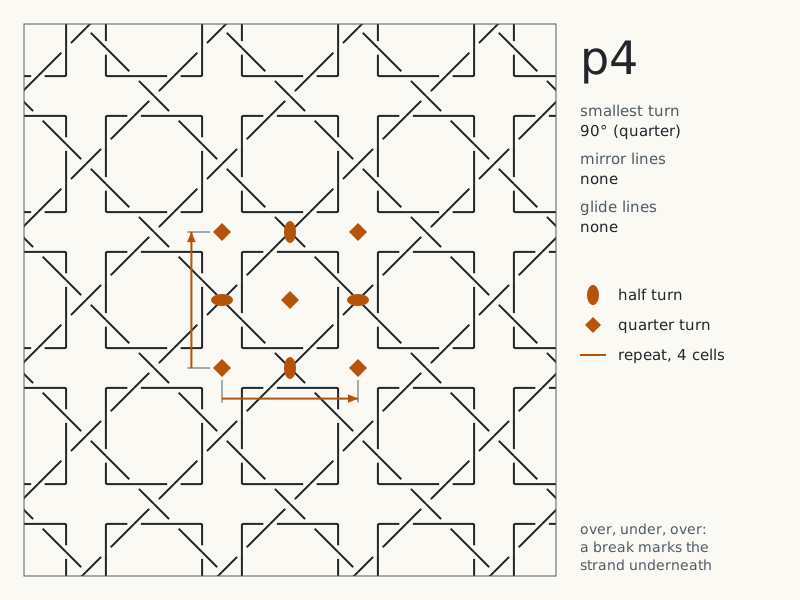
Narrow screen? Scroll the drawing sideways, or open it full size.
Full credit to copy
"The woven eight-point star pattern: p4" by Drawn Mathematics, https://drawnmathematics.com/symmetry/islamic-geometric-patterns/, licensed under CC BY 4.0, https://creativecommons.org/licenses/by/4.0/
Why ten-point stars lose their tenth turn
Cut a circle into ten equal arcs and join each mark to the third mark along: one line closes into a ten-point star. Draw those stars on circles of radius 2 cells, and set them 4 cells apart across and 4 × sin 72° (about 3.80) cells apart down. Their tips then touch, as the eight-point stars did.
A single ten-point star looks the same after a tenth of a turn (36°). The pattern does not: turn it a tenth about any star centre and the next star along lands where no star is centred. This site's program finds that the smallest turn left is a half turn, with mirror lines across and down through every half-turn centre, so the type is pmm.
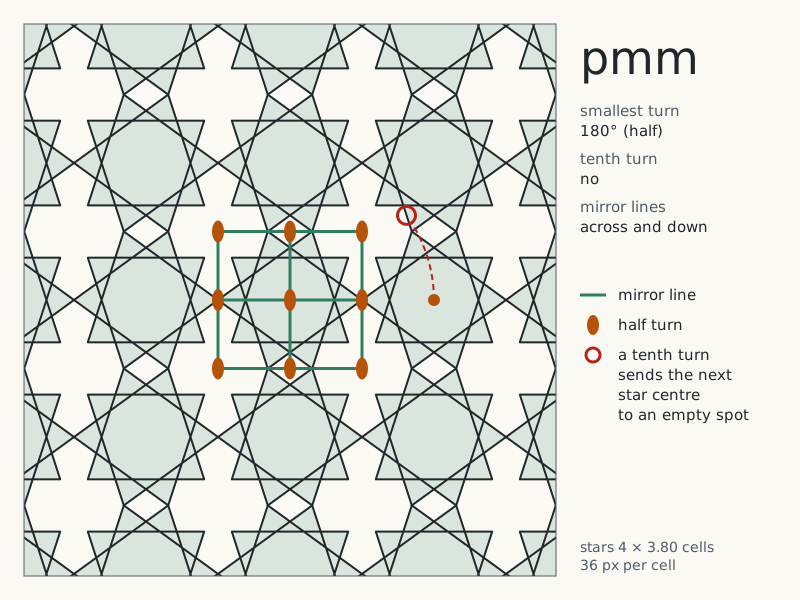
Narrow screen? Scroll the drawing sideways, or open it full size.
Full credit to copy
"Ten-point stars in a repeating pattern: pmm" by Drawn Mathematics, https://drawnmathematics.com/symmetry/islamic-geometric-patterns/, licensed under CC BY 4.0, https://creativecommons.org/licenses/by/4.0/
The reason is a theorem, not a feature of this one design. Pavel Etingof's notes Groups Around Us sketch the proof that a pattern repeating in two directions can turn onto itself only by a half, a third, a quarter or a sixth of a full turn, or by several of these in a row. A turn about a star's centre that leaves the pattern unchanged must also carry that star onto itself, so for a ten-point star it has to be a multiple of 36°, and the only such turn that passes both tests is 180°. For an eight-point star the multiples of 45° that pass are 90°, 180° and 270°, which is why the quarter turn could survive in the patterns above and the eighth turn (45°) could not.
| Pattern on this page | Smallest turn | Mirror lines | Glide lines off the mirrors | Type |
|---|---|---|---|---|
| Eight-point stars, lines | 90° | across, down and diagonal | yes | p4m |
| Eight-point stars, woven | 90° | none | none | p4 |
| Ten-point stars, lines | 180° | across and down | none | pmm |
Each test behind this table, with where it was tried and its result, is one row of the CSV file: islamic-geometric-patterns-symmetry.csv (CSV; where this file comes from: source, version and license, JSON) Source data: Computed for this page from exact constructions of the three star patterns; Rule that third and sixth turns need a repeat cell of two equilateral triangles: Pavel Etingof, Groups Around Us (2009 notes), Theorem 11.2 and its proof sketch
Draw it yourself:
With paper and a few simple tools
- Cut out a paper circle 4 cells across with scissors (children should cut with an adult present). Fold it in half three times, then unfold it: the creases meet the edge at 8 points, 45° apart.
- Lay the circle on graph paper with its centre on a grid corner and one crease along a grid line, and mark the 8 points.
- Join every second point, then the other four, so that two squares overlap into an eight-point star.
- Repeat the star with centres 4 cells apart in a 3 × 3 block, so that tips meet at grid corners.
- Trace the block onto thin paper, pin the tracing at the centre of the middle star and turn it a quarter turn: every line lands on a line.
Next: Kaleidoscope: Lopsided Drawings Close Up at 60°, Not at 50° · Three folds cut a full turn into 45° steps, the way crease patterns split a turn: Flat Origami: Mountains and Valleys Differ by 2 at Inner Points
Sources
- [1] Ghazal Refalian, "A study on the implementation of a string-rewriting system for digital modeling of the islamic geometric patterns," thesis, Universitat Politècnica de Catalunya (2024). https://doi.org/10.5821/dissertation-2117-441421 Read: abstract.
- [2] Original data for this page: exact constructions of an eight-point star pattern (a circle of radius 2 grid cells split into 8 arcs, stars every 4 cells) and a ten-point star pattern, with every symmetry test computed in exact arithmetic (method in the text); one row per test in the CSV download. https://drawnmathematics.com/symmetry/islamic-geometric-patterns/islamic-geometric-patterns-symmetry.csv Read: this page's own computation; method in the text, data in the CSV download.
- [3] Owen Jones, The Grammar of Ornament (London: Bernard Quaritch, 1910): scan of the copy in the National Library, Warsaw (Polona, accession 1.028.021), on Wikimedia Commons. https://commons.wikimedia.org/wiki/File:The_grammar_of_ornament_1910_(139551113).jpg Read: catalogue record on the file page (publisher, year, number of plates); the plates themselves are the images on this page.
- [4] Pavel Etingof, Groups Around Us, notes of a group-theory mini-course for high school students given in the summer of 2009, section 11, "The wallpaper groups." https://math.mit.edu/~etingof/groups.pdf Read: full text; paraphrased.

Cite this page
Drawn Mathematics. “Islamic Geometric Patterns: The 8-Point Star Is Two Squares.” Drawn Mathematics. Published 2026-10-26. https://drawnmathematics.com/symmetry/islamic-geometric-patterns/ (accessed: add the date you read it).
How each drawing is checked: Checking the constructionCorrections and redrawsHow to reach us