Dissection puzzles, tangrams and visual paradoxes such as the missing square, each drawn to scale, with every answer checked by exhaustive search or a proof.
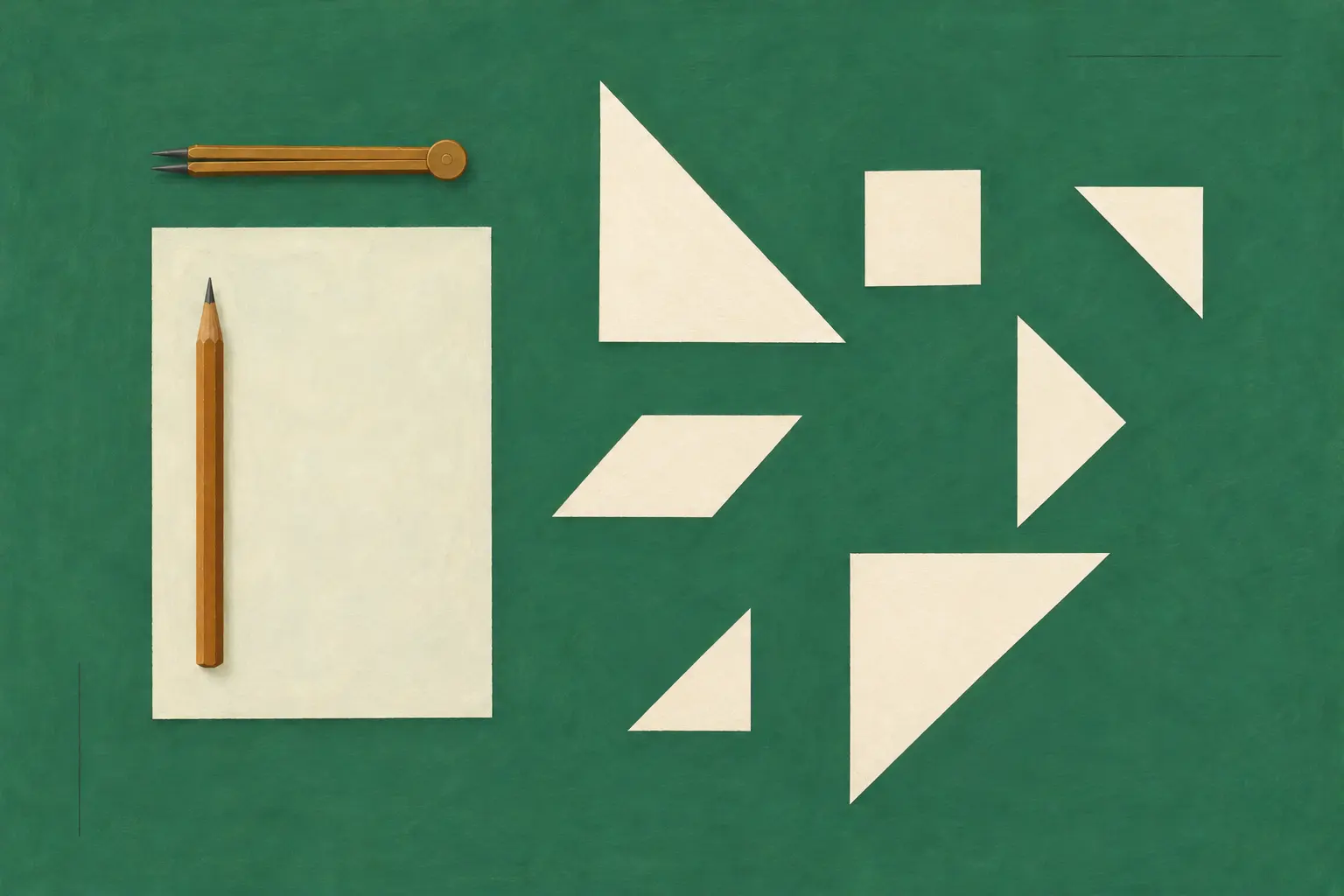
Seven tangram pieces make endless figures, yet only 13 convex shapes. See all 13 drawn to scale, the 7 near-misses, and how a 1942 proof closes the list.
Image credit
Illustration: Drawn Mathematics. Generated scene illustration — not a photograph, historical image or researched reconstruction. Use terms: may be reused with credit to "Drawn Mathematics"; provided without any claim of historical accuracy.
The missing square puzzle's two 13-by-5 figures are not triangles. Each long edge bends by about 1.2°, and the thin gap between them is exactly one square.
Image credit
Illustration: Drawn Mathematics. Generated scene illustration — not a photograph, historical image or researched reconstruction. Use terms: may be reused with credit to "Drawn Mathematics"; provided without any claim of historical accuracy.
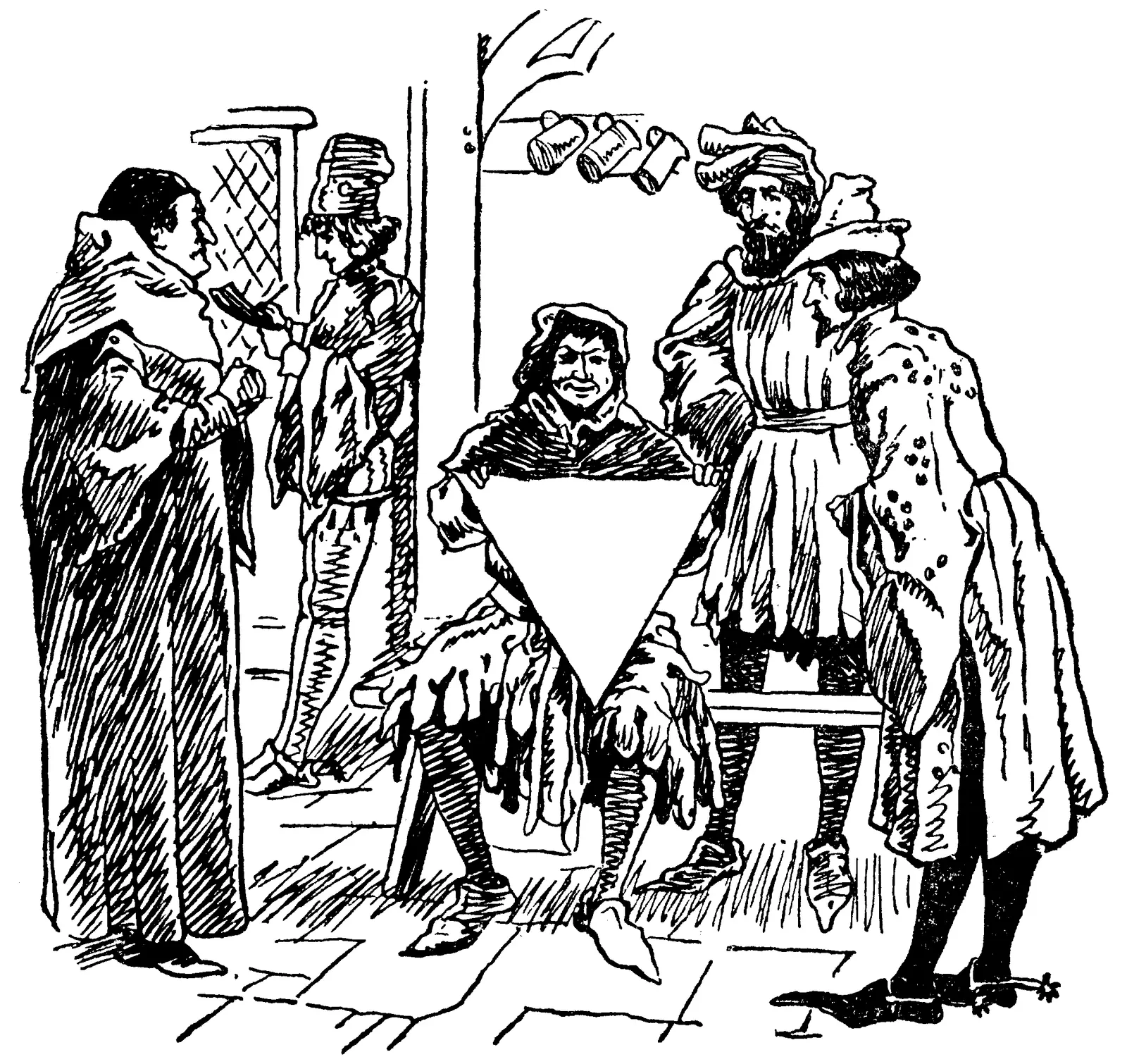
In Dudeney's haberdasher's puzzle, four hinged pieces turn a triangle into a square. See the exact cuts, and why three straight-edged pieces fail if none flip.
Image credit
"The Haberdasher's Puzzle (illustration to No. 26, The Canterbury Puzzles, 1919 edition, page 49)" by an unnamed illustrator, in Henry Ernest Dudeney's The Canterbury Puzzles (London: T. Nelson, 1919) — https://commons.wikimedia.org/wiki/File:The_Canterbury_puzzles,_and_other_curious_problems_(IA_ahk6307.0001.001.umich.edu).pdf — Public domain (Henry Ernest Dudeney d. 1930; unsigned illustration treated as anonymous; this edition London: T. Nelson and Sons, 1919; PD worldwide (US: published before 1930; EU: more than 70 years since the author's death and since publication)); modified: cropped to the illustration on page 49 (scan page 47 of the PDF); the surrounding text removed; not scaled; tones not altered
May this site count your visit with Google Analytics? It sets cookies only if you allow it. Cloudflare Web Analytics, which sets no cookies, counts page views either way, and there are no ads. Details: Privacy practices.