Missing Square Puzzle: Neither Shape Is Really a Triangle
TL;DR: Neither 13-by-5 figure in the missing square puzzle is a triangle: each long edge bends by about 1.2°. The two edges bend in opposite directions, and the thin gap between them has an area of exactly one grid square.
Rule: Slide four grid pieces into a 13-by-5 frame two ways; the areas must add up.
Narrow screen? Scroll the drawing sideways, or open it full size.
Full credit to copy
"Missing square puzzle: the same four pieces in two arrangements" by Drawn Mathematics, https://drawnmathematics.com/puzzles/missing-square/, licensed under CC BY 4.0, https://creativecommons.org/licenses/by/4.0/
Field-guide card
- Name
- Missing square puzzle
- Classification
- Visual Puzzles · dissection fallacy
- Generating rule
- Four pieces (right triangles with legs 8 and 3 and legs 5 and 2, L-shapes of 7 and 8 squares) packed two ways in a 13 × 5 frame
- Diagram
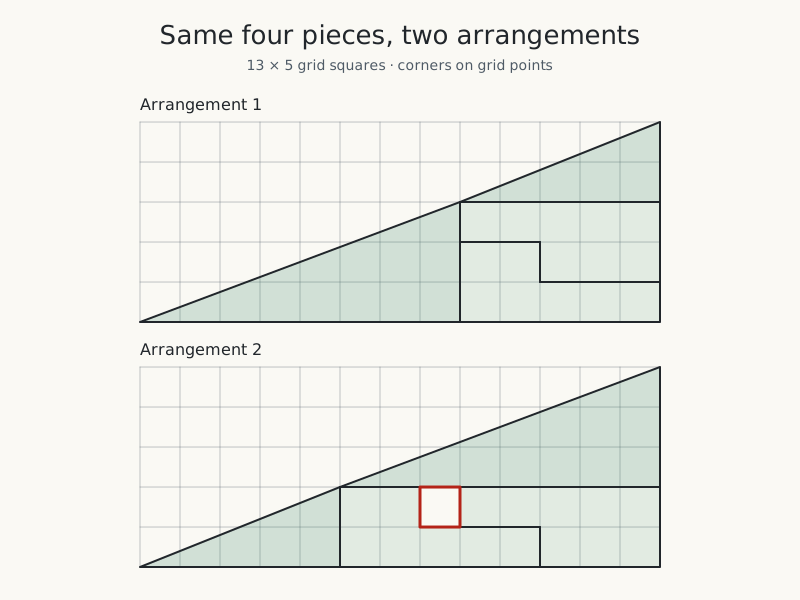
- Figure 1: both arrangements, drawn from exact grid corner points at 40 px per grid square
- How it was checked
- Exact arithmetic with fractions: corner points, slopes 3/8 and 2/5, the vertical 1/13-square offset at each bend, and the one-square gap between the bent edges How checks are done
These fields as CSV (missing-square-card.csv)Where this file comes from: source, version and license (JSON)
Source data: Computed for this page from exact grid coordinates of the four pieces; name and the term dissection fallacy as used in Wolfram MathWorld (Curry Triangle; Dissection Fallacy)
Two arrangements, one square short
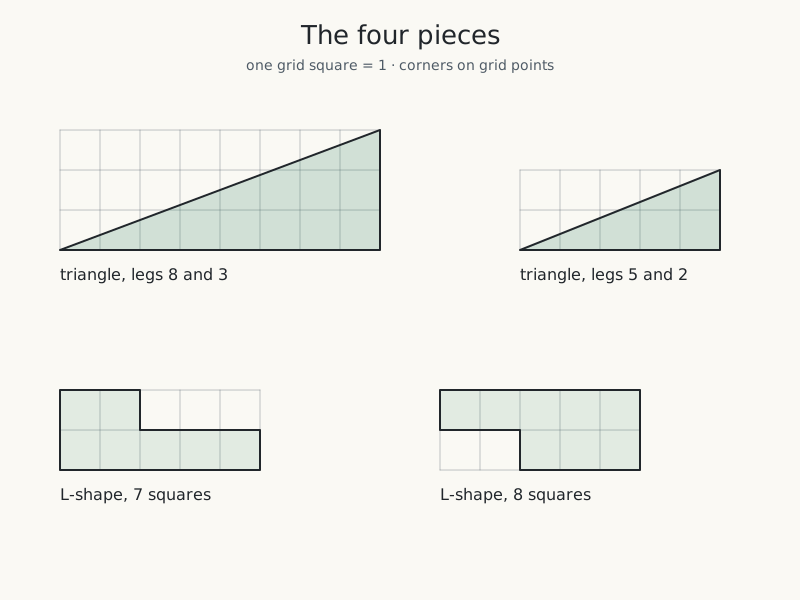
Four pieces seem to fill a triangle 13 grid squares wide and 5 tall: right triangles with legs 8 and 3 and with legs 5 and 2, and L-shapes of 7 and 8 squares. Figure 1 shows them with every corner on a grid point.
Narrow screen? Scroll the drawing sideways, or open it full size.
Full credit to copy
"The four pieces of the missing square puzzle" by Drawn Mathematics, https://drawnmathematics.com/puzzles/missing-square/, licensed under CC BY 4.0, https://creativecommons.org/licenses/by/4.0/
Now slide the same four pieces into a second layout, swapping the two triangles and moving the L-shapes without turning anything. The outline looks the same. Yet one grid square is left empty.
A dissection puzzle is one set of pieces, cut so it rebuilds more than one shape. A true one keeps the area exactly, like the triangle that becomes a square in Haberdasher's Puzzle: Four Hinged Pieces, Triangle to Square; this one only seems to. Wolfram MathWorld files tricks like it under dissection fallacies: two figures that seem to use the same pieces but differ in area.
Find where the square went before you open the solution.
Show the solution
Lay a ruler on the long edge
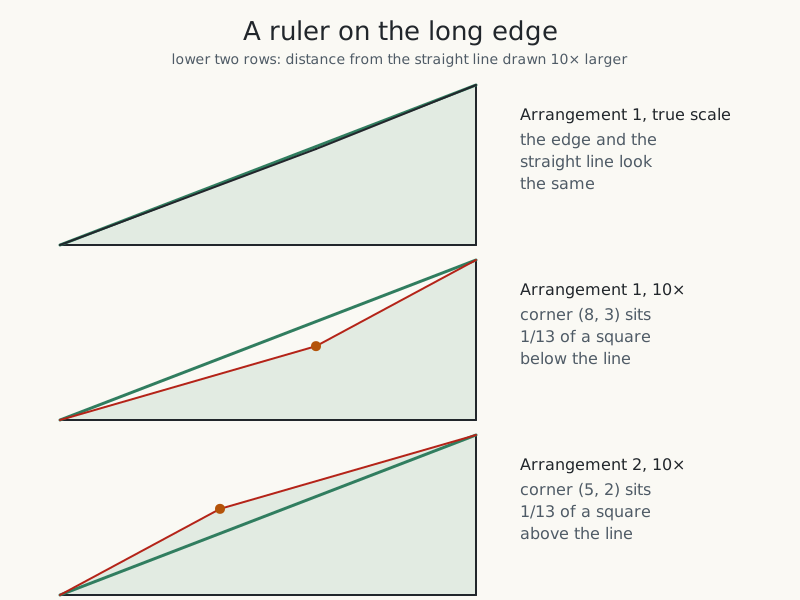
Lay a ruler from the bottom-left to the top-right corner of either figure, and the long edge does not quite follow it. In the missing square puzzle, the large triangle climbs 3 squares for every 8 across (a slope of 3/8, or 0.375), while the small triangle climbs 2 for every 5 (2/5, or 0.4). The straight line climbs 5 over 13, about 0.385, between the two.
So the edge bends where the two triangles meet: in the first layout that corner is at grid point (8, 3), 1/13 of a square below the ruler (measured straight down), and the edge sags inward. In the second layout the small triangle comes first, and its corner at (5, 2) sits 1/13 of a square above the ruler, so the edge bulges outward. Each bend turns the edge by about 1.2°.
Narrow screen? Scroll the drawing sideways, or open it full size.
Full credit to copy
"A ruler on the long edge of the missing square puzzle" by Drawn Mathematics, https://drawnmathematics.com/puzzles/missing-square/, licensed under CC BY 4.0, https://creativecommons.org/licenses/by/4.0/
Neither figure is a triangle, then. The first is a four-sided shape with a slight dent, and the second has a slight bulge.
Add up the areas
The pieces cover 12 + 5 + 7 + 8 = 32 squares in both layouts; a true triangle 13 wide and 5 tall would hold 13 × 5 ÷ 2 = 32.5. The dented first figure is half a square short of that, so the pieces fill it exactly. The bulging second figure is half a square over, so its outline holds 33 squares and the pieces leave one empty.
| Shape | Area in grid squares |
|---|---|
| Right triangle, legs 8 and 3 | 12 |
| Right triangle, legs 5 and 2 | 5 |
| L-shape of 7 squares | 7 |
| L-shape of 8 squares | 8 |
| All four pieces | 32 |
| Straight triangle, 13 by 5 | 32.5 |
| First figure, edge sagging | 32 |
| Second figure, edge bulging, empty square included | 33 |
Put the two bent edges together and they enclose a thin four-sided gap with corners at (0, 0), (8, 3), (13, 5) and (5, 2). The gap is never taller than 1/8 of a square. But it runs 13 squares long, and its area is exactly 1. That gap is the missing square, spread along the whole edge.
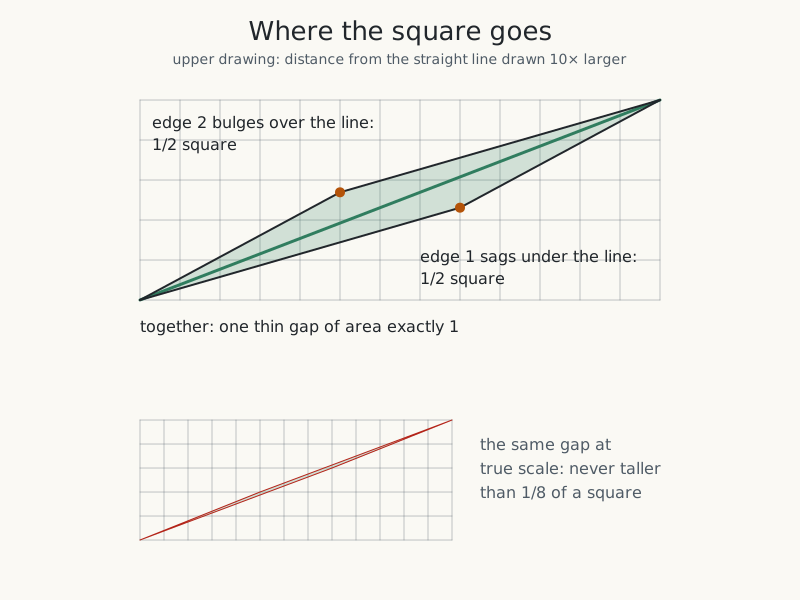
Narrow screen? Scroll the drawing sideways, or open it full size.
Full credit to copy
"Where the missing square goes: the gap between the two long edges" by Drawn Mathematics, https://drawnmathematics.com/puzzles/missing-square/, licensed under CC BY 4.0, https://creativecommons.org/licenses/by/4.0/
The lengths 2, 3, 5, 8 and 13 are consecutive Fibonacci numbers, and 8 × 2 − 3 × 5 = 1 gives the gap's area.
The check behind these numbers, in exact fractions, confirms that the pieces never overlap and leave no hole but the empty square. It also tries all 80 ways to split the 5-by-3 block into connected pieces of 7 and 8 squares; only 4 refill the 8-by-2 block with one square spare when the pieces slide without turning. All 4 are pairs of L-shapes.
The CSV file lists the corner points and exact areas of every piece, both outlines and the gap: missing-square-pieces.csv (CSV; where this file comes from: source, version and license, JSON) Source data: Computed for this page from exact grid coordinates of the four pieces
The same trick turns 64 squares into 65
Cut an 8-by-8 chessboard square into two right triangles with legs 8 and 3 and two trapezoids with parallel sides 3 and 5. Lay the four pieces out as a rectangle 5 wide and 13 long, and it seems to hold 65 squares, one more than the 64 you started with.
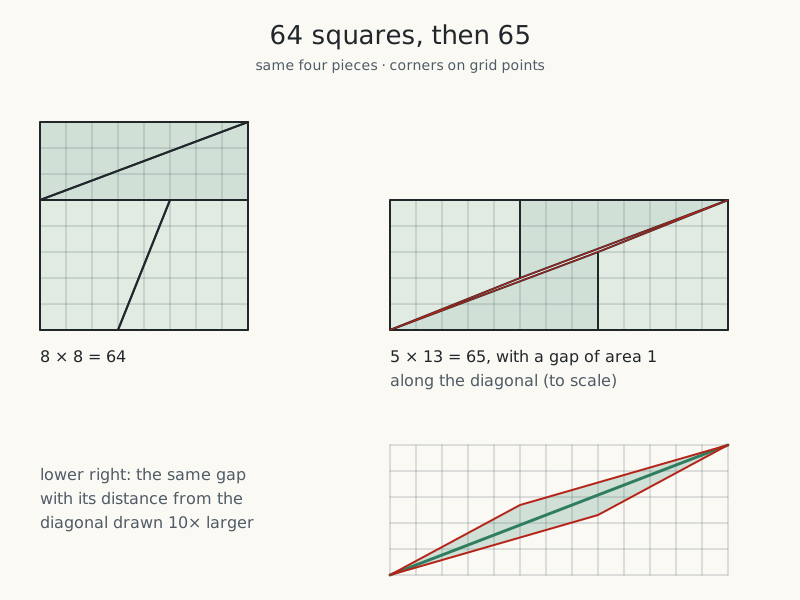
Narrow screen? Scroll the drawing sideways, or open it full size.
Full credit to copy
"64 squares, then 65: the chessboard version of the vanishing square" by Drawn Mathematics, https://drawnmathematics.com/puzzles/missing-square/, licensed under CC BY 4.0, https://creativecommons.org/licenses/by/4.0/
In the rectangle, the cut edges climb 3 over 8 and 2 over 5, the triangle puzzle's two slopes. In the chessboard version, the pieces leave the same thin gap along the diagonal, with area exactly 1. Wolfram MathWorld uses this 64-and-65 cut as an example of a dissection fallacy.
Where people get stuck
Where does the missing square go?
Into the long edge. Neither figure is a true triangle: the first edge sags at its bend and the second bulges, so the first outline holds 32 squares and the second holds 33. The extra square is a thin gap along the whole edge, never more than 1/8 of a square tall.
Why can't you see the bend?
Each edge turns by only about 1.2° where the two triangles meet, and that corner sits 1/13 of a square above or below the straight line. On graph paper with 5 mm squares, that is less than 0.4 mm. Drawn with 1 cm squares, the offset is about 0.77 mm, twice as wide.
Who invented the missing square puzzle?
No published source that we have been able to read names the inventor of this four-piece version. Wolfram MathWorld says the same name is sometimes used for the Curry triangle, a six-piece figure created by L. Vosburgh Lions to show an effect Paul Curry discovered. That entry cites a 1959 book by Martin Gardner.
Draw it yourself:
With paper and a few simple tools
- Rule a rectangle 13 squares wide and 5 tall on graph paper with 1 cm squares, or rule a 1 cm grid on A4.
- Draw the four pieces with every corner on a grid point, copying the corner points from the CSV file.
- Cut out the pieces with scissors, with an adult present if children are cutting.
- Pack the pieces inside the rectangle both ways, as in Figure 1.
- Lay a ruler from corner to corner along the long edge and look for the sliver.
Next: Tangram: Seven Pieces Make Only 13 Convex Shapes · Lay an exact line over a painting instead: Vermeer's Milkmaid: 11 Traced Edges Aim Just Above Her Hand
Sources
- [1] Weisstein, Eric W., with contributions by Margherita Barile. "Dissection Fallacy." From MathWorld--A Wolfram Resource. https://mathworld.wolfram.com/DissectionFallacy.html Read: used to check facts only; no text, figures or tables reproduced.
- [2] Weisstein, Eric W., with contributions by Margherita Barile. "Curry Triangle." From MathWorld--A Wolfram Resource. https://mathworld.wolfram.com/CurryTriangle.html Read: used to check facts only; no text, figures or tables reproduced.
- [3] Original data for this page: exact fractions for every corner point, slope and area in both layouts, the gap between the two long edges and the 8 × 8 chessboard version, and a search of all 80 ways to split the 5 × 3 block into two connected grid pieces of 7 and 8 squares (method in the text); corner points and areas are in the CSV download. https://drawnmathematics.com/puzzles/missing-square/missing-square-pieces.csv Read: this page's own computation; method in the text, data in the CSV download.
Cite this page
Drawn Mathematics. “Missing Square Puzzle: Neither Shape Is Really a Triangle.” Drawn Mathematics. Published 2026-10-26. https://drawnmathematics.com/puzzles/missing-square/ (accessed: add the date you read it).
How each drawing is checked: Checking the constructionCorrections and redrawsHow to reach us