Vermeer's Milkmaid: 11 Traced Edges Aim Just Above Her Hand
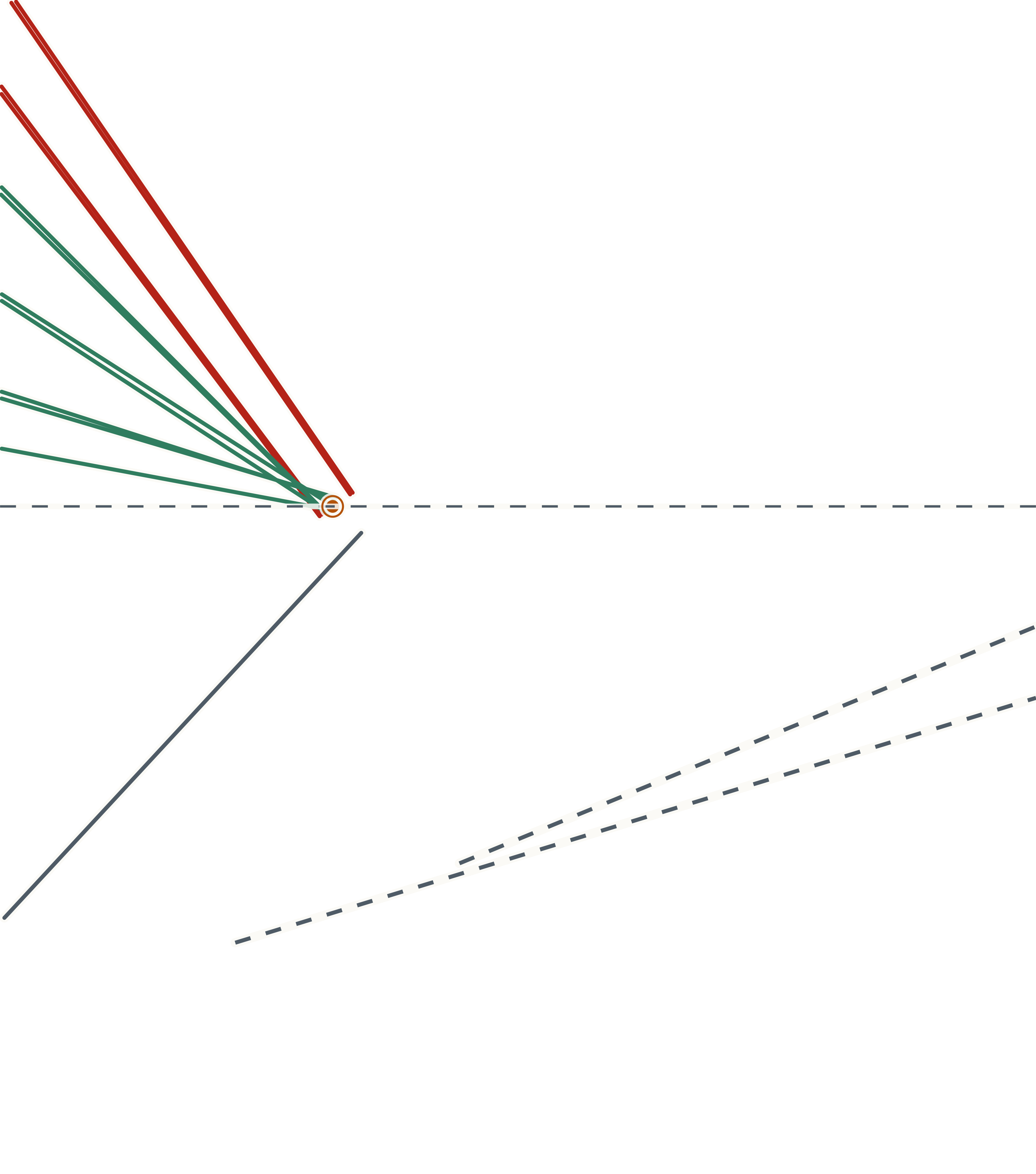
TL;DR: In this site's overlay, the window lines of Vermeer's The Milkmaid nearly meet just above her right hand. The 11 window and sill edges miss that best-fit point by up to about 2.3% of the painting's width, against a 1% tolerance set before measuring, and only the two highest glazing bars go past it.
Rule: Extend edges painted as parallel; measure where, and how tightly, they meet.
Full credit to copy
"Overlay: the window edges of The Milkmaid and their best-fit vanishing point" by Drawn Mathematics, https://drawnmathematics.com/perspective/vermeer-milkmaid/, licensed under CC BY 4.0, https://creativecommons.org/licenses/by/4.0/. The license covers the overlay only. Base image: "The Milkmaid" by Johannes Vermeer — https://commons.wikimedia.org/wiki/File:Johannes_Vermeer_-_Het_melkmeisje_-_rijksmuseum_-_001.jpg — Public domain (Johannes Vermeer d. 1675 (Library of Congress name authority, 1632–1675); PD worldwide (US: published before 1930; EU: author died more than 70 years ago); museum photograph of a two-dimensional work marked public domain by the Rijksmuseum (Public Domain Mark 1.0, SK-A-2344)); modified: cropped to the painted surface (x 245–4600, y 215–5150 of the 4814 × 5537 px file), leaving out the canvas margins, frame edge, black background and colour chart; not scaled; colours not altered, computed vanishing lines, best-fit point, 1% ring and horizon overlaid; the painting is not altered.
The painting and the question
This page runs the vanishing audit on Johannes Vermeer's The Milkmaid. The vanishing audit is this site's name for one procedure: pick edges that should be parallel in the painted room, compute where their extensions meet, then lay the lines back over the painting and measure how far each one misses.
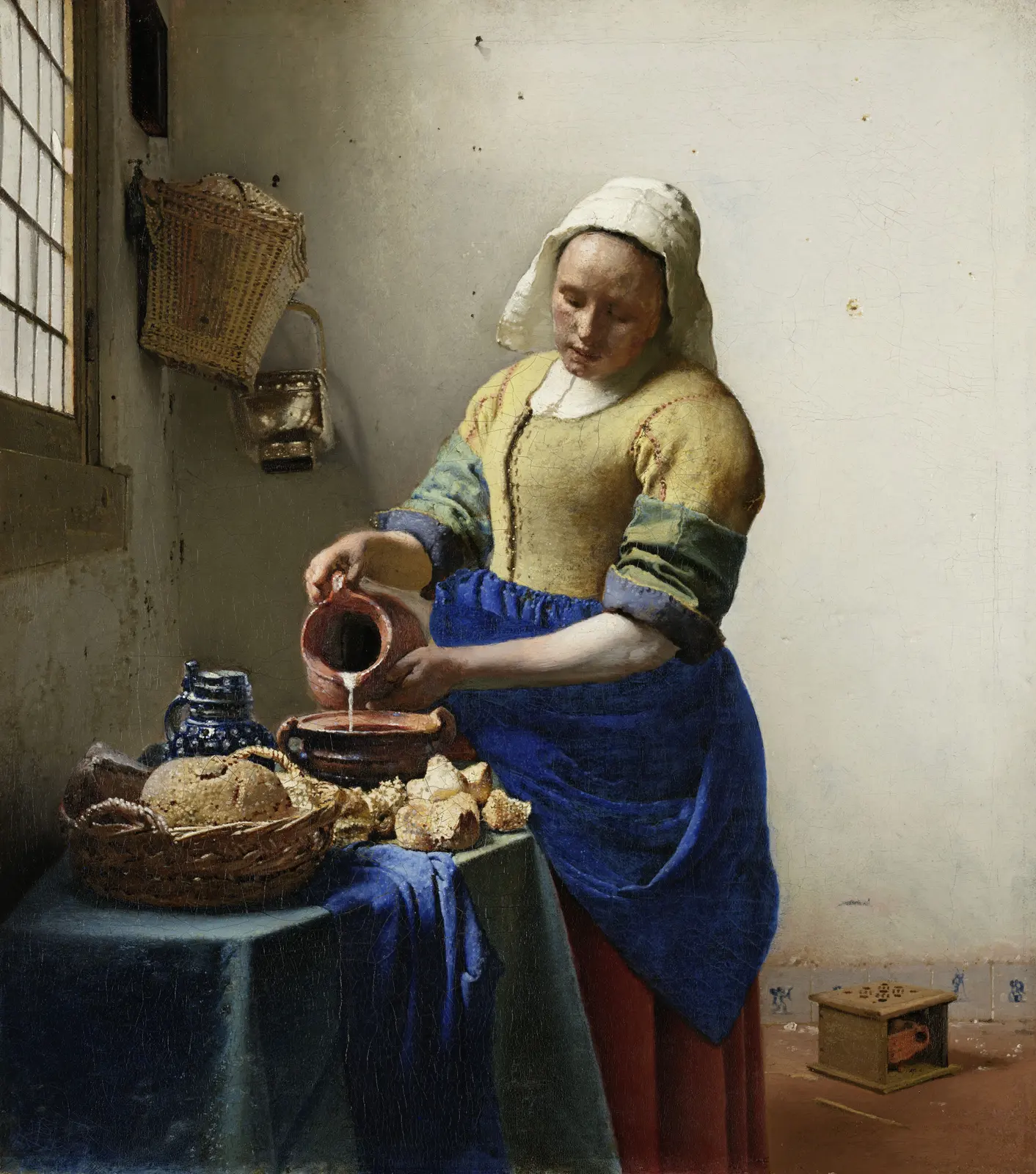
The Milkmaid is an oil painting on canvas, 45.5 cm high and 41 cm wide, that the Rijksmuseum dates to about 1660 (object SK-A-2344). A maid stands at a table by a window and pours milk from a jug into a bowl. The window on the left wall has dark glazing bars across the glass, and the wall seems to run straight back from you.
Full credit to copy
"The Milkmaid" by Johannes Vermeer — https://commons.wikimedia.org/wiki/File:Johannes_Vermeer_-_Het_melkmeisje_-_rijksmuseum_-_001.jpg — Public domain (Johannes Vermeer d. 1675 (Library of Congress name authority, 1632–1675); PD worldwide (US: published before 1930; EU: author died more than 70 years ago); museum photograph of a two-dimensional work marked public domain by the Rijksmuseum (Public Domain Mark 1.0, SK-A-2344)); modified: cropped to the painted surface (x 245–4600, y 215–5150 of the 4814 × 5537 px file), leaving out the canvas margins, frame edge, black background and colour chart; not scaled; colours not altered
The audit assumes straight-line perspective with a single vanishing point, on a flat canvas. Every level edge that runs straight back, at right angles to the picture, should then aim at that one point. It also assumes a rectangular room whose back wall faces you, with the window shut and flat in the left wall. A picture built for an eye far off to one side follows a different setup, which is the idea behind Anamorphic Art: The Smear in The Ambassadors Is a Skull.
Choosing the lines
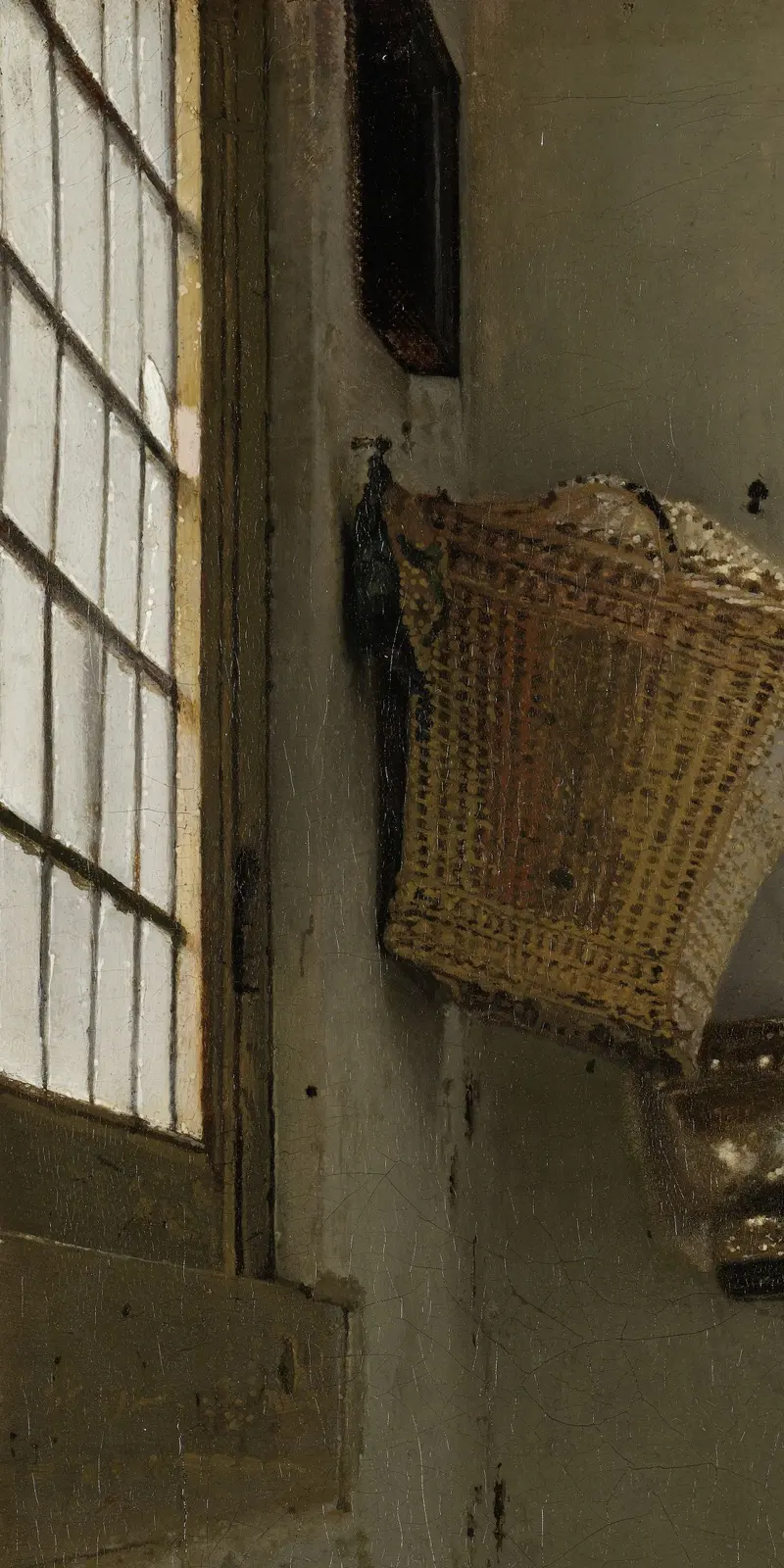
Look at the window and you can count four dark glazing bars across the glass, a lower rail where the glass ends, and a thin light line along the top of the board below it. In the room these are taken to be level parts of one wall that runs straight back, so they should be parallel to each other. Each bar and the rail is a band with two long edges. Both edges went in as separate lines, for 11 edges in all.
Full credit to copy
"The Milkmaid (window)" by Johannes Vermeer — https://commons.wikimedia.org/wiki/File:Johannes_Vermeer_-_Het_melkmeisje_-_rijksmuseum_-_001.jpg — Public domain (Johannes Vermeer d. 1675 (Library of Congress name authority, 1632–1675); PD worldwide (US: published before 1930; EU: author died more than 70 years ago); museum photograph of a two-dimensional work marked public domain by the Rijksmuseum (Public Domain Mark 1.0, SK-A-2344)); modified: cropped to the window and the wall beside it (x 245–1445, y 215–2615 of the 4814 × 5537 px file); not scaled; colours not altered
Some edges were left out on purpose. A wicker basket and a metal pot hang on the wall, so their edges need not be level. The lower edge of the board under the window was on the list, but no clear edge could be found there. A short stretch of the board's top edge, right of the window frame, was under the 150-pixel minimum.
The rules were written down before any line was measured. An edge had to be straight, at least 150 pixels long and visible at both ends. The tolerance was 1% of the image width: 43.55 pixels on the Rijksmuseum's photograph, cropped to the painted surface at 4,355 × 4,935 pixels. The area that would count as above her right hand was also fixed in advance.
The table's edges form a separate group. They were tested against the room's point afterward but did not help place it. The site's general rules for painting overlays are on the checking page.
Where the window lines meet
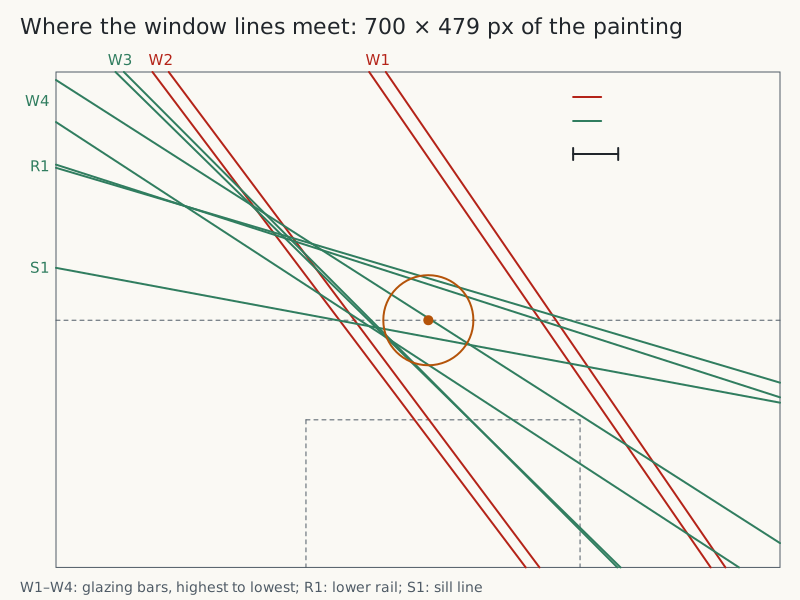
The fitted point is the one with the smallest sum of squared distances to all 11 lines. It lies at x 1,398, y 2,129 pixels. That is 96 pixels above the top of her right hand, inside the area fixed before measuring. On the canvas, the point is roughly 13 cm from the left edge and 26 cm up from the bottom.
Narrow screen? Scroll the drawing sideways, or open it full size.
Full credit to copy
"Where the window lines of The Milkmaid meet" by Drawn Mathematics, https://drawnmathematics.com/perspective/vermeer-milkmaid/, licensed under CC BY 4.0, https://creativecommons.org/licenses/by/4.0/
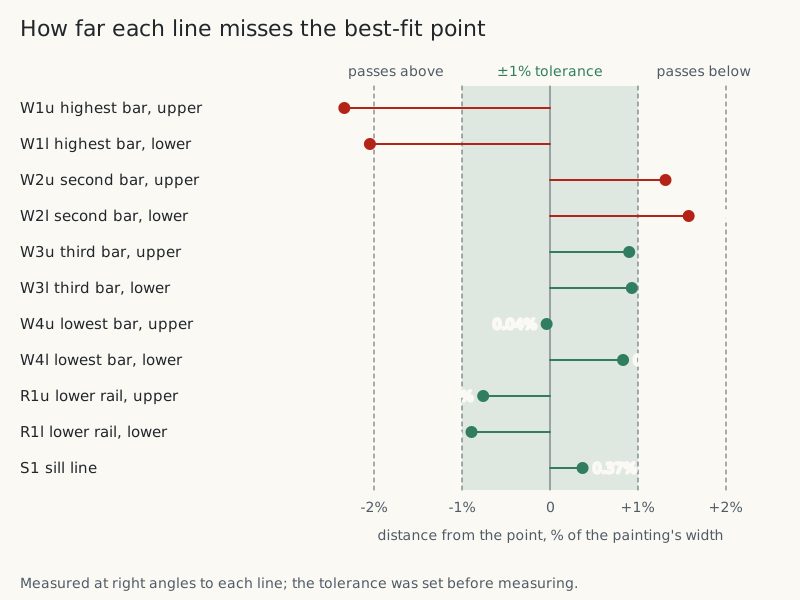
Seven of the 11 lines pass within the 1% tolerance. The other four, both edges of the highest bar and both edges of the second bar, miss by 1.31% to 2.34% of the width. The largest miss is 101.8 pixels, and the typical miss (root mean square) is 55.3 pixels, or 1.27%. For every line to pass, the tolerance would have to be 2.34%.
| Edge | Line | Passes the point | Miss (px) | Miss (% of width) | Within 1%? |
|---|---|---|---|---|---|
| Highest bar, upper edge | W1u | above | 101.8 | 2.34 | no |
| Highest bar, lower edge | W1l | above | 89.1 | 2.05 | no |
| Second bar, upper edge | W2u | below | 57.2 | 1.31 | no |
| Second bar, lower edge | W2l | below | 68.6 | 1.58 | no |
| Third bar, upper edge | W3u | below | 39.2 | 0.90 | yes |
| Third bar, lower edge | W3l | below | 40.5 | 0.93 | yes |
| Lowest bar, upper edge | W4u | above | 1.7 | 0.04 | yes |
| Lowest bar, lower edge | W4l | below | 36.1 | 0.83 | yes |
| Lower rail, upper edge | R1u | above | 33.1 | 0.76 | yes |
| Lower rail, lower edge | R1l | above | 38.8 | 0.89 | yes |
| Sill line | S1 | below | 16.1 | 0.37 | yes |
A level line through the point is the picture's horizon: the height of the viewer's eye in the painted room. It crosses the canvas at about 57% of its height, measured from the bottom. Her right hand sits just below it and the tabletop lies well below it, so you look down onto the bread and into the bowl.
How firm is the point?
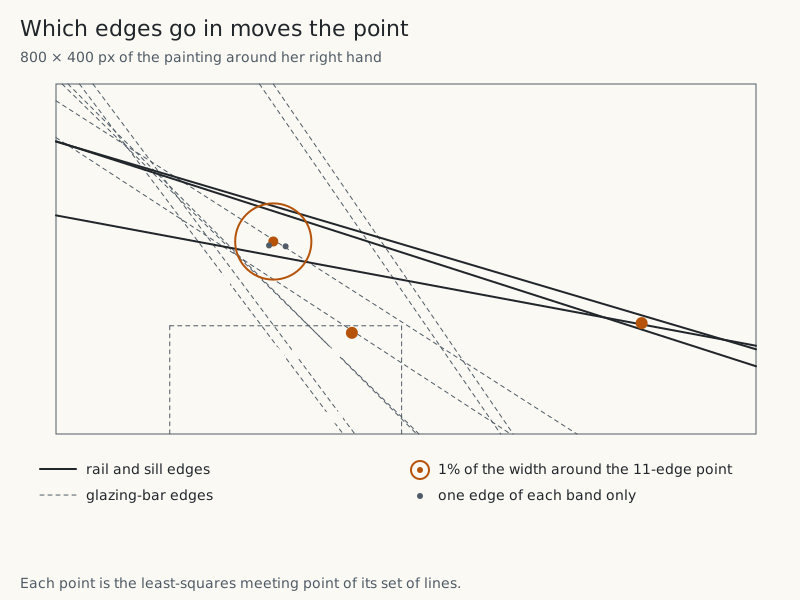
The overall miss does not hang on one reading. We reran the fit 4,000 times with every end point nudged at random by about a pixel: no run put all 11 lines within 1%, and the largest miss stayed between about 2.1% and 2.7% in 95% of the runs. The count of seven is less firm, since three of those lines pass within 0.11 percentage points of the limit: in the reruns, six lines stayed inside more often than seven. Using only one edge of each band moves the point by 7 to 15 pixels and leaves the result the same.
Which edges go in matters more. Fitted on their own, the eight bar edges put the point about 140 pixels lower and to the right. The three rail and sill edges pass within 9 pixels of a point of their own, but that point lies about 430 pixels (10% of the width) to the right of the 11-line point. Every line, its end points, the fitted point and each distance are in vermeer-milkmaid-audit-lines.csv (CSV; where this file comes from: source, version and license, JSON) Source data: Measured for this page on the Rijksmuseum's public-domain photograph of The Milkmaid (SK-A-2344), cropped to the painted surface, 4355 × 4935 px, with the table edges and the control edges.
Narrow screen? Scroll the drawing sideways, or open it full size.
Full credit to copy
"Where different sets of window edges in The Milkmaid meet" by Drawn Mathematics, https://drawnmathematics.com/perspective/vermeer-milkmaid/, licensed under CC BY 4.0, https://creativecommons.org/licenses/by/4.0/
The two highest bars
The misses have a pattern. The highest bar aims above the point: on a vertical line through the point, its two edges pass 157 and 180 pixels too high. The second bar aims below, 95 and 114 pixels too low. The two lower bars, the rail and the sill line all agree within the tolerance.
Narrow screen? Scroll the drawing sideways, or open it full size.
Full credit to copy
"How far each window line of The Milkmaid misses the best-fit point" by Drawn Mathematics, https://drawnmathematics.com/perspective/vermeer-milkmaid/, licensed under CC BY 4.0, https://creativecommons.org/licenses/by/4.0/
Something other than the painter could bend these lines. Start with the camera: two long painted vertical edges at the window, 1,500 and 1,800 pixels long, bow by less than 1 pixel, far less than the largest misses of about 100 pixels. That check was added after the fit, instead of a test on the colour chart in the museum's image, which this site judges to be a digital addition: its edges are straight to hundredths of a pixel and it has no grain. The photograph is barely turned: the top edge of the row of wall tiles lies 0.1° off level.
Next comes the canvas. Essential Vermeer, a reference site on the painter, cites the 1995 exhibition catalogue Johannes Vermeer (National Gallery of Art, Washington, and the Mauritshuis, The Hague, edited by Arthur K. Wheelock Jr.) for its technical notes. By those notes, the canvas was relined with wax and resin in 1950. The overlay has no way to measure what that did, and the Rijksmuseum's online record gives no treatment history.
Why the top two bars stray is a separate question. That Vermeer set the upper bars by eye, rather than aiming them at the same point as the lower ones, is this site's interpretive hypothesis. A window not quite flat in its wall, or a canvas that has shifted near its top edge, could also push these lines apart, and no source read for this page settles which.
Does the table follow the room?
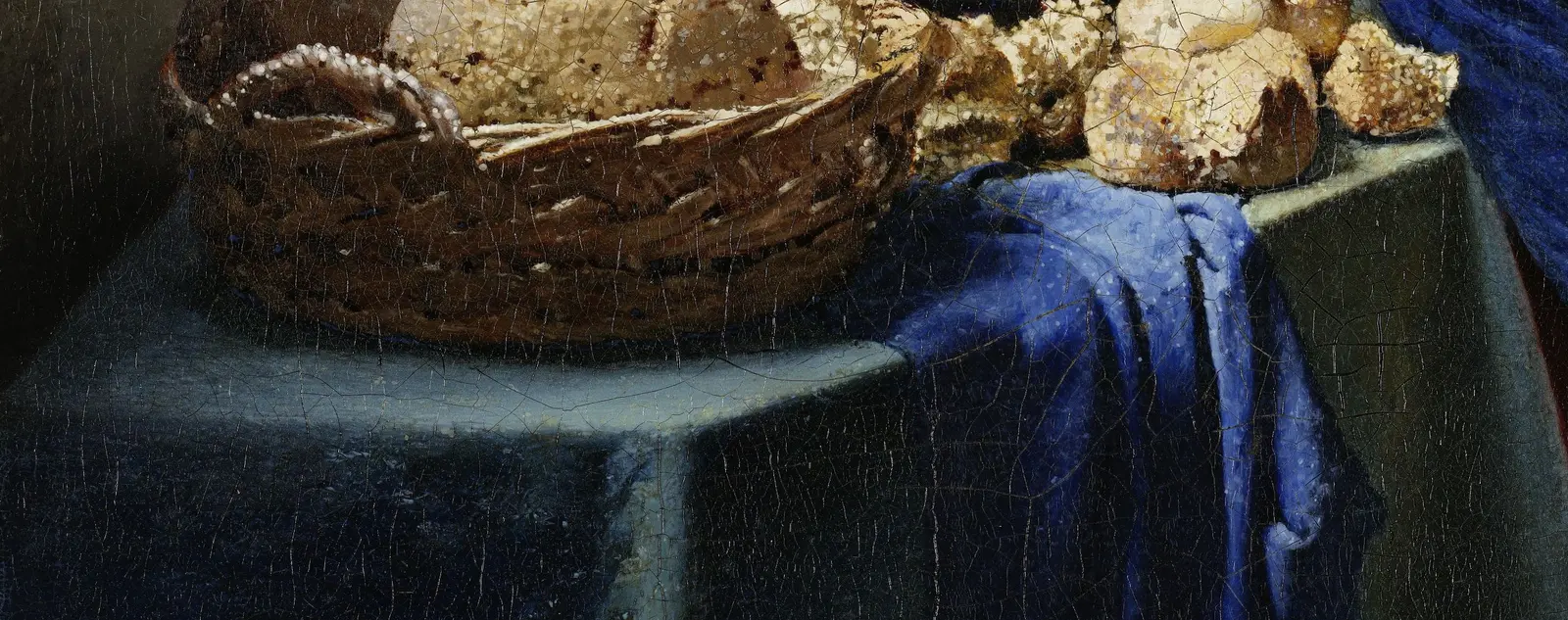
Only one table edge was found that looks as if it runs straight back: the left end of the tabletop, where the cloth meets the dark background. Extended, it passes 164 pixels (3.8% of the width) from the window lines' point, far outside the tolerance. It is a soft edge, about 16 pixels wide, but nudging its end points at random by about 3 pixels still leaves it 115 to 211 pixels away in 95% of 4,000 runs.
Full credit to copy
"The Milkmaid (table)" by Johannes Vermeer — https://commons.wikimedia.org/wiki/File:Johannes_Vermeer_-_Het_melkmeisje_-_rijksmuseum_-_001.jpg — Public domain (Johannes Vermeer d. 1675 (Library of Congress name authority, 1632–1675); PD worldwide (US: published before 1930; EU: author died more than 70 years ago); museum photograph of a two-dimensional work marked public domain by the Rijksmuseum (Public Domain Mark 1.0, SK-A-2344)); modified: cropped to the table (x 245–2645, y 3500–4450 of the 4814 × 5537 px file); not scaled; colours not altered
The tabletop's right-hand edge, which rises toward the right, does not settle it. Its two visible pieces, on either side of the blue cloth, slant at 17.0° and 22.3° from level, so they are not parts of one straight line. Extended, both reach the horizon well beyond the right side of the picture. The front edge is not quite level either: its two soft borders tilt by 0.6° and 2.1°.
All of this rests on one soft edge and one broken edge, measured for this page. That the table is turned at an angle to the room, or is not a plain rectangle, is this site's interpretive hypothesis. The painting alone cannot tell a turned table from edges placed by eye.
What the overlay cannot show
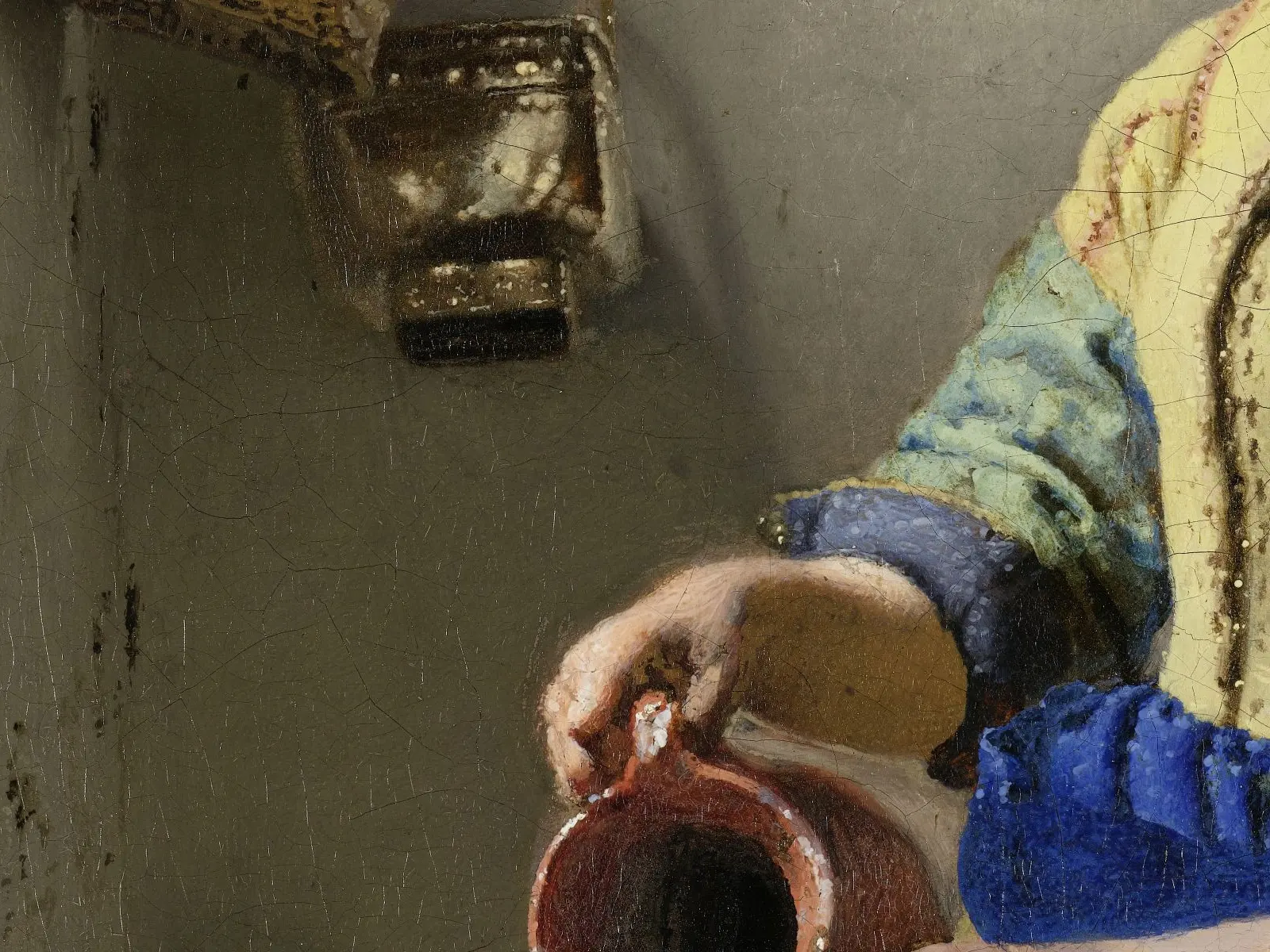
Essential Vermeer's technical notes, sourced to the 1995 catalogue, make one more claim. By that account, a pinhole can be seen in the paint above the maid's right hand, and Vermeer used it to mark the vanishing point. This page has not read the catalogue or seen the painting's surface, so the claim is reported here only as those notes give it.
The overlay cannot test that account. It measures painted edges, not holes in a canvas, and it says nothing about how the lines were laid out. Its fitted point also falls above the right hand, but a point that the top two bars miss by up to 2.3% of the width, and that moves with the choice of edges, is a best fit, not a mark in the paint.
Full credit to copy
"The Milkmaid (right hand)" by Johannes Vermeer — https://commons.wikimedia.org/wiki/File:Johannes_Vermeer_-_Het_melkmeisje_-_rijksmuseum_-_001.jpg — Public domain (Johannes Vermeer d. 1675 (Library of Congress name authority, 1632–1675); PD worldwide (US: published before 1930; EU: author died more than 70 years ago); museum photograph of a two-dimensional work marked public domain by the Rijksmuseum (Public Domain Mark 1.0, SK-A-2344)); modified: cropped to the right hand and the wall above it (x 843–2443, y 1744–2944 of the 4814 × 5537 px file); not scaled; colours not altered
Draw it yourself:
With paper and a few simple tools
- Print or trace a public-domain painting with a window or floor tiles; the image of The Milkmaid on this page is public domain.
- Rule along two edges that should be parallel in the room, and extend them until they cross.
- Extend a third such edge and measure how far it passes from that crossing, at right angles to it.
- Divide that distance by the width of the picture; this page counted anything under 1% as a hit.
- Rule a level line through the crossing: it marks the eye height the picture assumes.
Next: Build the same rule from a blank sheet: One-Point Perspective: Lines Straight Back Meet at One Dot · An exact straight line exposes a famous puzzle too: Missing Square Puzzle: Neither Shape Is Really a Triangle
Sources
- [1] Rijksmuseum, Het melkmeisje (The Milkmaid), Johannes Vermeer, object number SK-A-2344, collection record. https://id.rijksmuseum.nl/200108369 Read: collection record (key facts).
- [2] Original data for this page: the window and sill edges, the table edges and the control edges measured on the Rijksmuseum's photograph of The Milkmaid, with their best-fit point and the checks made after the fit (CSV download). https://drawnmathematics.com/perspective/vermeer-milkmaid/vermeer-milkmaid-audit-lines.csv Read: this page's own computation; method in the text, measured lines in the CSV download.
- [3] Jonathan Janson, Essential Vermeer, catalogue entry "The Milkmaid", technical report (citing the exhibition catalogue Johannes Vermeer, National Gallery of Art, Washington, and Mauritshuis, The Hague, 1995, edited by Arthur K. Wheelock Jr.). https://www.essentialvermeer.com/catalogue/milkmaid.html Read: technical report section read in full; paraphrased. The 1995 catalogue it cites was not read.
Cite this page
Drawn Mathematics. “Vermeer's Milkmaid: 11 Traced Edges Aim Just Above Her Hand.” Drawn Mathematics. Published 2026-10-26. https://drawnmathematics.com/perspective/vermeer-milkmaid/ (accessed: add the date you read it).
How each drawing is checked: Checking the constructionCorrections and redrawsHow to reach us