Anamorphic Art: The Smear in The Ambassadors Is a Skull
TL;DR: The grey smear across the bottom of Holbein's The Ambassadors (1533) is a skull stretched along one slanting line. Seen from the side, nearly edge-on, that line shrinks and the skull comes back; by this page's estimate the stretch is 4.3 to 6.7 times, depending on the eye socket's true shape.
Rule: Stretch a picture along one direction; a nearly edge-on view squeezes it back.
Full credit to copy
"Vanishing audit overlay on the floor of The Ambassadors" by Drawn Mathematics, https://drawnmathematics.com/perspective/anamorphic-art/, licensed under CC BY 4.0, https://creativecommons.org/licenses/by/4.0/. The license covers the overlay only. Base image: "The Ambassadors (Jean de Dinteville and Georges de Selve)" by Hans Holbein the Younger — https://commons.wikimedia.org/wiki/File:Hans_Holbein_the_Younger_-_The_Ambassadors_-_Google_Art_Project.jpg — Public domain (Hans Holbein the Younger d. 1543 (Library of Congress name authority: 1497?–1543); painted 1533; PD worldwide (US: published before 1930; EU and UK: author died more than 70 years ago); the photograph is a faithful reproduction of a flat work, marked PD-Art on Wikimedia Commons); modified: reduced from 30000 × 29560 to 6000 × 5912 pixels by averaging 5 × 5 blocks; not cropped; colours not altered, computed lines overlaid; the painting is not altered.
A skull in plain sight
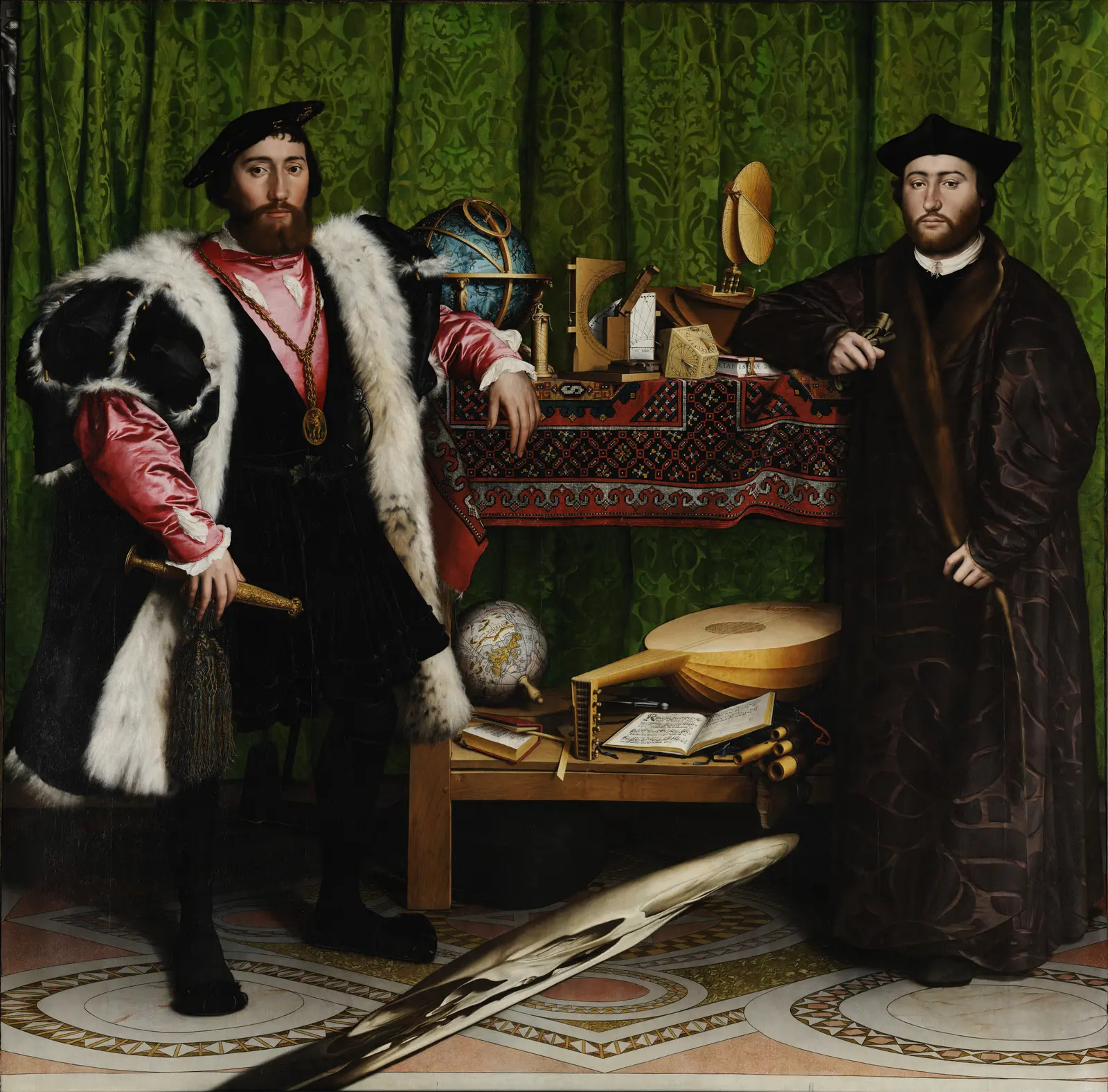
Hans Holbein the Younger painted The Ambassadors in 1533. It shows two French envoys, Jean de Dinteville and Georges de Selve, standing beside a two-tier shelf of globes, instruments, books and a lute. The panel is oak, 207 × 209.5 cm. It hangs in the National Gallery, London (NG1314), which bought it in 1890.
Across the mosaic floor between the men lies a long, pale, slanting shape, which the National Gallery describes as a skull, a memento mori: a sign that everyone dies. Anamorphic art, or anamorphosis, is a picture stretched on purpose so that it looks right only from one unusual viewpoint. The Gallery uses that word for this shape.
Full credit to copy
"The Ambassadors (Jean de Dinteville and Georges de Selve)" by Hans Holbein the Younger — https://commons.wikimedia.org/wiki/File:Hans_Holbein_the_Younger_-_The_Ambassadors_-_Google_Art_Project.jpg — Public domain (Hans Holbein the Younger d. 1543 (Library of Congress name authority: 1497?–1543); painted 1533; PD worldwide (US: published before 1930; EU and UK: author died more than 70 years ago); the photograph is a faithful reproduction of a flat work, marked PD-Art on Wikimedia Commons); modified: reduced from 30000 × 29560 to 6000 × 5912 pixels by averaging 5 × 5 blocks; not cropped; colours not altered
Measured along an outline traced at 26 points, the pale part of the shape is about 96 cm long and 12.8 cm across, about 7.5 times longer than it is wide. Its long axis rises to the right at about 26° above level. The plan fixed before measuring used the pale pixels themselves, but the skull's paint is too close in colour to the white floor bands to pick out, so the traced outline took their place.
Mary Hervey, who published a study of the painting in 1900, called it a skull "distorted by reflection in a curved mirror". This page tests a plainer idea: that the shape is a skull stretched in one straight direction.
Unstretch the skull
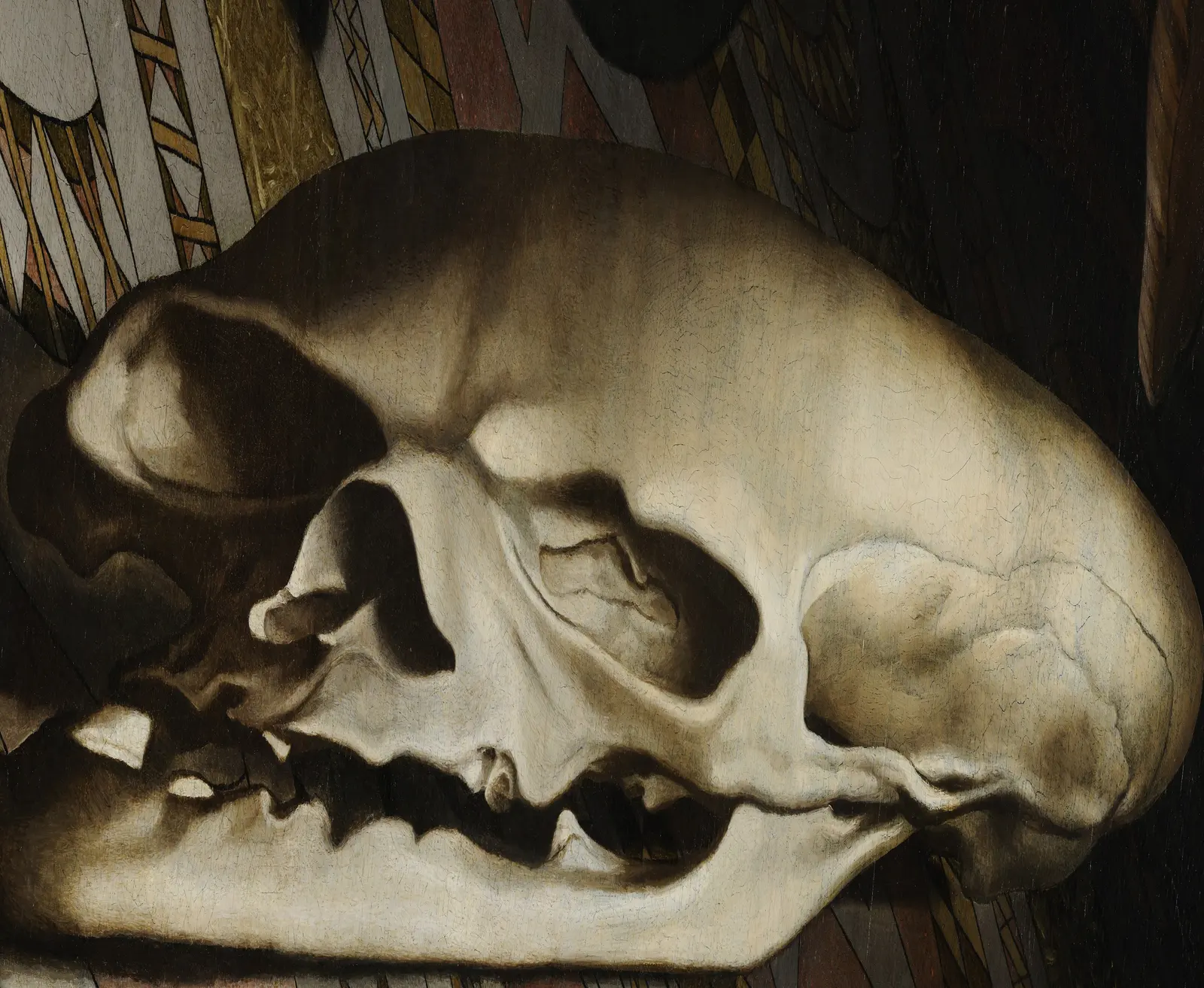
Turn the picture so the 26° axis is level, then squeeze it along that axis. If a one-direction stretch is all that happened, one squeeze factor should bring back a skull with nothing else changed.
Full credit to copy
"The skull from The Ambassadors, squeezed back along its axis" by Hans Holbein the Younger — https://commons.wikimedia.org/wiki/File:Hans_Holbein_the_Younger_-_The_Ambassadors_-_Google_Art_Project.jpg — Public domain (Hans Holbein the Younger d. 1543 (Library of Congress name authority: 1497?–1543); painted 1533; PD worldwide (US: published before 1930; EU and UK: author died more than 70 years ago); the photograph is a faithful reproduction of a flat work, marked PD-Art on Wikimedia Commons); modified: cropped to the skull, turned 26.2° so its long axis is level, and squeezed to 1/5.3 of its length along that axis; colours not altered
The painting gives no ruler for the skull, so the squeeze needs one assumption: the eye socket should come out about as wide as it is tall. Our program measured the dark socket on the levelled image: it is 5.34 times longer along the axis than across it, so the squeeze is 5.34. If the socket should instead be 0.8 to 1.25 times as wide as it is tall, the squeeze runs from 6.7 down to 4.3. The parameters are in anamorphic-art-skull-rectification.csv (CSV; where this file comes from: source, version and license, JSON) Source data: Computed for this page from the Wikimedia Commons photograph of The Ambassadors (public domain); panel size from the National Gallery, London (NG1314).
Part of what you see here is not Holbein's paint. Martin Wyld's 1998 restoration report in the National Gallery's Technical Bulletin explains that much of the skull's middle and lower end had been painted over in 1891, in a reconstruction the restorers judged inaccurate. For the 1990s restoration, they gave a digital image of the cleaned skull a perspective distortion and moved the viewpoint in three dimensions until the skull looked normal. That image guided a tentative rebuilding of the nose bone and the end of the lower jaw, so this squeeze partly tests their reconstruction too.
Where to stand
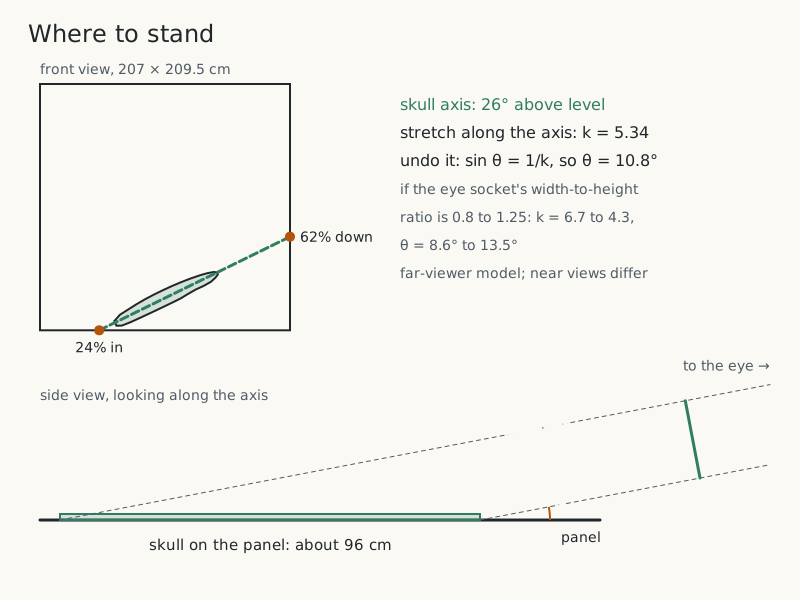
Seen from far off at an angle θ to its surface, a flat picture's lengths that run in the direction you are looking shrink by a factor of sin θ. To undo a stretch of k, you need sin θ = 1/k. For k = 5.34 that gives θ ≈ 10.8°, close to edge-on; across the range of socket assumptions, θ runs from 8.6° to 13.5°.
Narrow screen? Scroll the drawing sideways, or open it full size.
Full credit to copy
"Where to stand to see the skull in The Ambassadors" by Drawn Mathematics, https://drawnmathematics.com/perspective/anamorphic-art/, licensed under CC BY 4.0, https://creativecommons.org/licenses/by/4.0/
Look along the axis to get that squeeze. Extended, the axis leaves the panel on the bottom edge about a quarter of the way in from the left, and on the right edge about 62% of the way down. In this page's model the viewer is far away, and then either end gives the same picture. Only for a viewer close to the panel does the end matter, because the near and far parts of the skull are then squeezed by different amounts.
Read as Hervey reads them, the written directions all point to the right. A 1787 sale catalogue quoted by Hervey says the skull is "à prendre de l'angle gauche du tableau", from the picture's left corner, and Hervey's footnote reads "The spectator's right." Hervey herself wrote that it "resumes normal proportions when viewed downwards from the right-hand side of the picture." The National Gallery's description sends visitors to the bottom right corner, looking up; down or up is a near-viewer question that this page's model cannot settle.
The vanishing audit on the floor and shelf
Every painting analysis on this site runs the vanishing audit: compute where receding lines meet, then draw them back over the painting. Here it asks whether the floor agrees on one eye. For a full audit of a smaller room, see Vermeer's Milkmaid: 11 Traced Edges Aim Just Above Her Hand.
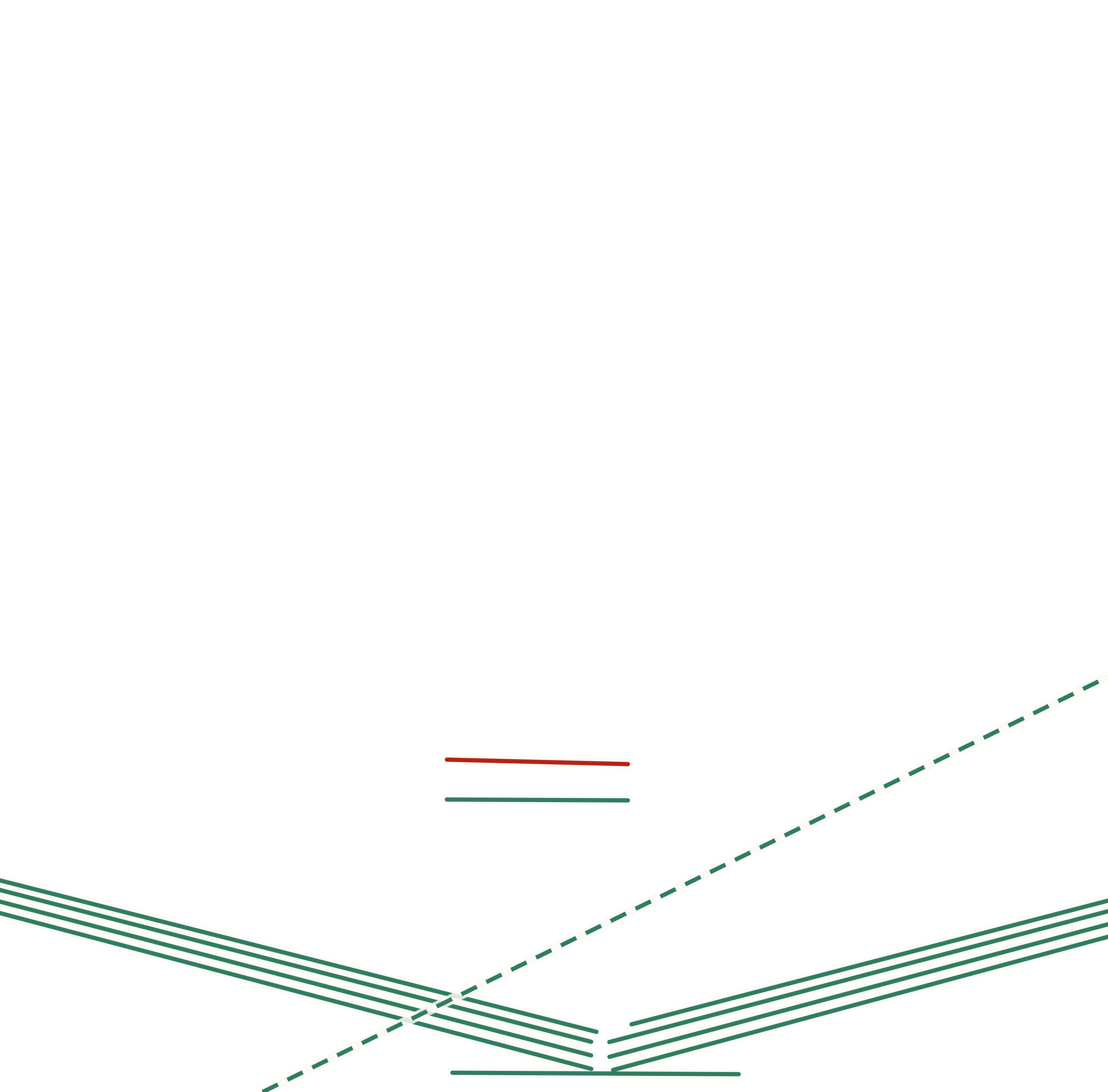
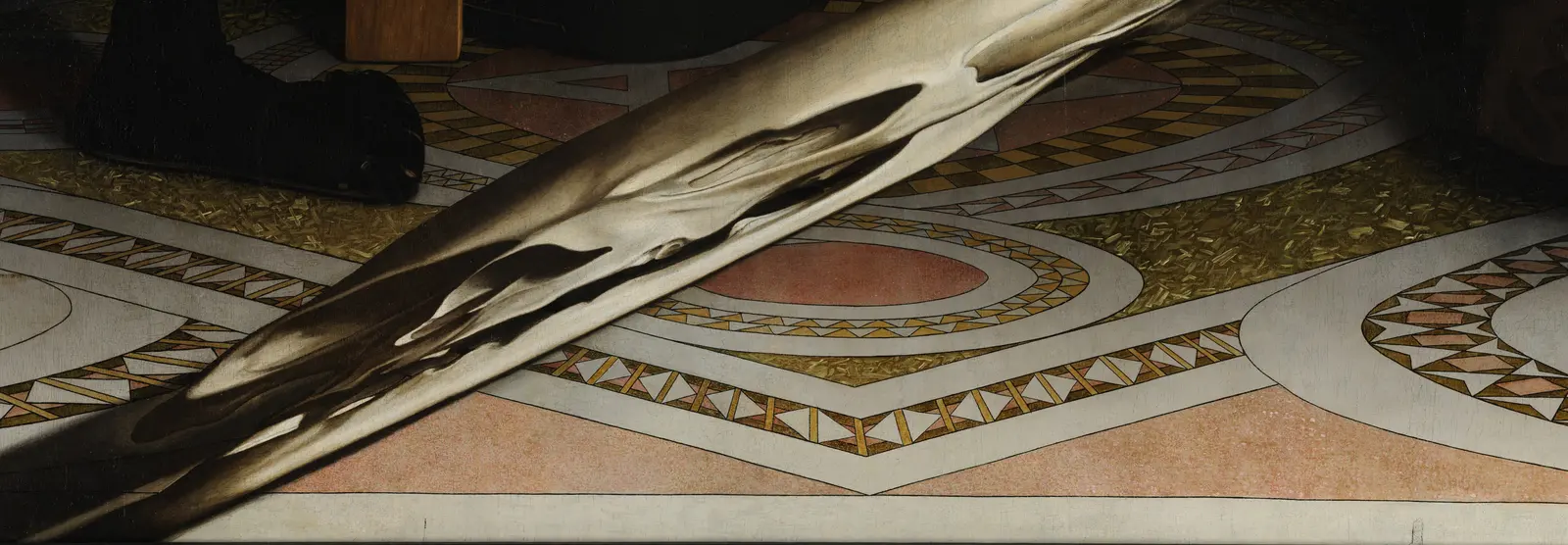
The projection assumed is single-viewpoint linear perspective on a flat panel, with a level floor. The lines chosen are the borders of the large diamond on the floor, a floor Hervey identified as a copy of the Westminster Abbey sanctuary pavement. Each lower side is a straight band with four borders, taken as parallel on the floor. Only the part of each band next to the bottom corner could be read, since farther out the skull covers part of the left band and both bands meet the circular borders around the roundels, so the longest border read spans about a seventh of the picture's width.
Full credit to copy
"The Ambassadors (Jean de Dinteville and Georges de Selve), detail of the floor" by Hans Holbein the Younger — https://commons.wikimedia.org/wiki/File:Hans_Holbein_the_Younger_-_The_Ambassadors_-_Google_Art_Project.jpg — Public domain (Hans Holbein the Younger d. 1543 (Library of Congress name authority: 1497?–1543); painted 1533; PD worldwide (US: published before 1930; EU and UK: author died more than 70 years ago); the photograph is a faithful reproduction of a flat work, marked PD-Art on Wikimedia Commons); modified: cropped to the floor around the bottom corner of the large diamond and reduced by averaging 4 × 4 blocks; colours not altered
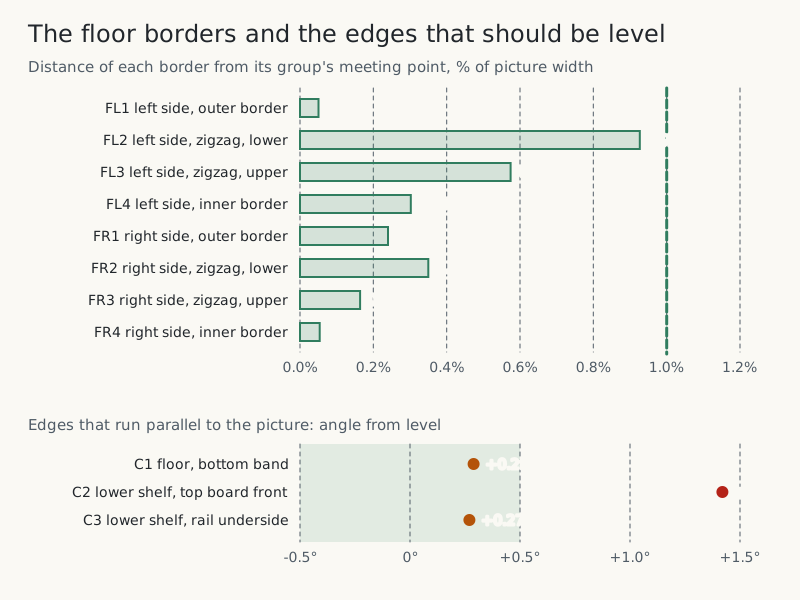
The rule and the 1% tolerance were fixed before measuring: take every straight border at least 300 pixels long with both ends clearly visible. The shadowed upper-left side failed that rule and was left out. Figure 1 shows the chosen borders extended.
Distortion could come from the photograph, from the panel and from restoration. Wyld reports that the panel's ten oak planks were planed thin and cradled in 1891, then warped and split, and that the floor is damaged on both sides of the central join, worst to its left.
What the audit finds
Narrow screen? Scroll the drawing sideways, or open it full size.
Full credit to copy
"The floor borders of The Ambassadors and the edges that should be level" by Drawn Mathematics, https://drawnmathematics.com/perspective/anamorphic-art/, licensed under CC BY 4.0, https://creativecommons.org/licenses/by/4.0/
| Group | Borders | Largest distance from the point | Where the point lies | Point's height when ends move up to 1 px (5th to 95th percentile, 4,000 tries) |
|---|---|---|---|---|
| Lower-left side | 4 | 0.93% of the width | 3.1 widths left of the frame | 2,034 px above to 2,347 px below the top edge |
| Lower-right side | 4 | 0.35% of the width | 3.4 widths right of the frame | 2,056 px above to 987 px below the top edge |
Both groups pass: on each side, the four borders could have been ruled toward one point. But the points lie far outside the frame, near the height of its top edge. In a check added after the fit, nudging every end point at random by up to 1 pixel moves a point's height by a quarter to two-fifths of the panel either way, because the borders are so short and so nearly parallel. The two heights differ by 7.8% of the width, beyond the 1% bar for a level horizon but well inside that spread, so the floor alone cannot settle one eye level.
Three edges that run parallel to the picture were checked for tilt. The floor's bottom band and the lower shelf's rail sit within 0.3° of level, so the image is not noticeably turned. The front edge of the shelf's top board drops about 24 pixels over 980, a slope of 1.42°. Reading it as a board drawn slightly turned is this site's interpretive hypothesis; Wyld's report of losses in the shelves beside the central join points to restoration as another possible source.
All readings are in anamorphic-art-audit-lines.csv (CSV; where this file comes from: source, version and license, JSON) Source data: Computed for this page from the Wikimedia Commons photograph of Hans Holbein the Younger's The Ambassadors (Google Art Project file, public domain), reduced to 6000 × 5912 pixels.
Stretch your own drawing
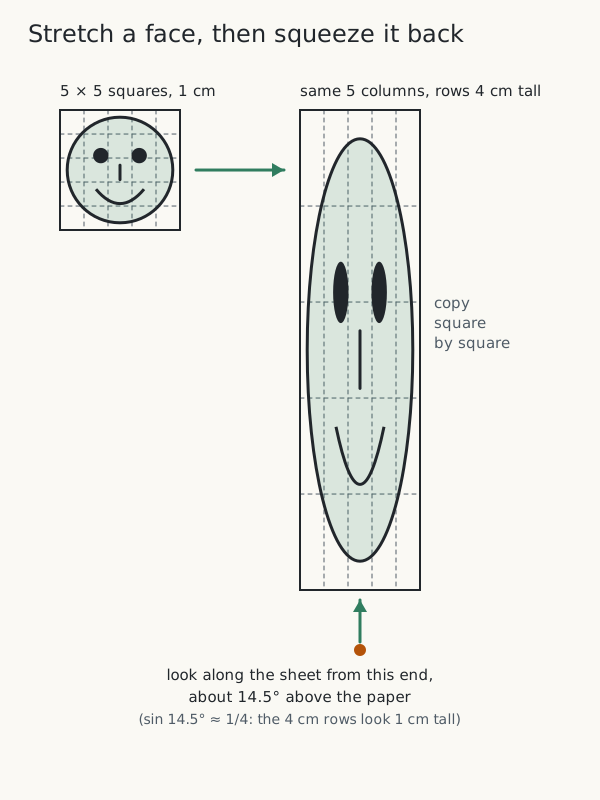
To make anamorphic art, draw in a square grid, then copy each square into a grid stretched k times in one direction. Looked at from the short end, the stretched grid squeezes back when sin θ = 1/k. With rows four times taller, θ ≈ 14.5°.
Narrow screen? Scroll the drawing sideways, or open it full size.
Full credit to copy
"Stretch a face on a grid, then squeeze it back" by Drawn Mathematics, https://drawnmathematics.com/perspective/anamorphic-art/, licensed under CC BY 4.0, https://creativecommons.org/licenses/by/4.0/
Holbein's skull follows the same rule along a slanting axis, at a stretch of about 5.3 by this page's estimate. Even rows suit a viewer far away. For an eye close to the paper, the rows must grow taller toward the far end, which is the kind of perspective distortion the restorers modelled. Pavement pictures drawn to look solid from one marked spot rely on the same idea at a larger size.
The painted floor uses the same rule in reverse. Wyld notes that the borders around the floor's circles are about three times wider at the sides than at the top and bottom. If those circles are round on a level floor, the floor is drawn at about a third of its depth, the view you get when your line of sight meets it at about 19.5° (sin 19.5° ≈ 1/3). In geometric terms, Holbein squeezed the floor for a viewer in front and stretched the skull for a viewer at the side.
Other stretched pictures
Holbein was not the only artist stretching pictures. A woodcut by Erhard Schön packs stretched portraits into horizontal bands, with small towns, riders and a ship drawn at normal size along the edges.
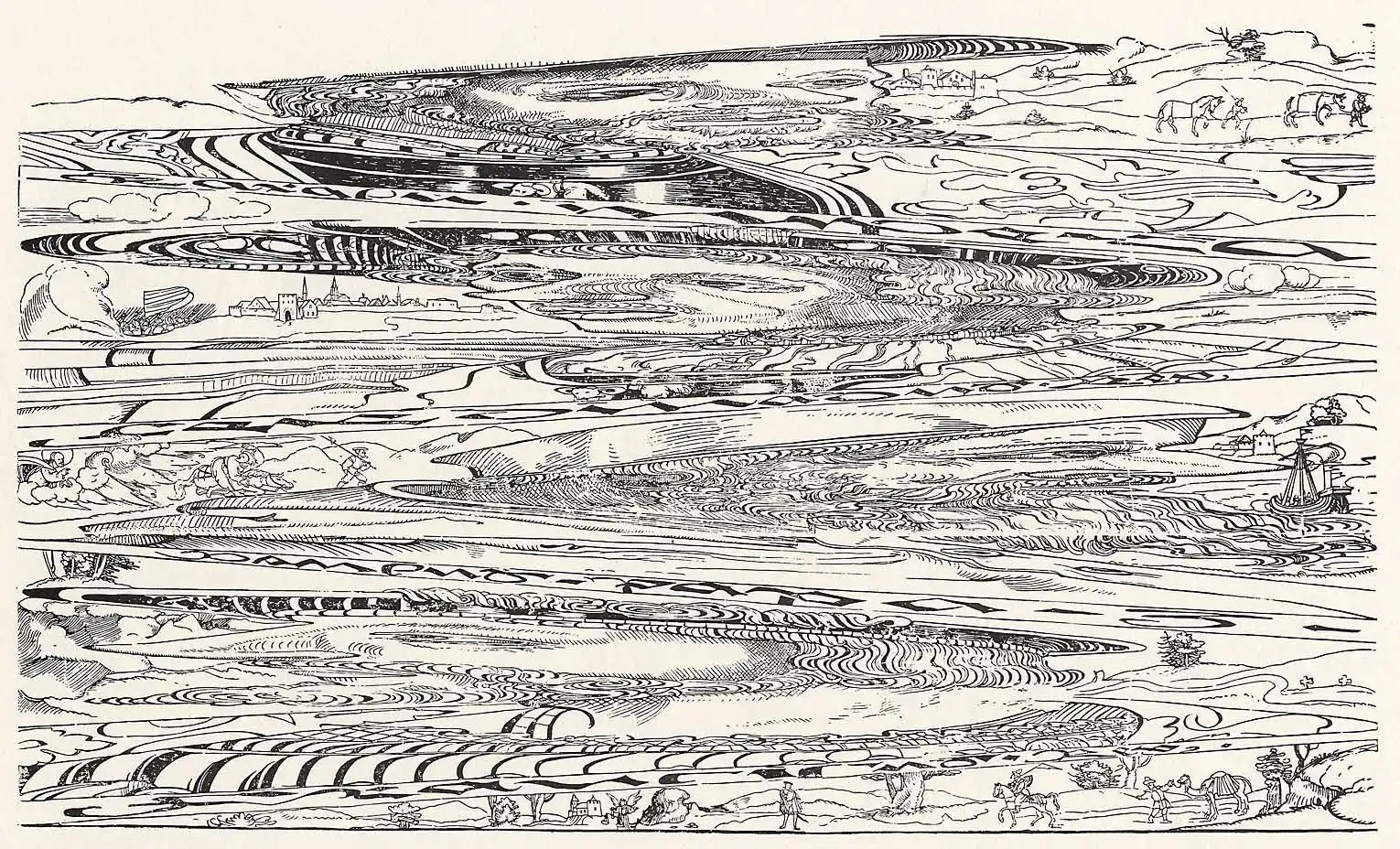
Schön's bands are stretched sideways, so you look along the sheet from its left or right edge. The National Gallery points to another stretched portrait, of Henry VIII's son Edward VI, in the National Portrait Gallery, London.
Draw it yourself:
With paper and a few simple tools
- Draw a simple face in a 5 × 5 grid of 1 cm squares.
- On another sheet, rule a grid with the same 5 columns but rows 4 cm tall; the whole grid is 5 × 20 cm and fits on A4.
- Copy the face square by square: whatever crosses a small square goes into the matching tall one.
- Lay the sheet flat, hold your eye low and well back from the short end, and look along it: the face comes back at about 14.5° above the paper.
- Rule a second grid with rows 5 cm tall and repeat; the angle drops to about 11.5°, close to this page's estimate for Holbein's skull.
Next: The perspective the floor uses, built step by step: One-Point Perspective: Lines Straight Back Meet at One Dot · Another shape the eye accepts until an exact line is laid on it: Missing Square Puzzle: Neither Shape Is Really a Triangle
Sources
- [1] National Gallery, London: collection record for NG1314, Hans Holbein the Younger, The Ambassadors (Jean de Dinteville and Georges de Selve), 1533 (key facts and the Gallery's description); and Martin Wyld, "The Restoration History of Holbein's The Ambassadors", National Gallery Technical Bulletin 19 (1998), 4–25. Both are published by the Gallery and are cited here by name, without a link; the link goes to Wikidata item Q1212937, which repeats the key facts and gives the width as 209 cm. https://www.wikidata.org/wiki/Q1212937 Read: collection record (key facts) and the Gallery's description, paraphrased; Wyld (1998), full text, paraphrased.
- [2] Mary F. S. Hervey, Holbein's "Ambassadors": The Picture and the Men; An Historical Study (London: George Bell & Sons, 1900). https://www.gutenberg.org/ebooks/77401 Read: full text; quoted and paraphrased.
- [3] Original data for this page: line readings and least-squares meeting points for the floor of The Ambassadors, and the stretch, axis and viewing angle of its skull (method in the text); both CSV files are downloadable. https://drawnmathematics.com/perspective/anamorphic-art/anamorphic-art-audit-lines.csv Read: this page's own computation; method in the text, data in the CSV downloads.
- [4] Wikimedia Commons, file page for "Erhard schön-cuatro retratos.jpg" (Erhard Schön's woodcut of stretched portraits, after zeno.org). https://commons.wikimedia.org/wiki/File:Erhard_sch%C3%B6n-cuatro_retratos.jpg Read: file description page; attribution to Erhard Schön as stated there.

Cite this page
Drawn Mathematics. “Anamorphic Art: The Smear in The Ambassadors Is a Skull.” Drawn Mathematics. Published 2026-10-26. https://drawnmathematics.com/perspective/anamorphic-art/ (accessed: add the date you read it).
How each drawing is checked: Checking the constructionCorrections and redrawsHow to reach us