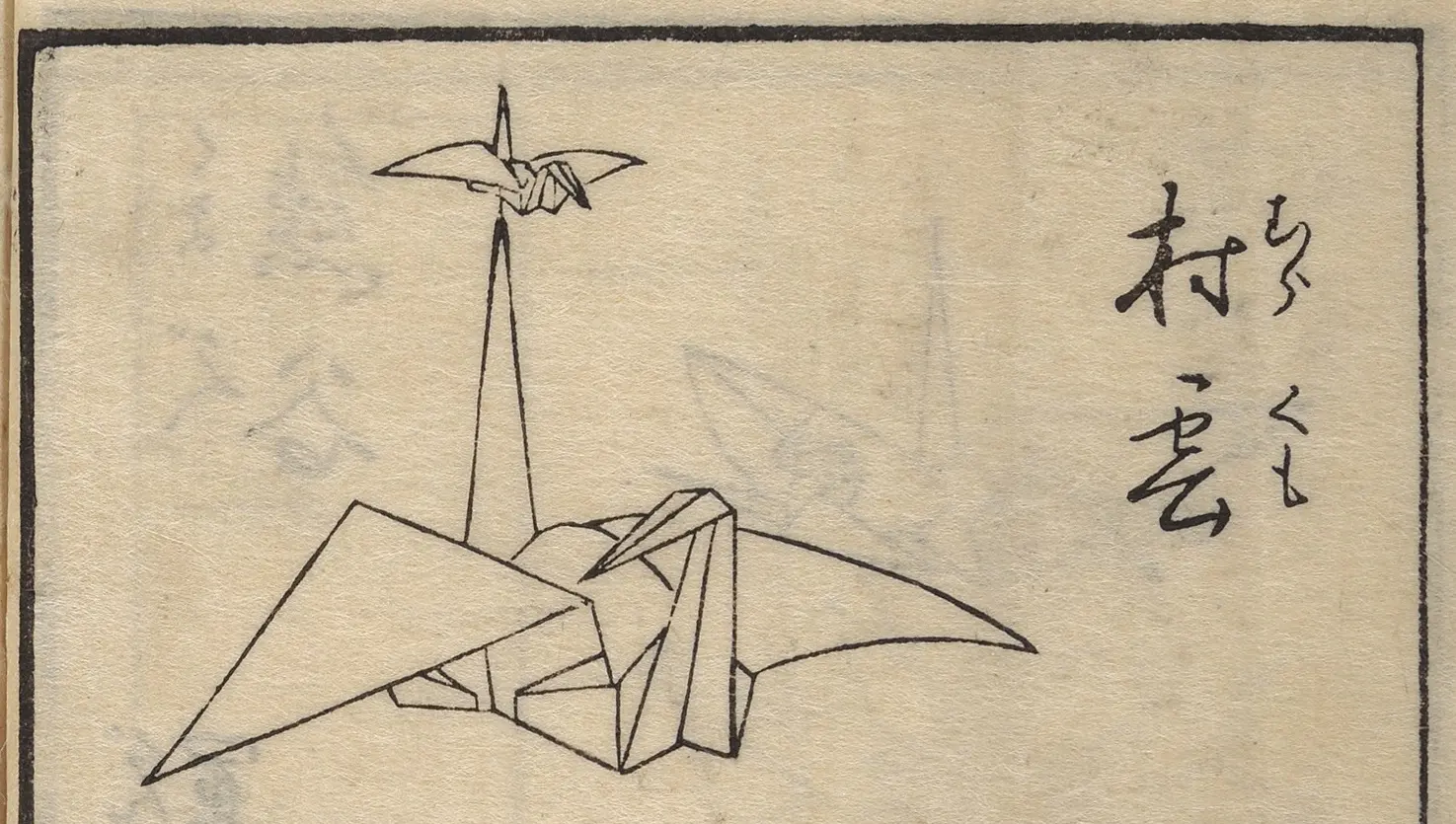
Reading origami crease patterns, the theorems of flat folding, facts you can fold from one sheet, and traditional models, with each pattern's check stated.
Read an origami crease pattern: sort its lines into mountains and valleys, then count at each inner point. If it folds flat, they differ by 2. Crane included.
Image credit
"Hiden Senbazuru Orikata" by Rokiku and Rokōan — https://commons.wikimedia.org/wiki/File:Hiden_Senbazuru_Orikata.jpg — Public domain (Book published in Kyoto with a preface dated 1797 (National Diet Library record 000007300291); everyone who made a book printed in 1797 died long before 1956; PD worldwide (US: published before 1930; Japan and EU: authors died more than 70 years ago); faithful scan of a flat printed page); modified: cropped to the upper part of the page (the poem and the cutting diagram below are left out); colours not altered, not enlarged
A4 paper is 210 × 297 mm, a √2 rectangle to within a millimetre. Fold one sheet to see the ratio, then follow the proof that only √2 survives being halved.
Image credit
Illustration: Drawn Mathematics. Generated scene illustration — not a photograph, historical image or researched reconstruction. Use terms: may be reused with credit to "Drawn Mathematics"; provided without any claim of historical accuracy.
Kawasaki's theorem: an inner point of a flat sheet folds flat only if alternate angles each total 180°. See a worked example, the ant-walk proof and the limits.
Image credit
Illustration: Drawn Mathematics. Generated scene illustration — not a photograph, historical image or researched reconstruction. Use terms: may be reused with credit to "Drawn Mathematics"; provided without any claim of historical accuracy.
May this site count your visit with Google Analytics? It sets cookies only if you allow it. Cloudflare Web Analytics, which sets no cookies, counts page views either way, and there are no ads. Details: Privacy practices.