Flat Origami: Mountains and Valleys Differ by 2 at Inner Points
TL;DR: If a crease pattern folds flat, every inner point where creases meet has mountains and valleys differing by exactly 2. To read one, sort its lines into those two kinds and count at each point: the traditional crane below passes at all 42 points, which is a local check, not proof that the whole sheet folds flat.
Rule: At every inner point of a flat fold, mountains and valleys differ by two.
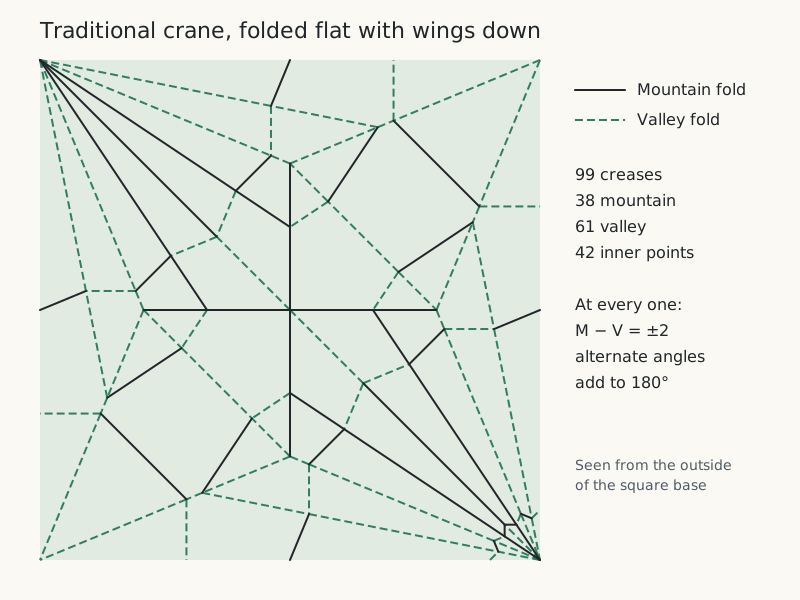
Narrow screen? Scroll the drawing sideways, or open it full size.
Full credit to copy
"Crease pattern of the traditional crane, flat-folded state" by Drawn Mathematics, https://drawnmathematics.com/crease-patterns/origami-crease-pattern/, licensed under CC BY 4.0, https://creativecommons.org/licenses/by/4.0/
Crease check: Level 1: local flat-folding conditions pass (Maekawa and Kawasaki at every interior vertex; not a proof that the sheet folds flat). How the three check levels are defined
Mountain or valley: the two line styles
A crease pattern is the map of a folded model drawn on the flat square: unfold the model, and the pattern marks every crease the finished model uses. Thomas Hull's survey of flat folding calls it a structural blueprint of the fold.
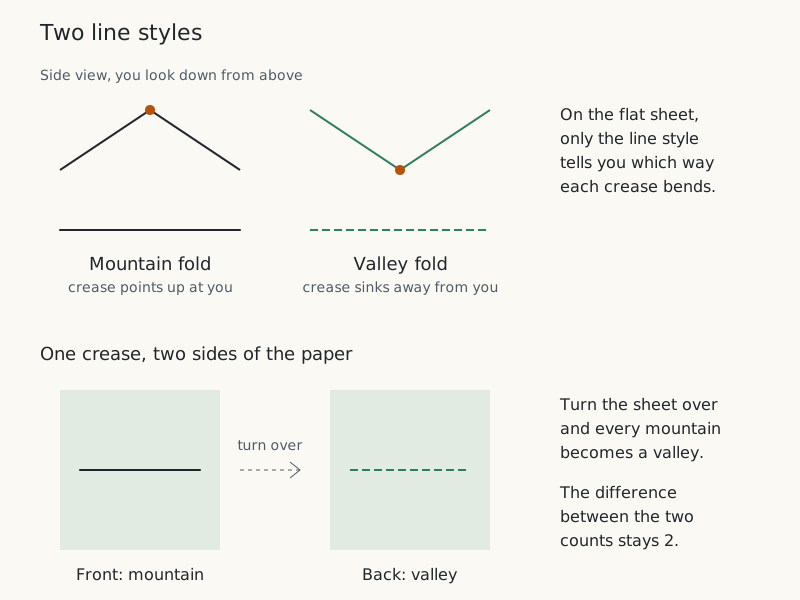
Each line is one of two kinds. A mountain fold bends the paper away from you, so the crease points up at you like a ridge; a valley fold bends it toward you, so the crease sinks like a trough.
On this site, a mountain is a solid dark line and a valley is a dashed green line. On any other pattern, find the key before you count. The kind of a crease also depends on the side you look from, as Hull points out: turn the sheet over and every mountain becomes a valley. Every crane pattern on this page is drawn from the side of the paper that faces out on the square base, the first folded shape of the crane.
Narrow screen? Scroll the drawing sideways, or open it full size.
Full credit to copy
"Mountain and valley line styles" by Drawn Mathematics, https://drawnmathematics.com/crease-patterns/origami-crease-pattern/, licensed under CC BY 4.0, https://creativecommons.org/licenses/by/4.0/
A point where creases meet inside the paper, not on its edge, is an inner point; the theorems call it an interior vertex. The smallest crease pattern has no inner point at all: fold an A4 sheet in half once and you get one straight line, and A4 Paper Size: Built So Each Half Keeps the Same Shape is about what that single fold shows.
Find the bird base inside the crane
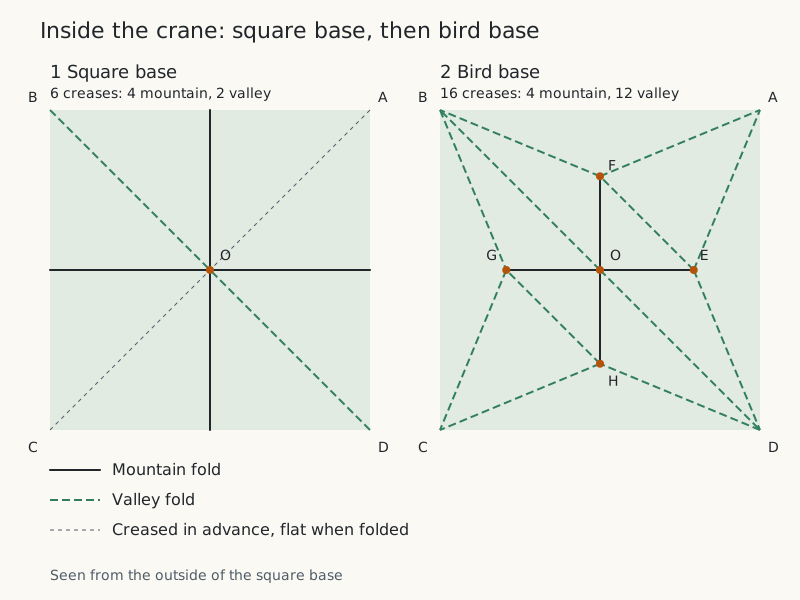
The crane starts from the square base, also called the preliminary base, whose crease pattern has six creases meeting at the centre O: the two midlines are mountains and one diagonal is a valley. The other diagonal may be creased in advance. But it lies flat in the finished base, so it does not count. Fold all four lines and the centre would have four mountains and four valleys, a difference of 0, which no flat fold allows.
Narrow screen? Scroll the drawing sideways, or open it full size.
Full credit to copy
"Square base and bird base crease patterns" by Drawn Mathematics, https://drawnmathematics.com/crease-patterns/origami-crease-pattern/, licensed under CC BY 4.0, https://creativecommons.org/licenses/by/4.0/
A petal fold on the front and another on the back turn the square base into the bird base. Each one lifts a flap on a hinge line while its sides fold in. The bird base keeps the diagonal and the inner part of each midline, adds two hinges and eight lines at 22.5°, and has 16 creases in all. The outer parts of the midlines lie flat again.
| Creases | From and to | Fold | Count |
|---|---|---|---|
| Inner part of each midline | O to E, F, G and H | mountain | 4 |
| Diagonal | B through O to D | valley | 2 |
| Petal hinges | E to F, G to H | valley | 2 |
| Lines at 22.5° to an edge | A–E, A–F, B–F, B–G, C–G, C–H, D–H, D–E | valley | 8 |
| Bird base, total | all of the above | 4 mountain, 12 valley | 16 |
Points E, F, G and H sit on the midlines, about 0.207 of a side in from the edge (half of tan 22.5°). Every bird base crease runs at a multiple of 22.5°. That angle cuts a full turn into 16 equal steps. The eight-point star in Islamic Geometric Patterns: The 8-Point Star Is Two Squares is drawn on a circle cut into eight steps of 45°, every other one of these.
Add the neck, tail and head
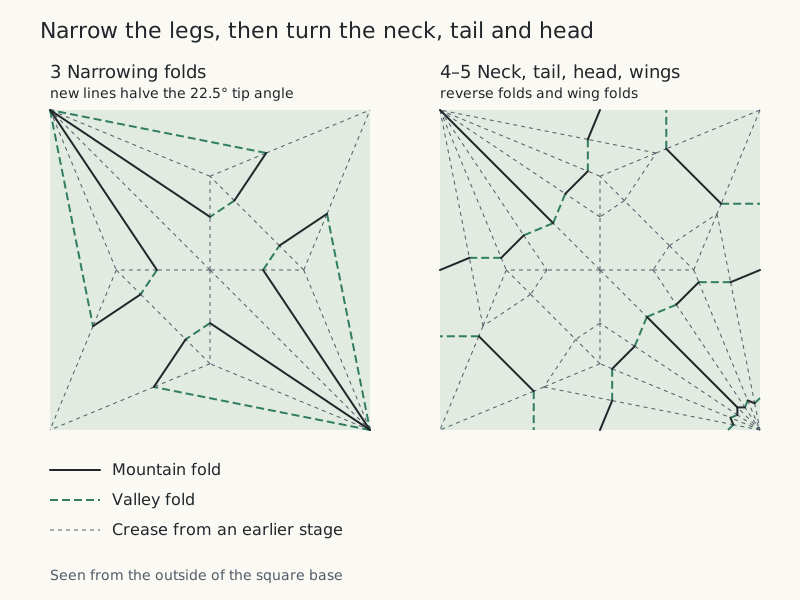
The two lower flaps of the bird base, the legs, become the neck and the tail. First, four narrowing folds lay each leg's edge onto its centre line, front and back. Each one halves the 22.5° angle at the tip of a leg, so the finished crane also has lines at 11.25° steps, while the bird base alone keeps to 22.5°.
Next come three inside reverse folds. The neck and the tail turn up between their own layers, and the head turns down near the tip of the neck. Last, the wings fold down, one to the front and one to the back.
A reverse fold flips the spine of the flap it turns, and the unfolded sheet shows it. The diagonal from B to D is a valley in the bird base, a mountain past each reverse-fold line, and a valley again past the head fold.
Narrow screen? Scroll the drawing sideways, or open it full size.
Full credit to copy
"Narrowing, reverse-fold and wing creases of the crane" by Drawn Mathematics, https://drawnmathematics.com/crease-patterns/origami-crease-pattern/, licensed under CC BY 4.0, https://creativecommons.org/licenses/by/4.0/
The angles of the neck, tail and head are choices, not part of the model's rules. This page turns the neck and the tail up at 45°, folds the head 80% of the way along the neck, and folds the wings down along a line through the centre of the square.
We computed the pattern fold by fold with a short program. It reflects each flap across its fold line in the traditional order and records which way every new crease bends. In the table, a crease is one straight segment between two points where creases meet or end.
| Stage | Creases | Mountains | Valleys | Inner points | Points passing both tests |
|---|---|---|---|---|---|
| 1. Square base | 6 | 4 | 2 | 1 | 1 |
| 2. Bird base | 16 | 4 | 12 | 5 | 5 |
| 3. Legs narrowed | 44 | 16 | 28 | 17 | 17 |
| 4. Neck, tail and head | 89 | 36 | 53 | 38 | 38 |
| 5. Wings down, finished | 99 | 38 | 61 | 42 | 42 |
Every crease, with its end points, its fold and the stage it first appears in, is in this file: origami-crease-pattern-crane-creases.csv (CSV; where this file comes from: source, version and license, JSON) Source data: Computed for this page from the traditional crane folding order (square base, bird base, narrowing folds, reverse folds, wing folds)
Count at one point
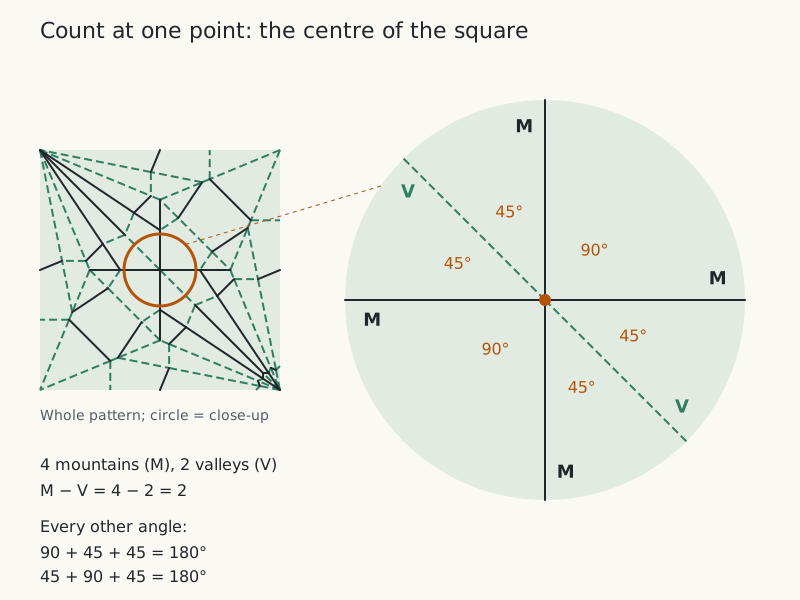
Pick the centre of the square. Six creases meet there in the finished crane: four mountains and two valleys, so mountains minus valleys is 4 − 2 = 2. The angles between neighbouring creases are 90°, 45°, 45°, 90°, 45° and 45°. Take every other angle and each set adds to 180°: 90 + 45 + 45 and 45 + 90 + 45.
Narrow screen? Scroll the drawing sideways, or open it full size.
Full credit to copy
"The six creases at the centre of the crane pattern" by Drawn Mathematics, https://drawnmathematics.com/crease-patterns/origami-crease-pattern/, licensed under CC BY 4.0, https://creativecommons.org/licenses/by/4.0/
Those counts are the two tests behind the label. Maekawa's theorem says that at any single point that folds flat, the mountain count M and the valley count V satisfy M − V = ±2 (Theorem 2.2 in Hull's 2002 survey, credited to Maekawa and Justin). Kawasaki's theorem says that a single point with an even number of creases can fold flat, with some choice of mountains and valleys, exactly when the alternate angles balance. On a flat sheet, that means each set adds to 180° (Theorem 2.1, credited to Kawasaki and Justin).
Most inner points of the crane have four creases (30 with one mountain and three valleys, 11 with three mountains and one valley). The centre is the only point with six. All 42 pass both tests, and the file lists each point with its angles: origami-crease-pattern-crane-vertices.csv (CSV; where this file comes from: source, version and license, JSON) Source data: Computed for this page from the crane crease pattern on this page (Maekawa and Kawasaki conditions at every inner point)
Why it is always 2
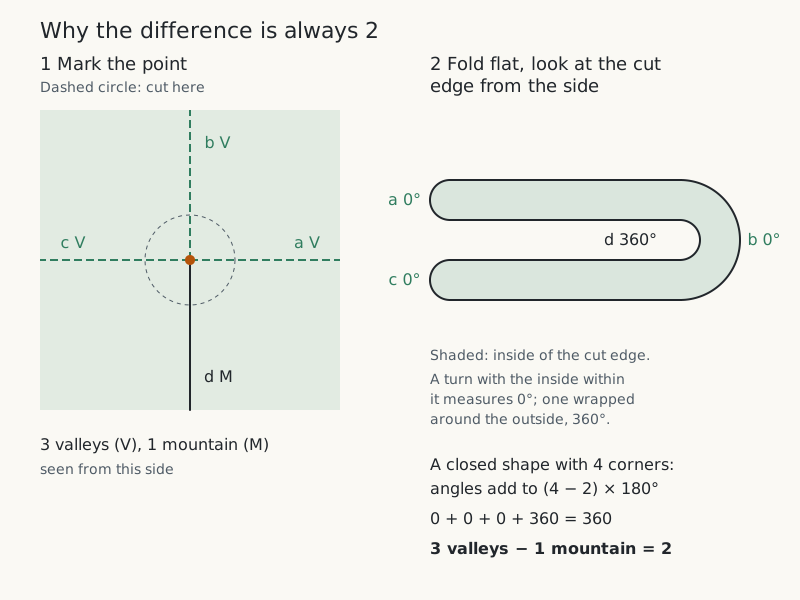
Take the simplest flat point: four creases at right angles, three valleys and one mountain. Fold it flat, imagine cutting a tiny circle around the point, and look at the cut edge from the side. It forms a closed, flattened shape with one corner for each crease. Each corner turns all the way back.
Narrow screen? Scroll the drawing sideways, or open it full size.
Full credit to copy
"Why mountains and valleys differ by two at a flat point" by Drawn Mathematics, https://drawnmathematics.com/crease-patterns/origami-crease-pattern/, licensed under CC BY 4.0, https://creativecommons.org/licenses/by/4.0/
The proof in Hull's survey, credited to Siwanowicz, counts those corners. Seen from one side, every valley corner has an angle of 0° and every mountain corner an angle of 360°. The angles of any closed shape with n corners add to (n − 2) × 180°, so 360 × M = (M + V − 2) × 180, which gives V − M = 2. Look from the other side and mountains and valleys swap, giving M − V = 2.
For the four-crease point, the corners are 0 + 0 + 0 + 360 = 360, which is (4 − 2) × 180. The same count has a second consequence that Hull draws out: M + V equals 2V ± 2, so every inner point of a flat fold has an even number of creases. This one point is Level 2: proven to fold flat (layer order solved, or a published proof). Hull's survey notes that when all the angles around a point are equal, any choice with M − V = ±2 folds flat, and it counts 8 valid choices for four right angles.
Folding the paper demonstrates the count for one particular point; the proof covers every point of every flat fold.
What the count cannot tell you
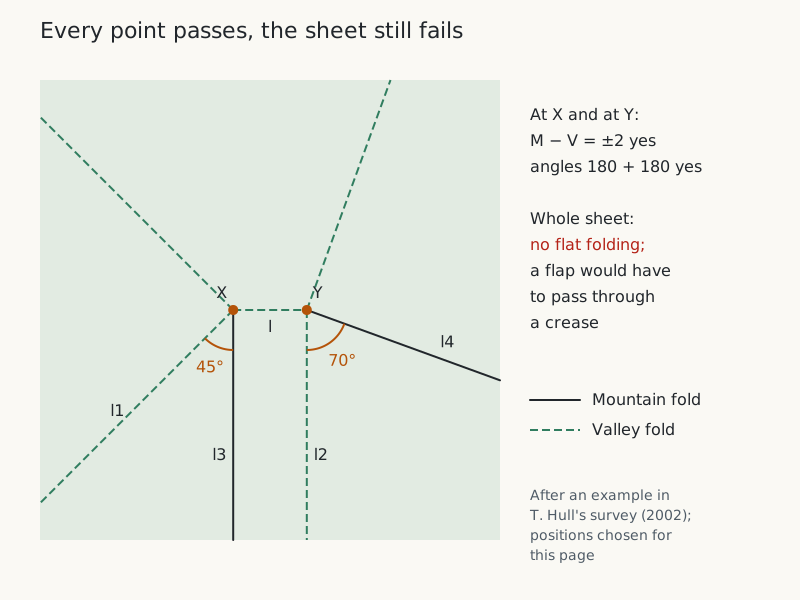
A pattern can pass at every point and still not fold flat. Hull's survey shows two points joined by a short crease: each point passes both tests and has valid mountain-valley choices, "but still fails to fold flat." Try it, Hull writes, and "some flap of paper will have to intersect one of the creases." Move the points relative to the edge of the paper, or lengthen the crease between them, and by Hull's account it does fold flat.
Narrow screen? Scroll the drawing sideways, or open it full size.
Full credit to copy
"Every point passes, the sheet still fails" by Drawn Mathematics, https://drawnmathematics.com/crease-patterns/origami-crease-pattern/, licensed under CC BY 4.0, https://creativecommons.org/licenses/by/4.0/
The drawing rebuilds that layout from the angles marked in Hull's figure, with positions chosen for this page. For these positions too, checking how the layers overlap rules out every mountain-valley choice that passes at X and Y: some flap must cross a crease.
Erik and Martin Demaine's 2001 survey of computational origami sums up the gap. Checking every point is fast: it can be done in time proportional to the size of the pattern. Deciding whether a whole pattern folds flat is NP-hard, a class of problems with no known fast general method, as Marshall Bern and Barry Hayes proved in 1996. Even when the folds are known to work, finding the order of the stacked layers is NP-hard too.
That is why the crane carries a Level 1 label, explained with the site's three check levels. A crease pattern also leaves out the order of the folds. This page gives no step-by-step instructions for the crane, and its checks are about the finished, flat state only.
A crane in a book from 1797
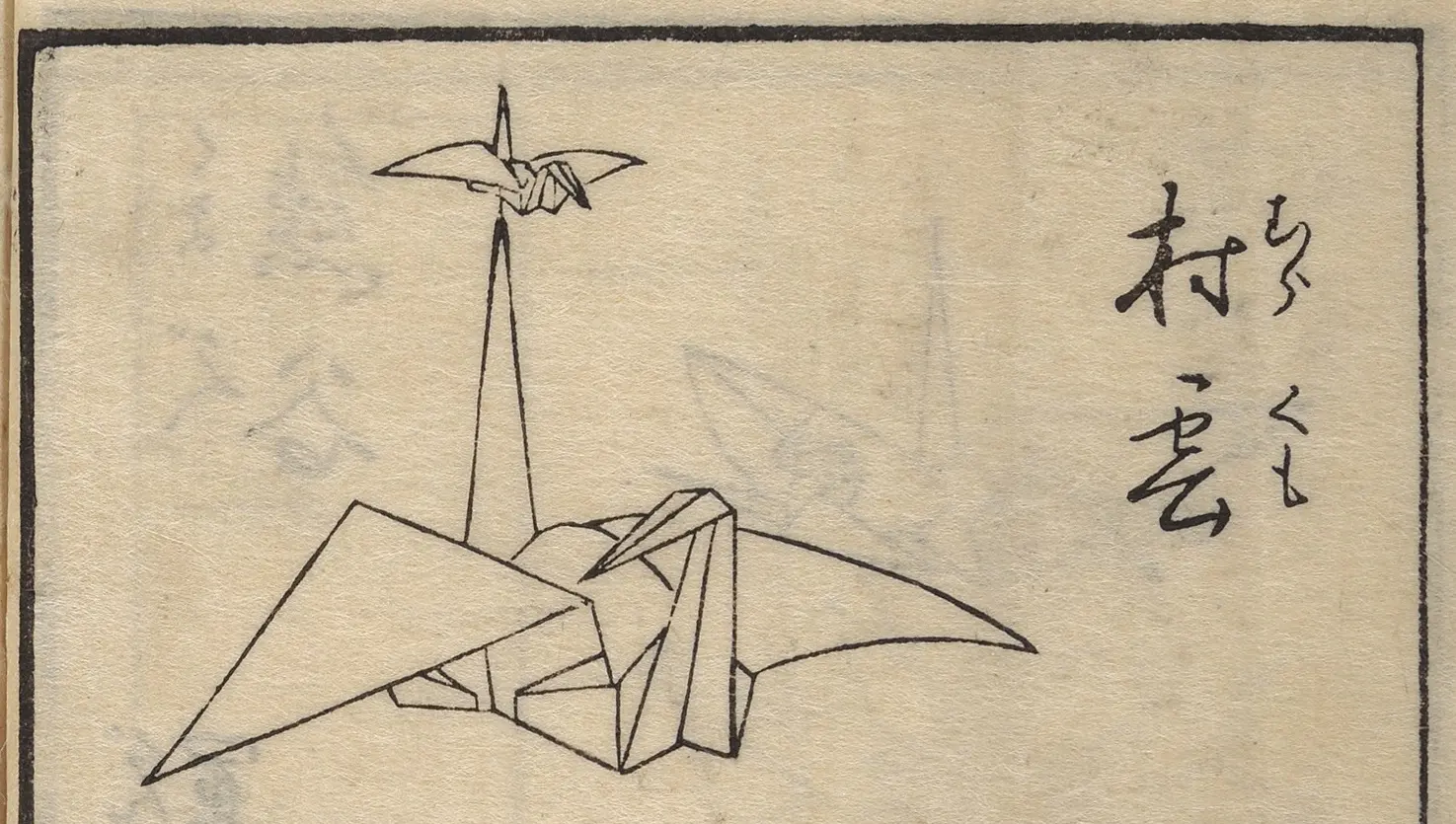
The National Diet Library in Tokyo catalogues a book titled Senbazuru orikata, also known as Hiden senbazuru orikata (秘伝千羽鶴折形), roughly "secret folding patterns for a thousand cranes." Its record gives a preface dated 1797 (Kansei 9), the Kyoto publisher Yoshinoya Tamehachi, and the authors Rokiku and Rokōan.
Full credit to copy
"Hiden Senbazuru Orikata" by Rokiku and Rokōan — https://commons.wikimedia.org/wiki/File:Hiden_Senbazuru_Orikata.jpg — Public domain (Book published in Kyoto with a preface dated 1797 (National Diet Library record 000007300291); everyone who made a book printed in 1797 died long before 1956; PD worldwide (US: published before 1930; Japan and EU: authors died more than 70 years ago); faithful scan of a flat printed page); modified: cropped to the upper part of the page (the poem and the cutting diagram below are left out); colours not altered, not enlarged
This picture shows finished cranes, not a crease pattern. The drawing at the top of this page shows the other view, the lines a traditional crane leaves on the square when you unfold it.
Draw it yourself:
With paper and a few simple tools
- Draw a square 8 cells wide on graph paper and mark its centre. Rule the two midlines, so four lines leave the centre at 90° to each other.
- Mark three of the four lines as valleys (dashed) and the fourth as a mountain (solid).
- Cut out the square with scissors, and have an adult present if a child is cutting. Fold along the midline that is a valley on both sides of the centre, then fold the doubled strip in half toward you along the other midline. It lies flat in four layers.
- Draw a second square with two mountains and two valleys at the centre and try again. It will not press flat without a new crease, because 2 − 2 is 0.
- Count the six creases at the centre of the crane pattern at the top of this page: four mountains, two valleys.
Next: The angle test at the same points: Kawasaki's Theorem: A Flat Fold Splits 360° Into Two 180°s · Fold a strip in half again and again: Dragon Curve: Fold a Strip, Open to 90°, and a Stage Appears
Sources
- [1] Thomas C. Hull, "The Combinatorics of Flat Folds: a Survey," in Origami³: The Third International Meeting of Origami Science, Mathematics, and Education (A K Peters, 2002); arXiv:1307.1065 (2013). https://arxiv.org/abs/1307.1065 Read: full text; paraphrased with short quotations.
- [2] Erik D. Demaine and Martin L. Demaine, "Recent Results in Computational Origami," in Origami³: Proceedings of the 3rd International Meeting of Origami Science, Math, and Education (OSME 2001) (A K Peters), 3–16; authors' submitted version. https://erikdemaine.org/papers/OSME2001/ Read: full text of the authors' submitted version; paraphrased.
- [3] Original data for this page: the traditional crane's crease pattern computed fold by fold from the square (square base, bird base, narrowing folds, neck, tail and head reverse folds, wing folds), with a Maekawa and Kawasaki check at every inner point of each stage; all creases and inner points are in the two CSV downloads. https://drawnmathematics.com/crease-patterns/origami-crease-pattern/origami-crease-pattern-crane-vertices.csv Read: this page's own computation; method in the text, data in the CSV downloads.
- [4] National Diet Library, bibliographic record of Senbazuru orikata (other title Hiden senbazuru orikata), by Rokiku and Rokōan (Karaku [Kyoto]: Yoshinoya Tamehachi, preface dated Kansei 9 [1797]), NDL Bib ID 000007300291. http://id.ndl.go.jp/bib/000007300291 Read: bibliographic record only. Text license: Public Data License 1.0.
Cite this page
Drawn Mathematics. “Flat Origami: Mountains and Valleys Differ by 2 at Inner Points.” Drawn Mathematics. Published 2026-10-26. https://drawnmathematics.com/crease-patterns/origami-crease-pattern/ (accessed: add the date you read it).
How each drawing is checked: Checking the constructionCorrections and redrawsHow to reach us