A4 Paper Size: Built So Each Half Keeps the Same Shape
TL;DR: An A4 sheet is 210 × 297 mm, a √2 rectangle trimmed to whole millimetres. Markus Kuhn's summary of ISO 216 lists that size, and √2 (about 1.414) is the only ratio whose half has the same shape as the whole, so a halved A4 keeps its shape to within a millimetre.
Rule: Cut the sheet in half; each half must keep the whole sheet's shape.
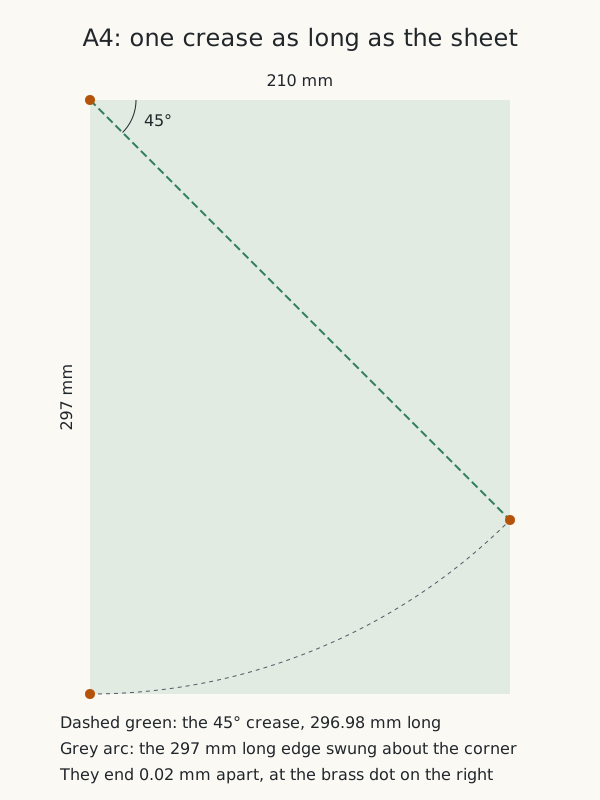
Narrow screen? Scroll the drawing sideways, or open it full size.
Full credit to copy
"A4 sheet: the 45° crease is as long as the long edge" by Drawn Mathematics, https://drawnmathematics.com/crease-patterns/a4-paper-size/, licensed under CC BY 4.0, https://creativecommons.org/licenses/by/4.0/
Demonstration: fold the short edge down
This page is a paper theorem: the first two sections are folds to make with A4 paper in hand, and the third states the theorem and proves it.
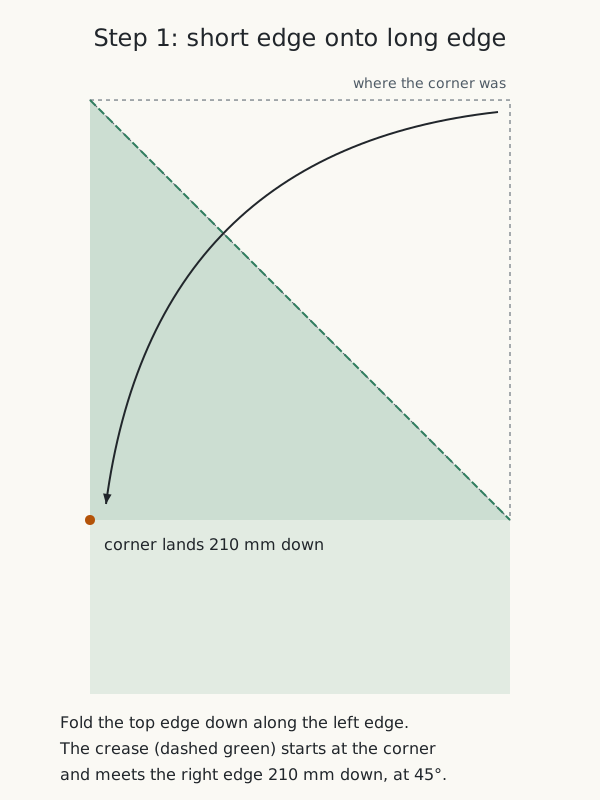
Hold an A4 sheet upright. Fold the top edge down until it lies along the left edge, then crease. The crease starts at the top corner, splits the 90° corner into two 45° angles and meets the right edge 210 mm down.
Narrow screen? Scroll the drawing sideways, or open it full size.
Full credit to copy
"Step 1: fold the short edge of A4 onto the long edge" by Drawn Mathematics, https://drawnmathematics.com/crease-patterns/a4-paper-size/, licensed under CC BY 4.0, https://creativecommons.org/licenses/by/4.0/
Now look at the crease: it is the diagonal of a square with 210 mm sides, so by Pythagoras it is 210 × √2 ≈ 296.98 mm long. The long edge of the sheet is 297 mm, so one fold has made a line as long as the sheet, to within 0.02 mm.
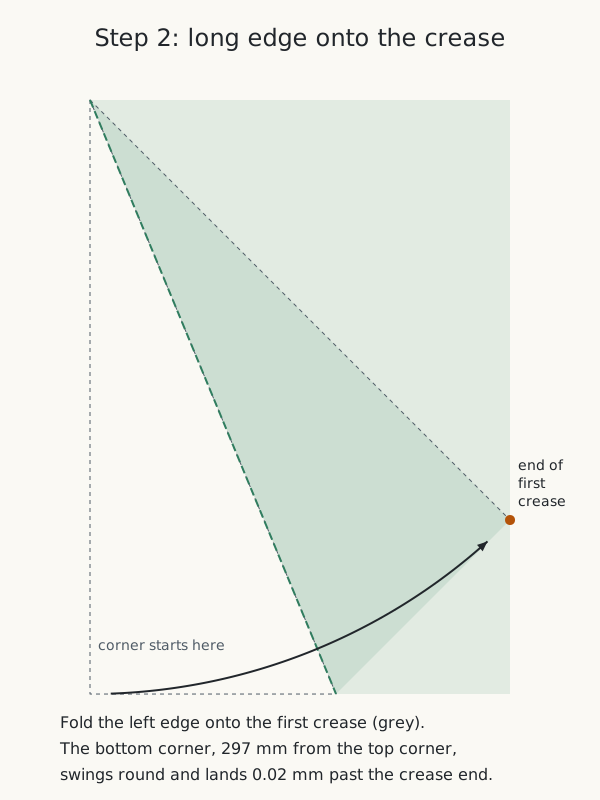
Unfold, then fold the left edge onto that first crease. The bottom corner swings around the top corner and lands where the first crease meets the right edge. On a sheet of exactly 210 × 297 mm it would land 0.02 mm past that point, far less than any crease can show.
Narrow screen? Scroll the drawing sideways, or open it full size.
Full credit to copy
"Step 2: fold the long edge of A4 onto the first crease" by Drawn Mathematics, https://drawnmathematics.com/crease-patterns/a4-paper-size/, licensed under CC BY 4.0, https://creativecommons.org/licenses/by/4.0/
The drawings use the line styles of Flat Origami: Mountains and Valleys Differ by 2 at Inner Points: dashed green for a valley fold, thin grey dashes for an earlier crease. Several creases meeting at one point are a separate problem, covered in Kawasaki's Theorem: A Flat Fold Splits 360° Into Two 180°s.
The fold cannot tell √2 from its neighbours. A sheet 210 × 297.2 mm would put the corner 0.2 mm past the crease's end. Paper thickness and a crease that wanders by a hair can hide a gap that small, so the claim needs a proof.
Demonstration: halve it and stack
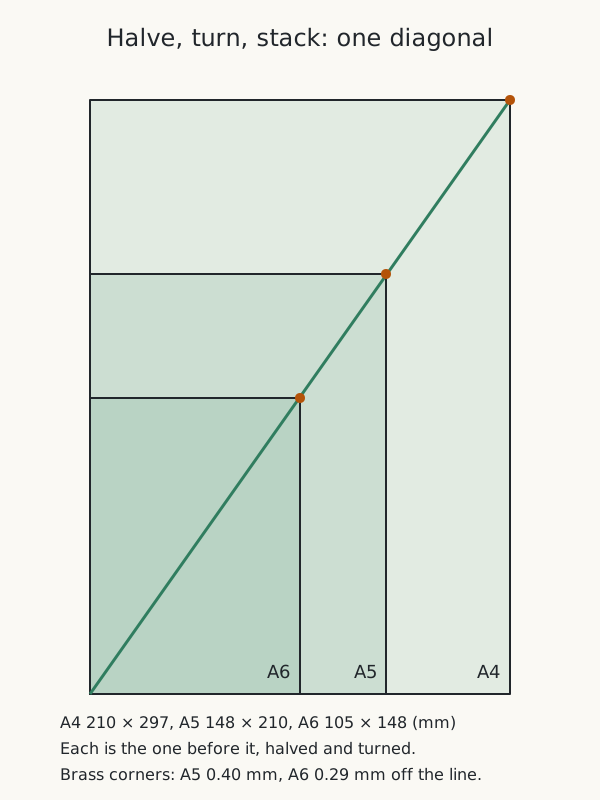
Fold a second A4 sheet in half, short edge onto short edge, and crease. The folded sheet is 148.5 × 210 mm. Turn it upright and lay it on a corner of a whole sheet, edges together.
Narrow screen? Scroll the drawing sideways, or open it full size.
Full credit to copy
"A4, A5 and A6 stacked at one corner share one diagonal" by Drawn Mathematics, https://drawnmathematics.com/crease-patterns/a4-paper-size/, licensed under CC BY 4.0, https://creativecommons.org/licenses/by/4.0/
Rule a line from the shared corner to the far corner of the whole sheet. The line also passes through the far corner of the folded sheet. An exact fold would leave that corner only 0.01 mm off the line.
Two rectangles laid at one corner, sides lined up, have the same shape exactly when their diagonals from that corner lie on one line, since the slope of each diagonal is its sheet's long side divided by its short side. The listed sizes nearly pass the test: A5 (148 × 210 mm) has its far corner 0.40 mm off the A4 diagonal, and A6 (105 × 148 mm) is 0.29 mm off. Both are under half a millimetre: close, but not exact.
Theorem: only √2 keeps its shape
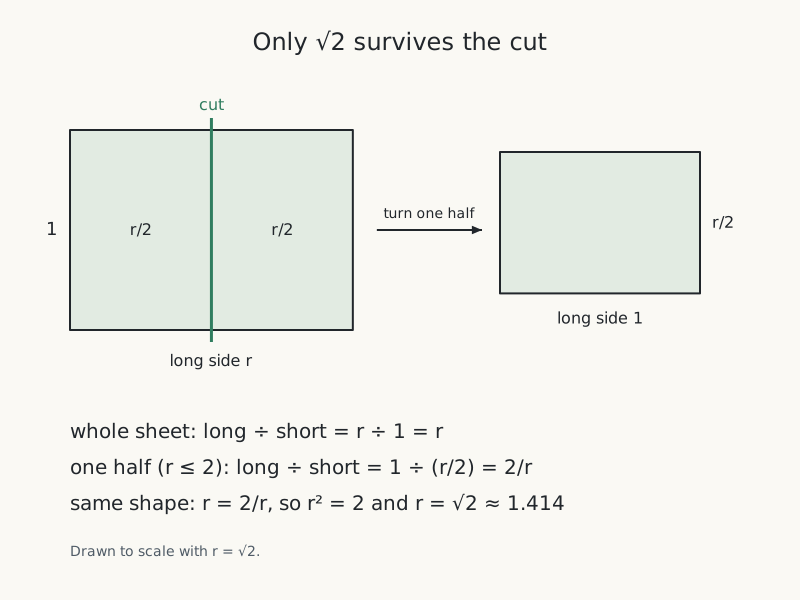
Theorem. A rectangle cut in half across its long side gives two halves with the same shape as the whole exactly when its long side is √2 times its short side.
The statement rests on three assumptions:
- The sheet is a flat rectangle.
- The cut is straight and joins the midpoints of the two long sides, so the halves are equal.
- "Same shape" means the long side divided by the short side is the same number for a half as for the whole.
Call the short side 1 and the long side r, with r at least 1, so each half measures 1 by r/2. If r is 2 or less, the half's long side is 1 and its short side is r/2, so its ratio is 2/r. The halves match the whole only if 2/r = r, which means r² = 2 and r = √2.
Narrow screen? Scroll the drawing sideways, or open it full size.
Full credit to copy
"Why only √2 survives the cut" by Drawn Mathematics, https://drawnmathematics.com/crease-patterns/a4-paper-size/, licensed under CC BY 4.0, https://creativecommons.org/licenses/by/4.0/
If r is more than 2, the half's long side is r/2, which is smaller than r, so the shapes cannot match. A cut the other way, joining the midpoints of the short sides, gives halves of 1/2 by r with a ratio of 2r, which is larger than r. So √2 is the only ratio that works, and since a √2 half is again a √2 rectangle, the same argument covers every later halving.
The folds in the first section show the same fact another way. In a √2 rectangle the long side equals the diagonal of the square on the short side, so in step 2 the corner lands on the end of the 45° crease.
One square metre, halved down to A10
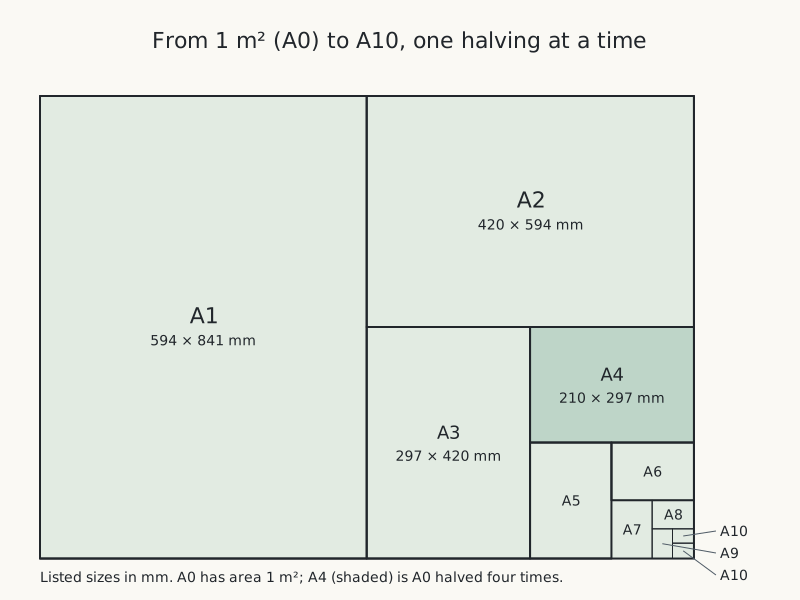
By Kuhn's summary of ISO 216, A0 has an area of 1 m² and a long side √2 times its short side, and each later size is the one before cut in half. Kuhn notes that a √2 ratio cannot give both sides round metric lengths, so the standard makes the area round instead. In the ideal series every size splits exactly into two copies of itself, each scaled down by 1/√2.
Narrow screen? Scroll the drawing sideways, or open it full size.
Full credit to copy
"A0 halved down to A10" by Drawn Mathematics, https://drawnmathematics.com/crease-patterns/a4-paper-size/, licensed under CC BY 4.0, https://creativecommons.org/licenses/by/4.0/
So A4's sides are not round numbers because the round number is the area: the ideal A0 is about 840.90 × 1189.21 mm, and A4, four halvings later, about 210.22 × 297.30 mm. Drop the fractions of a millimetre and you get the listed 210 × 297.
Kuhn's table lists A0 as 841 × 1189, the ideal A0 rounded to whole millimetres. He writes that the smaller sizes were calculated by halving again and again, rounding down each time. Rerunning that from the listed A0 with a short program reproduces every listed size down to A10. A0 and A1 are the two exceptions to "ideal size rounded down": their 841 mm side is 1 mm more than 840.90 rounded down.
| Size | Listed by Kuhn (mm) | Ideal (mm) | Ideal area (m²) |
|---|---|---|---|
| A0 | 841 × 1189 | 840.90 × 1189.21 | 1 |
| A1 | 594 × 841 | 594.60 × 840.90 | 1/2 |
| A2 | 420 × 594 | 420.45 × 594.60 | 1/4 |
| A3 | 297 × 420 | 297.30 × 420.45 | 1/8 |
| A4 | 210 × 297 | 210.22 × 297.30 | 1/16 |
| A5 | 148 × 210 | 148.65 × 210.22 | 1/32 |
| A6 | 105 × 148 | 105.11 × 148.65 | 1/64 |
| A7 | 74 × 105 | 74.33 × 105.11 | 1/128 |
| A8 | 52 × 74 | 52.56 × 74.33 | 1/256 |
| A9 | 37 × 52 | 37.16 × 52.56 | 1/512 |
| A10 | 26 × 37 | 26.28 × 37.16 | 1/1024 |
The CSV adds the rounding rule and the source for each size: a-series-sizes.csv (CSV; where this file comes from: source, version and license, JSON) Source data: Listed sizes: Markus Kuhn, "International standard paper sizes", https://www.cl.cam.ac.uk/~mgk25/iso-paper.html, CC BY 4.0 (https://creativecommons.org/licenses/by/4.0/); Ideal sizes, ratios and areas computed for this page from the definition of the A series (ratio √2, A0 area 1 m²)
Sixteen A4 sheets make one A0, since A4 is A0 halved four times. With the listed sizes, those 16 sheets cover 99.8% of a listed A0; as Kuhn points out, rounding down never lets two halves outgrow their sheet. The round area also helps with weight: at 80 g/m², which Kuhn gives as usual printer paper, an A4 sheet weighs 5 g.
Is A4 the same as US Letter?
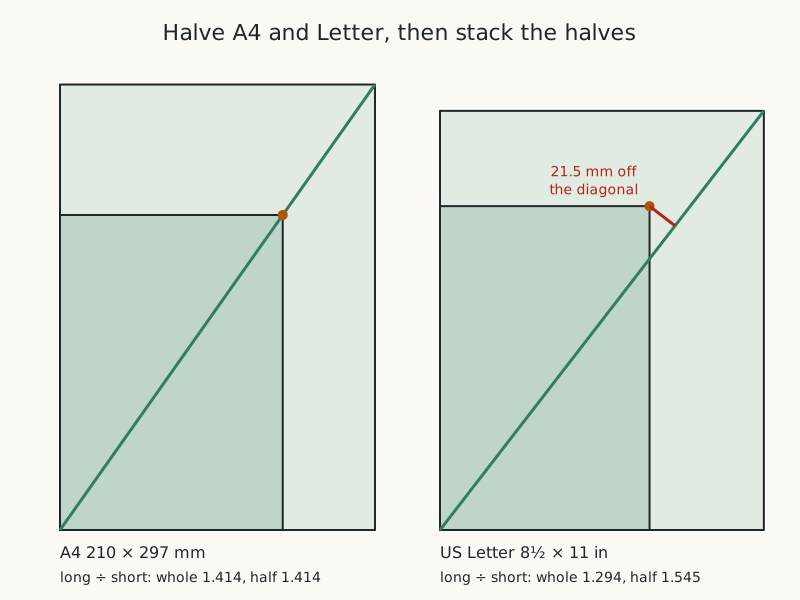
No. Kuhn lists US Letter as 216 × 279 mm (8½ × 11 inches), 6 mm wider than A4 and 18 mm shorter. The bigger difference is the shape: a Letter sheet's long side is 22/17, about 1.294, times its short side.
Narrow screen? Scroll the drawing sideways, or open it full size.
Full credit to copy
"A4 and US Letter halved and stacked" by Drawn Mathematics, https://drawnmathematics.com/crease-patterns/a4-paper-size/, licensed under CC BY 4.0, https://creativecommons.org/licenses/by/4.0/
Halve a Letter sheet and each half is 5½ × 8½ inches, a ratio of 17/11, about 1.545. Stacked on its whole sheet, the half's far corner sits 21.5 mm off the diagonal. Kuhn notes that US sizes alternate between these two ratios, so enlarging one to the next leaves an empty margin.
Who chose √2?
Kuhn names one of the oldest written records of the √2 ratio for paper: a letter that Georg Christoph Lichtenberg, a physics professor at Göttingen, wrote to Johann Beckmann on 25 October 1786. In it Lichtenberg says he once set a young Englishman he taught algebra a task: find a sheet that keeps one shape whether it lies open or is folded to folio, quarto, octavo and smaller. When he went to cut ordinary writing paper to the answer, he found it already had that shape.
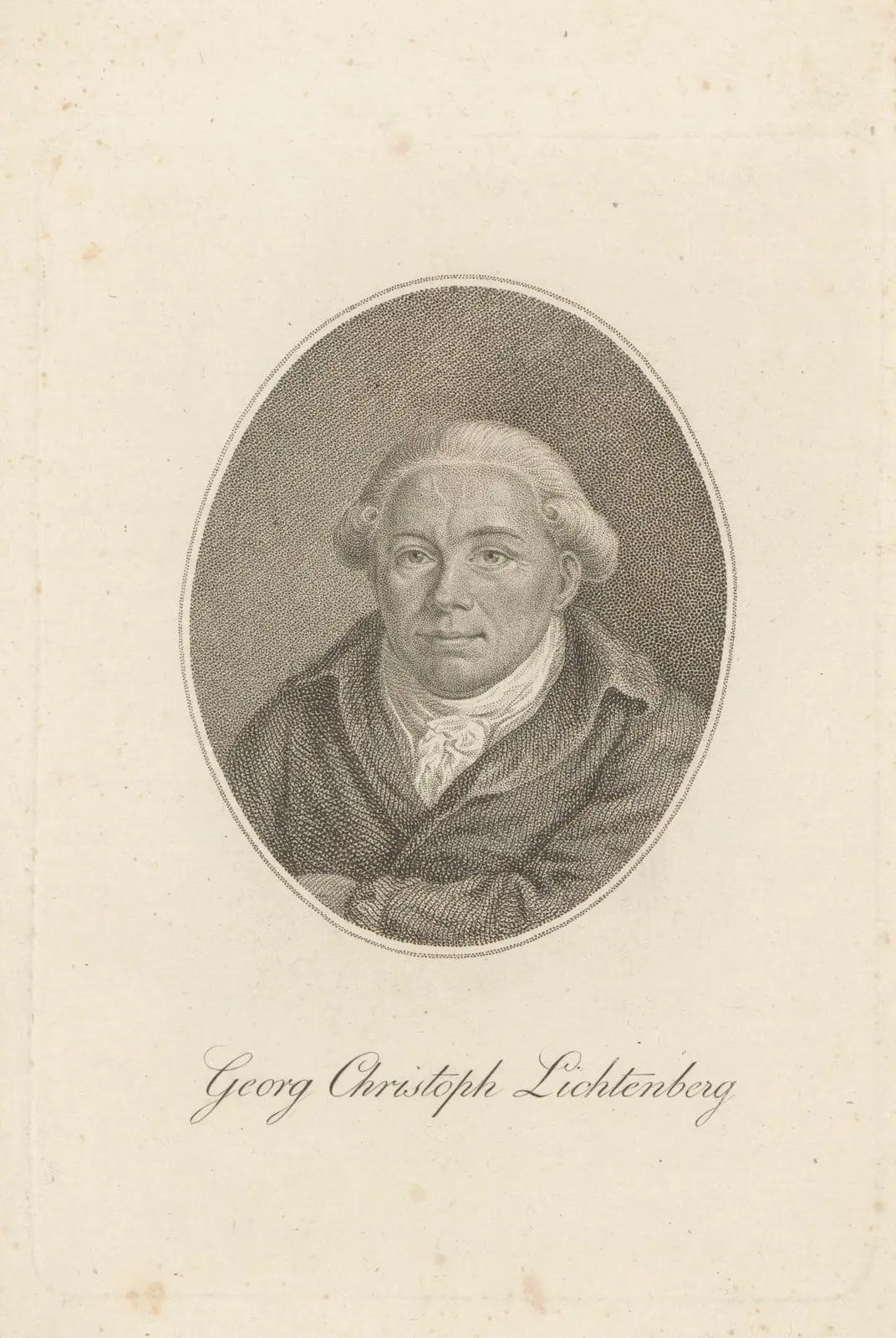
Full credit to copy
"Portret van Georg Christoph Lichtenberg" by Ernst Ludwig Riepenhausen — https://commons.wikimedia.org/wiki/File:Portret_van_Georg_Christoph_Lichtenberg,_RP-P-1914-3358.jpg — Public domain (Ernst Ludwig Riepenhausen d. 1840; PD worldwide (US: published before 1930; EU: author died more than 70 years ago); museum image released under CC0 by the Rijksmuseum (RP-P-1914-3358)); modified: cropped to the plate mark, removing pencil inventory numbers and a pencil artist's name from the margins; colours not altered
Die kleine Seite des Rechtecks muß sich nämlich zu der großen verhalten wie 1 : √2 oder wie die Seite des Quadrats zu seiner Diagonale.
That is Lichtenberg's German of 1786, from his Briefwechsel, vol. III (C. H. Beck, 1990), as transcribed by Kuhn. In English: the small side of the rectangle must relate to the large side as 1 to √2, or as the side of a square to its diagonal. It is the step 2 fold, put into words.
The rest of the history is Kuhn's account. A French paper-tax law of 3 November 1798, the Loi sur le timbre, defined formats that match today's A2 and A3, among others. Walter Porstmann's A, B and C series became the German standard DIN 476 in 1922, and the system became the international standard ISO 216 in 1975.
Draw it yourself:
With paper and a few simple tools
- Fold the short edge of an A4 sheet onto its long edge and crease: the crease runs at 45° from the corner.
- Unfold, then fold the long edge onto that crease: the corner lands where the crease meets the far edge.
- Fold a second A4 sheet in half, short edge onto short edge, and crease.
- Turn the folded sheet upright on a corner of a whole sheet and rule a line from that corner through both far corners.
- Divide the sheet's long side by its short side: 297 ÷ 210 ≈ 1.414, which matches √2 to three decimals.
Next: A pattern with many creases, read line by line: Flat Origami: Mountains and Valleys Differ by 2 at Inner Points · A shape that repeats itself only roughly, over a measured range: Coastline Paradox: Seven Rulers, Seven Lengths for Britain
Sources
- [1] Markus Kuhn, "International standard paper sizes" (A4 paper format), created 1996, last modified 2025-12-08. https://www.cl.cam.ac.uk/~mgk25/iso-paper.html Read: full text; the A-series sizes are reproduced under CC BY 4.0, the rest paraphrased. Text license: CC BY 4.0.
- [2] Georg Christoph Lichtenberg, letter to Johann Beckmann, Göttingen, 25 October 1786, in Briefwechsel, vol. III (1785–1792), Verlag C. H. Beck, 1990; transcribed by Markus Kuhn, "Lichtenberg's letter to Johann Beckmann". https://www.cl.cam.ac.uk/~mgk25/lichtenberg-letter.html Read: full text of the German letter (public domain), one sentence quoted and translated for this page; the English translation on the same page was not used.
- [3] Original data for this page: ideal A-series sizes computed from the definition and compared with the listed sizes, the 45° crease and landing point on an A4 sheet, corner offsets of stacked half sheets, and the halving ratios of US Letter (method in the text); A0 to A10 are in the CSV download. https://drawnmathematics.com/crease-patterns/a4-paper-size/a-series-sizes.csv Read: this page's own computation; method in the text, data in the CSV download.
Cite this page
Drawn Mathematics. “A4 Paper Size: Built So Each Half Keeps the Same Shape.” Drawn Mathematics. Published 2026-10-26. https://drawnmathematics.com/crease-patterns/a4-paper-size/ (accessed: add the date you read it).
How each drawing is checked: Checking the constructionCorrections and redrawsHow to reach us