Kawasaki's Theorem: A Flat Fold Splits 360° Into Two 180°s
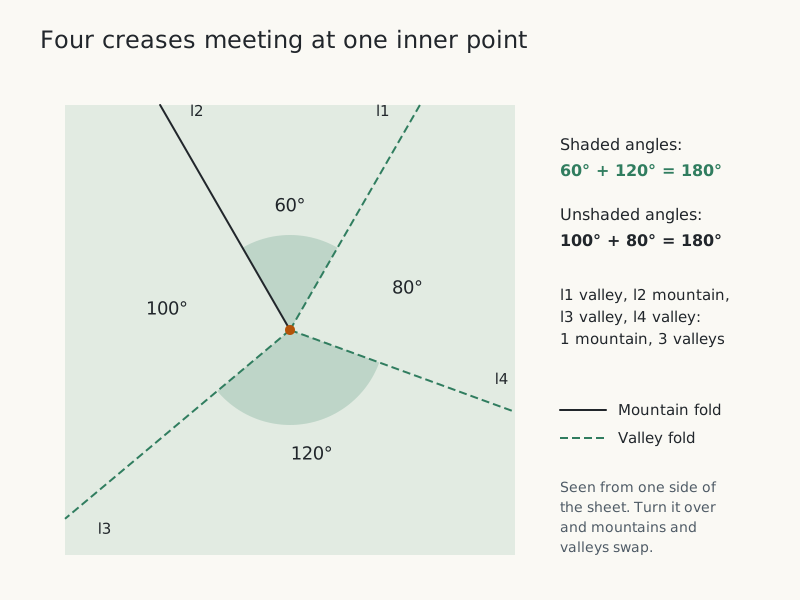
TL;DR: Four creases meeting at one point, 60°, 100°, 120° and 80° apart, fold flat: alternate angles each total 180°. By Kawasaki's theorem, an inner point of a flat sheet can fold flat, under at least one mountain-valley choice, exactly when both alternate sums are 180°; a whole pattern can fail even when every point passes.
Rule: Around any inner point of a sheet folded flat, alternate angles each add to 180°.
Narrow screen? Scroll the drawing sideways, or open it full size.
Full credit to copy
"Kawasaki's theorem at one point: creases 60°, 100°, 120° and 80° apart" by Drawn Mathematics, https://drawnmathematics.com/crease-patterns/kawasakis-theorem/, licensed under CC BY 4.0, https://creativecommons.org/licenses/by/4.0/
Field-guide card
- Name
- Kawasaki's theorem
- Classification
- Crease Patterns; a flat-folding condition at one inner point of a flat sheet
- Generating rule
- At one inner point of a flat sheet, the creases can fold flat, with some choice of mountains and valleys, exactly when the angles between neighbouring creases, taken alternately, each add up to 180°. For a choice already marked, the angle test is needed but not enough.
- First recorded
- Credited in Hull's survey to Jacques Justin (British Origami, June 1986; Ferrara proceedings, 1989) and Toshikazu Kawasaki (Ferrara proceedings, 1989)
- Diagram
- Figure 1: one inner point with creases 60°, 100°, 120° and 80° apart; one mountain and three valleys, seen from one side
- How it was checked
- Level 2: proven to fold flat (layer order solved, or a published proof). Applies to the Figure 1 point with the mountain and valley choice shown: Hull's survey, Theorem 2.1 and Section 5, and a stacking order found by this page's search. The 60°, 100°, 110°, 90° point fails the angle test, so no choice folds it flat. What Level 2 means
These fields as CSV (kawasakis-theorem-card.csv)Where this file comes from: source, version and license (JSON)
Source data: Computed for this page for the Figure 1 point; statement, credits and dates as given in Hull, arXiv:1307.1065, and Demaine and Demaine (2001)
Add every other angle
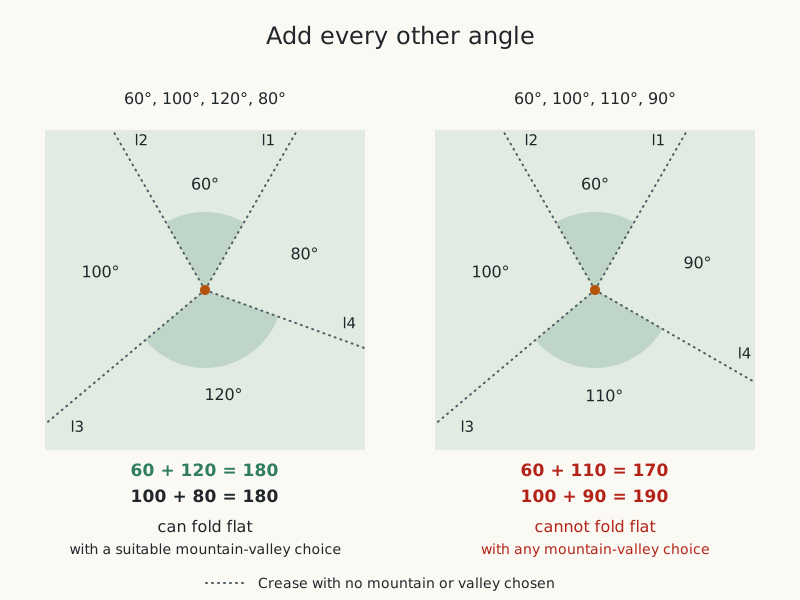
Go around the point in Figure 1 and read the angles between neighbouring creases: 60°, 100°, 120° and 80°. Add every other one. The shaded pair gives 60 + 120 = 180, and the unshaded pair gives 100 + 80 = 180.
Kawasaki's theorem turns this balance into a test for one inner point, a point inside the paper where creases meet (the theorems call it an interior vertex). On a flat sheet, if the alternate angles at such a point each add up to 180°, some mountain-valley choice folds the point flat; if not, none does. Hull's survey states it as Theorem 2.1 in a zero-sum form: the angles, added and subtracted in turn, give 0. Demaine and Demaine (2001) state the 180° form for a single point.
Narrow screen? Scroll the drawing sideways, or open it full size.
Full credit to copy
"Alternate angle sums at two points: 180° and 180° against 170° and 190°" by Drawn Mathematics, https://drawnmathematics.com/crease-patterns/kawasakis-theorem/, licensed under CC BY 4.0, https://creativecommons.org/licenses/by/4.0/
Move one crease 10° and the balance breaks. With creases 60°, 100°, 110° and 90° apart, the alternate sums are 170° and 190°, so no choice of mountains and valleys presses that point flat. One straight crease, like the one that halves the A4 sheet in A4 Paper Size: Built So Each Half Keeps the Same Shape, passes trivially: 180° on each side.
Why 180°: walk around the point
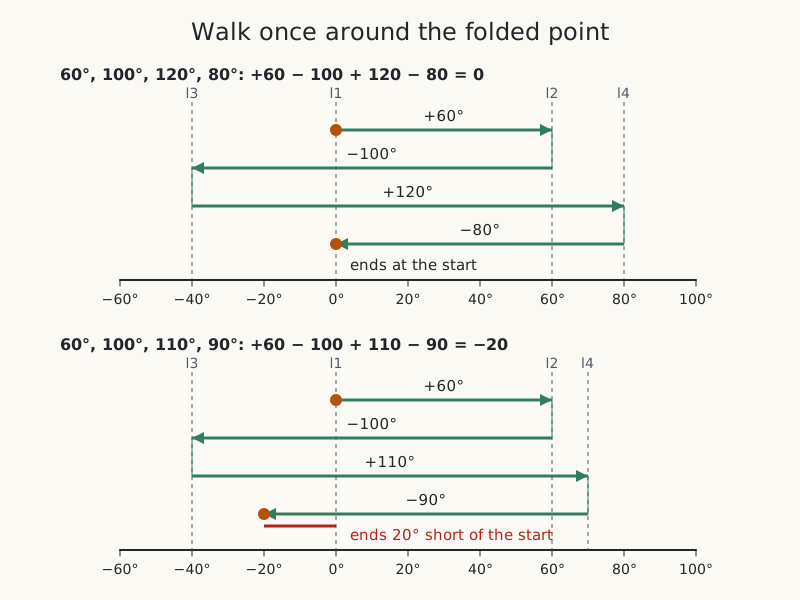
With an ant, Hull's survey proves only that the angles must balance. For the converse, it points to Hull's 1994 paper. Fold the point flat and let the ant walk once around it on the paper, close to the point. On the folded paper, each crease sends the ant back the way it came: 60° one way, 100° back, 120° forward and 80° back.
Narrow screen? Scroll the drawing sideways, or open it full size.
Full credit to copy
"The walk around a folded point: the turns cancel only when the angles balance" by Drawn Mathematics, https://drawnmathematics.com/crease-patterns/kawasakis-theorem/, licensed under CC BY 4.0, https://creativecommons.org/licenses/by/4.0/
Count forward as plus and back as minus. The ant ends where it started, so 60 − 100 + 120 − 80 = 0. On a flat sheet the four angles also add up to 360°, and those two facts together leave one answer: each alternate pair makes 180°. With 60°, 100°, 110° and 90°, the walk ends 20° short of its start, so the paper would have to tear or stretch.
Each crease flips the next wedge of paper over, like a mirror lying along the crease. Hull notes that the zero-sum form also holds at the tip of a paper cone, where the angles do not total 360°; the 180° form needs a flat sheet.
Angles and counts together
Kawasaki's theorem tests the angles. Maekawa's theorem tests the count: at a point that folds flat, mountains and valleys differ by exactly 2 (Hull's survey, Theorem 2.2). So such a point always has an even number of creases, and the angles pair up. On this site a mountain is a solid dark line and a valley a dashed green line, as in Flat Origami: Mountains and Valleys Differ by 2 at Inner Points.
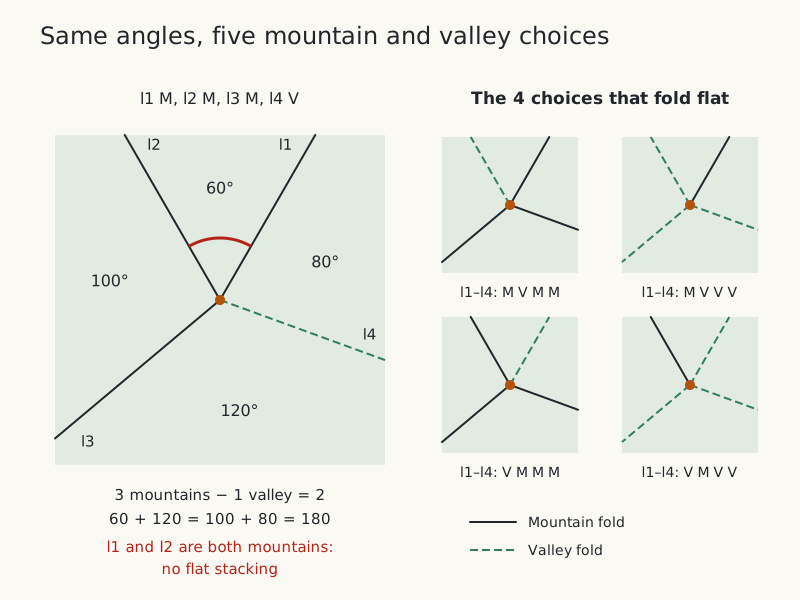
For a choice of mountains and valleys already marked, the two tests are needed but not enough. Below, the Figure 1 point gets three mountains and one valley. The count passes (3 − 1 = 2) and the angles balance. Yet the point cannot fold flat: both creases beside the 60° angle are mountains.
Narrow screen? Scroll the drawing sideways, or open it full size.
Full credit to copy
"Five mountain-valley choices at the same point: one jams, four fold flat" by Drawn Mathematics, https://drawnmathematics.com/crease-patterns/kawasakis-theorem/, licensed under CC BY 4.0, https://creativecommons.org/licenses/by/4.0/
Hull's survey gives the rule for a four-crease point whose smallest angle sits between two larger ones: the two creases beside that angle must be one mountain and one valley, and the other two must match. That leaves 4 of the 16 ways to mark four creases, while 8 of the 16 pass the count. This page's search tried every stacking order of the four paper wedges for all 16 and found a flat stacking for exactly those 4: kawasakis-theorem-examples.csv (CSV; where this file comes from: source, version and license, JSON) Source data: Computed for this page by an exhaustive search over stacking orders; the four valid choices at the first point agree with Hull, arXiv:1307.1065, Section 5
Passing Kawasaki's and Maekawa's tests at every point is still no promise for a whole sheet. Hull's survey shows a two-point pattern that passes both tests at each point and still will not fold flat. Both surveys cite Bern and Hayes's 1996 proof that deciding whether a crease pattern folds flat is NP-hard: no known fast method works for every pattern. So the site's Level 1 check, which tests every point, is not a proof that a sheet folds flat (how the check levels are defined).
Who found it
Hull's survey credits Kawasaki's theorem, its Theorem 2.1, to Toshikazu Kawasaki and Jacques Justin. It cites Justin's article in British Origami (June 1986) and papers by both in the proceedings of the First International Meeting of Origami Science and Technology (Ferrara, 1989). Hull adds that the theorem appears there without proof, though he does not doubt that both authors had proofs of their own; the survey's proof of the theorem comes from his own 1994 paper. By Hull's account, Justin called the zero-sum equation the isometries condition.

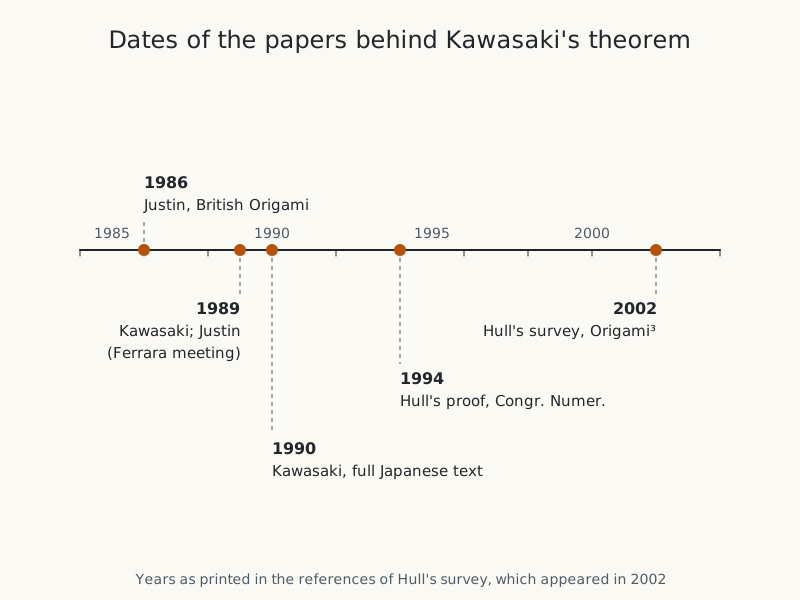
Narrow screen? Scroll the drawing sideways, or open it full size.
Full credit to copy
"Papers behind Kawasaki's theorem, 1986 to 2002" by Drawn Mathematics, https://drawnmathematics.com/crease-patterns/kawasakis-theorem/, licensed under CC BY 4.0, https://creativecommons.org/licenses/by/4.0/
The dates and titles below come from the survey's reference list; the last row is the survey itself.
| Year | Paper, as listed in Hull's survey |
|---|---|
| 1986 | Jacques Justin, “Mathematics of origami, part 9”, British Origami |
| 1989 | Kawasaki (abridged English) and Justin (French), Ferrara proceedings |
| 1990 | Kawasaki, full Japanese version, Sasebo College of Technology Reports 27 |
| 1994 | Thomas Hull, Congressus Numerantium 100: the proofs the survey uses |
| 2002 | Hull's survey, Origami³ |
Draw it yourself:
With paper and a few simple tools
- Mark a point near the middle of a square sheet. With a protractor, rule four lines from it to the edges, 60°, 100°, 120° and 80° apart in turn.
- Crease each line. Make the two lines beside the 60° angle one mountain and one valley, and the other two lines both valleys, as in Figure 1.
- Fold all four creases at once and press: the paper lies flat.
- Rule lines 60°, 100°, 110° and 90° apart on a second sheet and fold again: without a new crease, it will not press flat.
Next: A whole crease pattern, read point by point: Flat Origami: Mountains and Valleys Differ by 2 at Inner Points · Mirrors meeting at one point instead of creases: Kaleidoscope: Lopsided Drawings Close Up at 60°, Not at 50°
Sources
- [1] Thomas C. Hull, "The Combinatorics of Flat Folds: a Survey," in Origami³: The Third International Meeting of Origami Science, Mathematics, and Education (A K Peters, 2002); arXiv:1307.1065 (2013). https://arxiv.org/abs/1307.1065 Read: full text; paraphrased with short quotations.
- [2] Erik D. Demaine and Martin L. Demaine, "Recent Results in Computational Origami," in Origami³: Proceedings of the 3rd International Meeting of Origami Science, Math, and Education (OSME 2001) (A K Peters), 3–16; authors' submitted version. https://erikdemaine.org/papers/OSME2001/ Read: full text of the authors' submitted version; paraphrased.
- [3] Original data for this page: the alternate angle sums at two single points and an exhaustive search over the stacking orders of the four paper wedges for all 16 mountain-valley choices at the point whose angles balance (method in the text); all 32 cases at the two points are in the CSV download. https://drawnmathematics.com/crease-patterns/kawasakis-theorem/kawasakis-theorem-examples.csv Read: this page's own computation; method in the text, data in the CSV download.
Cite this page
Drawn Mathematics. “Kawasaki's Theorem: A Flat Fold Splits 360° Into Two 180°s.” Drawn Mathematics. Published 2026-10-26. https://drawnmathematics.com/crease-patterns/kawasakis-theorem/ (accessed: add the date you read it).
How each drawing is checked: Checking the constructionCorrections and redrawsHow to reach us