Dragon Curve: Fold a Strip, Open to 90°, and a Stage Appears
TL;DR: Fold a paper strip in half four times the same way, open each crease to 90°, and look down. The strip traces stage 4 of the dragon curve, a path of right-angle turns that never runs along the same edge twice in any stage this page's program checked, up to 16 folds.
Rule: Fold a strip in half the same way repeatedly; open each crease to 90°.
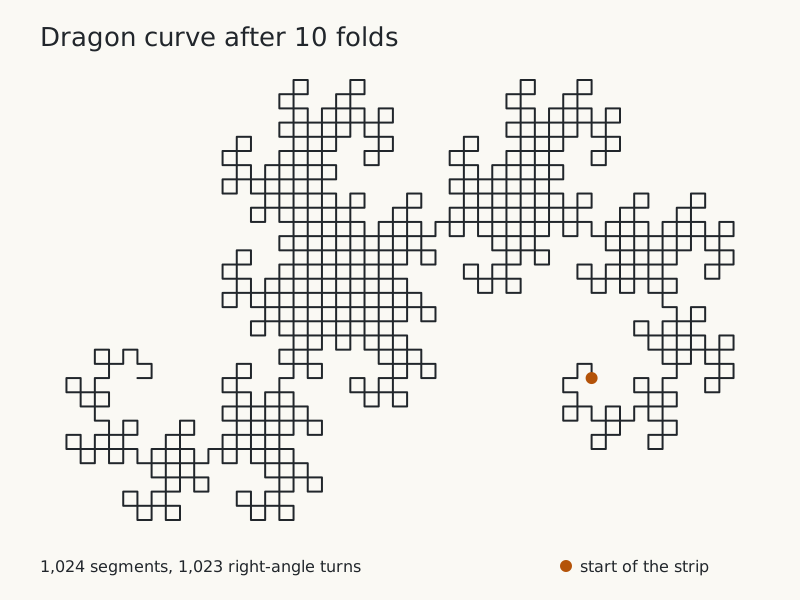
Narrow screen? Scroll the drawing sideways, or open it full size.
Full credit to copy
"Dragon curve after 10 folds" by Drawn Mathematics, https://drawnmathematics.com/fractals/dragon-curve/, licensed under CC BY 4.0, https://creativecommons.org/licenses/by/4.0/
Fold a strip in half, again and again
A dragon curve is the path a paper strip makes when you fold it in half again and again, always the same way, and then open every crease to a right angle. Each number of folds gives one stage of the curve, and the dragon curve itself is the shape those stages approach as the number of folds grows.
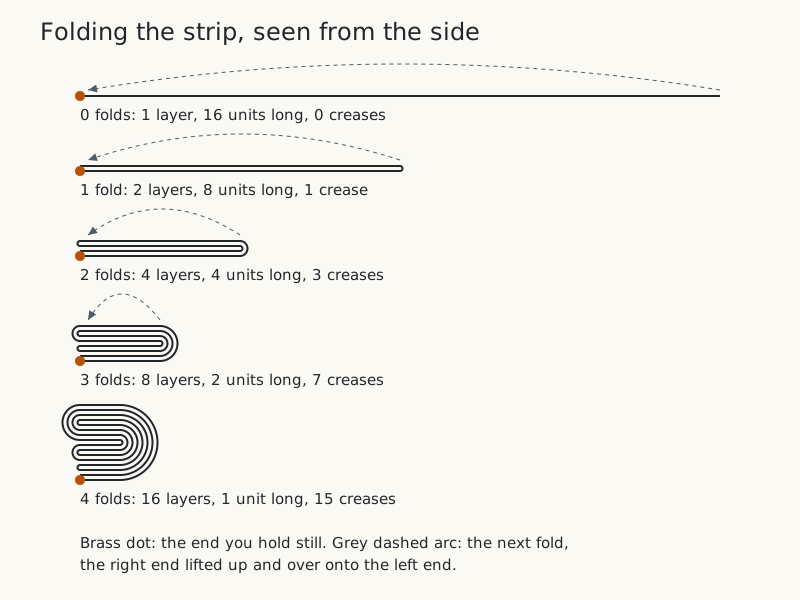
Lay the strip flat and hold its left end still. Lift the right end up and over, lay it on the left end, and crease the middle. Fold the doubled strip the same way, right end up and over onto the left. Keep going.
Every fold doubles the number of layers and halves the length, so after n folds the opened strip has 2ⁿ segments separated by 2ⁿ − 1 creases. Four folds make 16 segments and 15 creases. Ten folds make 1,024 segments, the path in Figure 1.
Narrow screen? Scroll the drawing sideways, or open it full size.
Full credit to copy
"A strip folded in half 0 to 4 times, seen from the side" by Drawn Mathematics, https://drawnmathematics.com/fractals/dragon-curve/, licensed under CC BY 4.0, https://creativecommons.org/licenses/by/4.0/
The curve is also known as Heighway's dragon. By the account of the mathematician Michel Dekking, John E. Heighway found in the early 1960s that a strip folded in half again and again draws this curve when its creases are opened to 90°, and Martin Gardner brought it to a wider audience in 1967. MathWorld traces the name to the shape's likeness to a dragon.
Open every crease to 90°
Seen from the side that faced up while you folded, each crease is either a valley, which sinks like a trough, or a mountain, which rises like a ridge. Unfold the strip and bend every crease back to a right angle, each one the way it was folded.
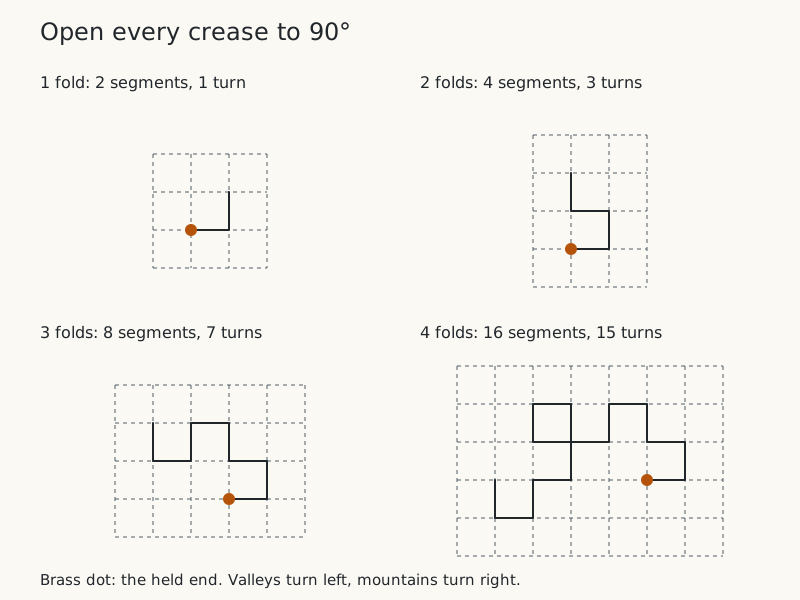
Stand the strip on its long edge with that same side on your left, and walk along it from the end you held. Every valley turns you left, and every mountain turns you right. Look straight down: the edge of the strip draws a path on the table.
Narrow screen? Scroll the drawing sideways, or open it full size.
Full credit to copy
"Dragon curve stages after 1, 2, 3 and 4 folds" by Drawn Mathematics, https://drawnmathematics.com/fractals/dragon-curve/, licensed under CC BY 4.0, https://creativecommons.org/licenses/by/4.0/
One fold gives a single left turn. Two folds give three turns: left, left, right. Each new fold adds a corner in the middle of every old segment, and the new corners turn left, right, left, right in order from the held end.
Turning the strip over, or folding the other way, gives the mirror image. Real paper has thickness, so its corners only come close to 90°, while MathWorld describes the exact version as an ideal ribbon of zero thickness with right-angle folds.
The creases spell a sequence
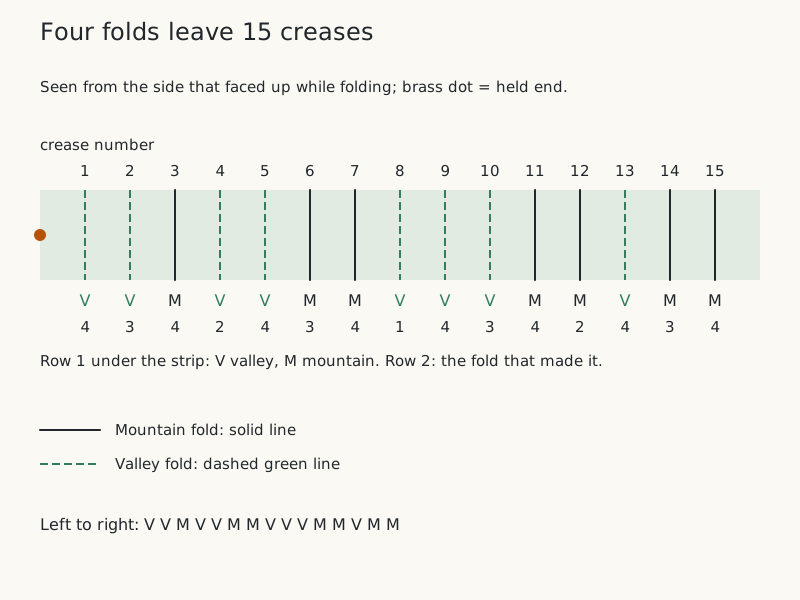
Number the creases from the held end. After four folds, read from the side that faced up, the 15 creases run valley, valley, mountain, valley, valley, mountain, mountain, valley, valley, valley, mountain, mountain, valley, mountain, mountain. Write 1 for a valley and 0 for a mountain, and you get 110110011100100. MathWorld lists the same digits, with 1 for a left turn, and notes that the sequence is sometimes called the regular paperfolding sequence.
Narrow screen? Scroll the drawing sideways, or open it full size.
Full credit to copy
"The 15 creases of a strip folded in half four times" by Drawn Mathematics, https://drawnmathematics.com/fractals/dragon-curve/, licensed under CC BY 4.0, https://creativecommons.org/licenses/by/4.0/
This strip is a crease pattern in one dimension. On this site, a mountain is a solid dark line and a valley is a dashed green line, the same styles that Flat Origami: Mountains and Valleys Differ by 2 at Inner Points uses to read the creases of a folded square.
The table shows where each fold puts its creases: one new crease in the middle of every segment, alternating valley, mountain, valley, mountain from the held end.
| Fold | Creases it adds (numbered from the held end) | Types, in order |
|---|---|---|
| 1 | 8 | valley |
| 2 | 4, 12 | valley, mountain |
| 3 | 2, 6, 10, 14 | valley, mountain, valley, mountain |
| 4 | 1, 3, 5, 7, 9, 11, 13, 15 | valley, mountain, valley, mountain, valley, mountain, valley, mountain |
| All four | 1 to 15 | V V M V V M M V V V M M V M M, so the turns are L L R L L R R L L L R R L R R |
A second rule gives the same list. The creases after one more fold are the old list, then a valley, then the old list read backwards with every valley and mountain swapped. For this page, a short program models the strip layer by layer through each fold and reads off every crease, and for 1 to 16 folds its creases match both rules.
Does the path ever run over itself?
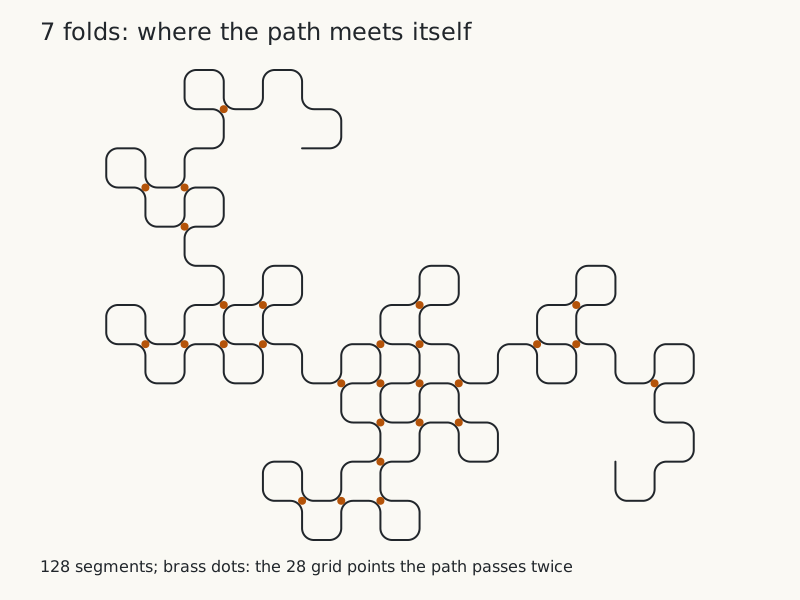
Call each one-square step of the path an edge. The same program walks the path on a square grid and counts how often each edge is used. For every number of folds from 1 to 16, no edge is used twice, so at 16 folds all 65,536 segments lie on different edges.
In the checked stages, the path meets itself only at corners. From 4 folds on, some grid points are visited twice, and up to 16 folds no point is visited more often. MathWorld also notes that these right-angle stages can touch themselves at corners.
Narrow screen? Scroll the drawing sideways, or open it full size.
Full credit to copy
"The 7-fold dragon path with rounded corners and its 28 double-visited points" by Drawn Mathematics, https://drawnmathematics.com/fractals/dragon-curve/, licensed under CC BY 4.0, https://creativecommons.org/licenses/by/4.0/
Every crease is a turn, so the path never runs straight through a point, and in the checked stages, when it comes back to a point, it uses the two edges it has not used yet. Round off every corner, as in the drawing above, and the two visits bend away from each other without crossing. Dekking uses the same rounding: when the path repeats no edge, the rounded path never crosses itself.
| Folds | Segments | Creases | Edges used twice | Most visits to one point | Points visited twice |
|---|---|---|---|---|---|
| 1 | 2 | 1 | 0 | 1 | 0 |
| 4 | 16 | 15 | 0 | 2 | 1 |
| 7 | 128 | 127 | 0 | 2 | 28 |
| 10 | 1,024 | 1,023 | 0 | 2 | 335 |
| 13 | 8,192 | 8,191 | 0 | 2 | 3,232 |
| 16 | 65,536 | 65,535 | 0 | 2 | 28,555 |
All 16 rows, with valley and mountain counts and end points, are in the CSV file: dragon-curve-folds.csv (CSV; where this file comes from: source, version and license, JSON) Source data: Computed for this page from the folding rule: fold a strip in half the same way and open every crease to a right angle
A check that stops at 16 folds demonstrates the pattern rather than proving it. By Dekking's account, C. Davis and Donald Knuth gave mathematical proofs of the curve's properties in the Journal of Recreational Mathematics in 1970, and one of them is that the endless folding curve never uses an edge twice. The creases of each stage begin the list for the next stage, so every stage is the start of that endless curve.
Four dragons around one point
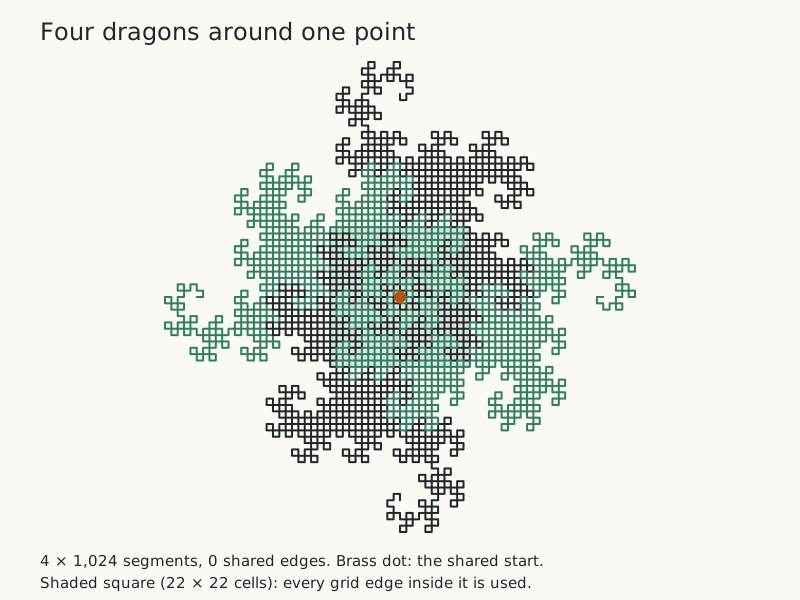
Start four copies of the 10-fold path at one point, heading east, north, west and south, so that each copy is the one before it turned a quarter turn about the start.
Narrow screen? Scroll the drawing sideways, or open it full size.
Full credit to copy
"Four 10-fold dragon paths around one point" by Drawn Mathematics, https://drawnmathematics.com/fractals/dragon-curve/, licensed under CC BY 4.0, https://creativecommons.org/licenses/by/4.0/
The program finds that the four copies share no edge, for every number of folds from 1 to 16. Near the start, the larger stages also leave no gap: at 10 folds, every grid edge in a 22-by-22-cell square around the start, border included, belongs to one of the four paths. At 16 folds, that square grows to 170 by 170 cells.
Davis and Knuth proved the endless version, again by Dekking's account: the four endless curves together use every edge of the square grid exactly once. In the words Dekking quotes from them, it is "probably the most interesting property of the dragon curve."
Folding is the demonstration
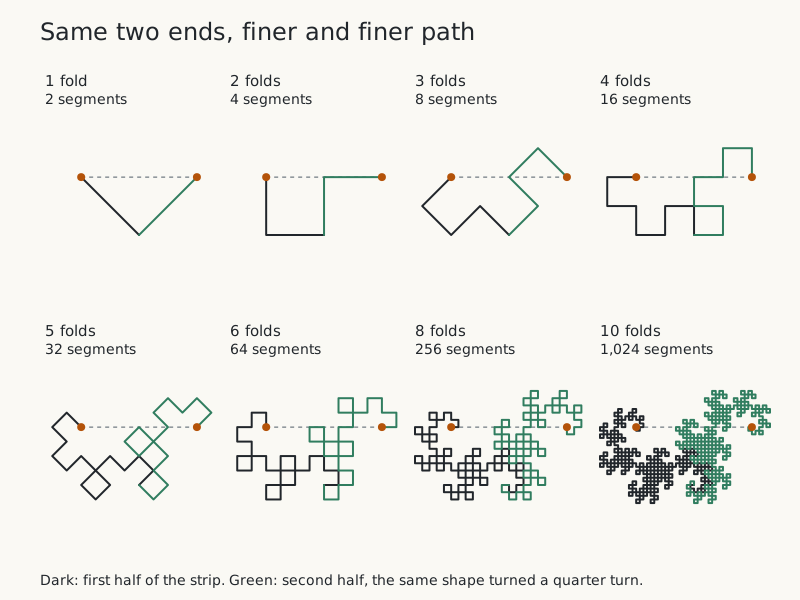
Three different things share the name on this page. The dragon curve itself is a limit: shrink each stage so its two ends stay put, and the paths close in on one shape as the folds go on. The drawings and checks here are finite stages, each labeled with its number of folds, and the checks stop at 16. A real strip shows only the first few stages.
Narrow screen? Scroll the drawing sideways, or open it full size.
Full credit to copy
"Dragon curve stages with both ends fixed" by Drawn Mathematics, https://drawnmathematics.com/fractals/dragon-curve/, licensed under CC BY 4.0, https://creativecommons.org/licenses/by/4.0/
Each stage is two copies of the stage before. In the opened strip, the half after the middle crease is the half before it, run backwards and turned a quarter turn about that crease. This is also how Dekking describes the unfolding. With the ends held on the same two dots, each half reaches 1/√2 as far, end to end, as the whole stage.
Paper stops the process early, because the layers double with every fold: four folds stack 16 layers, and ten would stack 1,024. Coastline Paradox: Seven Rulers, Seven Lengths for Britain keeps the Koch curve, a map and a coastline apart in the same way: a limit, a finite computation, and a real object that follows the rule only so far.
Draw it yourself:
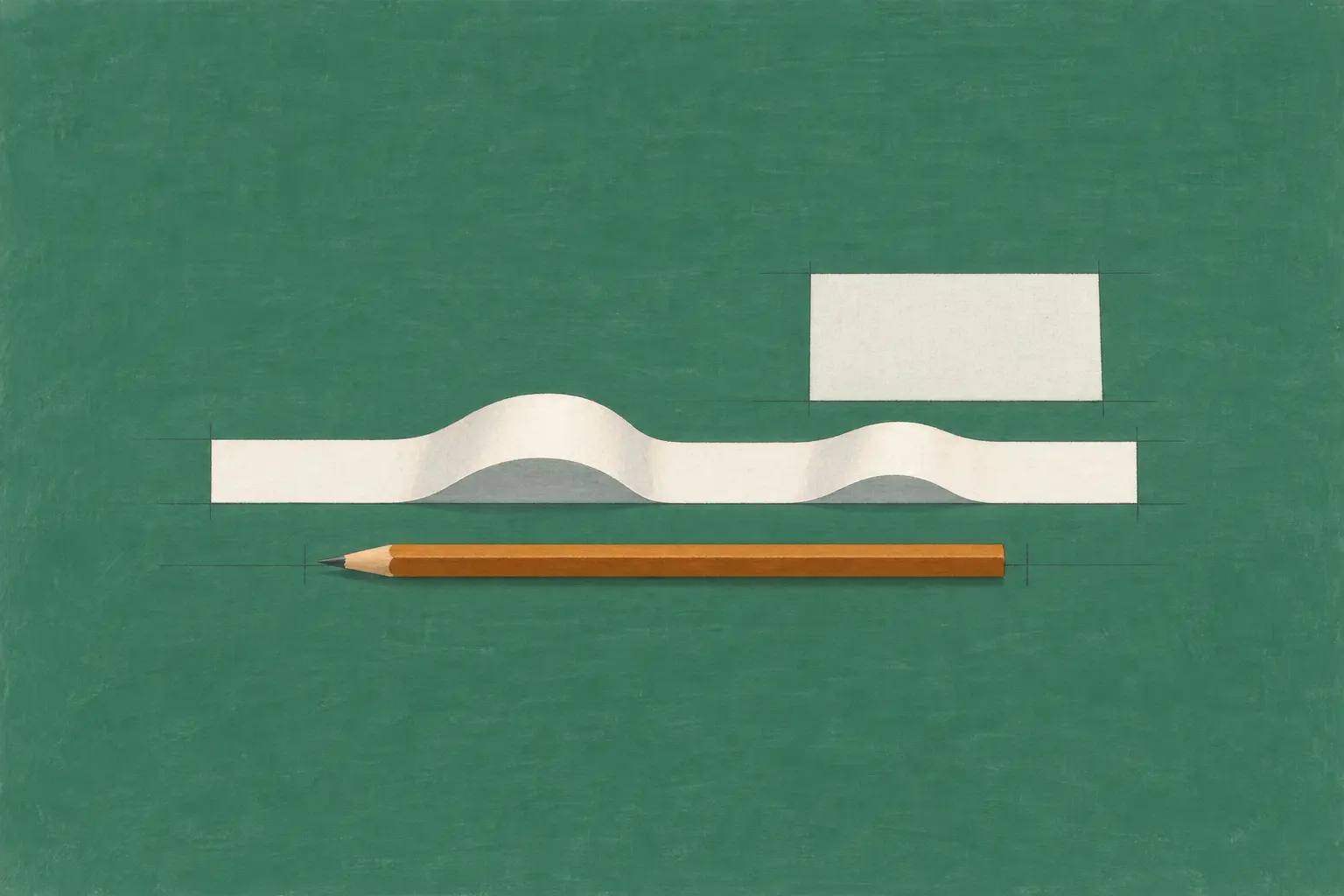
With paper and a few simple tools
- Cut a strip about 2 cm wide along the long side of an A4 sheet. Use scissors, and have an adult present if children are cutting.
- Hold the left end still, lift the right end up and over onto it, and crease. Repeat three more times, always the same way.
- Unfold the strip and bend every crease back to a right angle, each one the way it was folded.
- Stand the strip on its long edge, with the side that faced up on your left, and copy its path onto graph paper from above, one square per segment.
- Compare your 16 segments with the four-fold panel in the drawing of stages 1 to 4. A mirror image means the strip stood the other way round.
Next: Another fractal built from smaller copies of itself: Sierpinski Triangle: A Dice Game Draws It Dot by Dot · Mountains and valleys on a square sheet: Flat Origami: Mountains and Valleys Differ by 2 at Inner Points
Sources
- [1] Michel Dekking, "Paperfolding morphisms, planefilling curves, and fractal tiles," Theoretical Computer Science 414(1): 20–37 (2012); arXiv:1011.5788. https://arxiv.org/abs/1011.5788 Read: full text of the arXiv version (January 2011), sections 1, 2, 5, 6 and 8 and the references; paraphrased, with one short quotation that Dekking himself quotes from Davis and Knuth.
- [2] Weisstein, Eric W. "Dragon Curve." From MathWorld--A Wolfram Resource. https://mathworld.wolfram.com/DragonCurve.html Read: used to check facts only; no text, figures or tables reproduced.
- [3] Original data for this page: a model of a paper strip folded in half 1 to 16 times, tracked layer by layer, with every crease read off and the path walked on a square grid (method in the text); the counts and checks are in the CSV download. https://drawnmathematics.com/fractals/dragon-curve/dragon-curve-folds.csv Read: this page's own computation; method in the text, data in the CSV download.
Cite this page
Drawn Mathematics. “Dragon Curve: Fold a Strip, Open to 90°, and a Stage Appears.” Drawn Mathematics. Published 2026-10-26. https://drawnmathematics.com/fractals/dragon-curve/ (accessed: add the date you read it).
How each drawing is checked: Checking the constructionCorrections and redrawsHow to reach us