Sierpinski Triangle: A Dice Game Draws It Dot by Dot
TL;DR: Jump halfway toward a corner picked by a die, mark a dot, repeat: the dots fill in a Sierpinski triangle. That is the shape left when you cut a triangle into four, remove the middle one and repeat forever, and the odd numbers in Pascal's triangle draw its stages too.
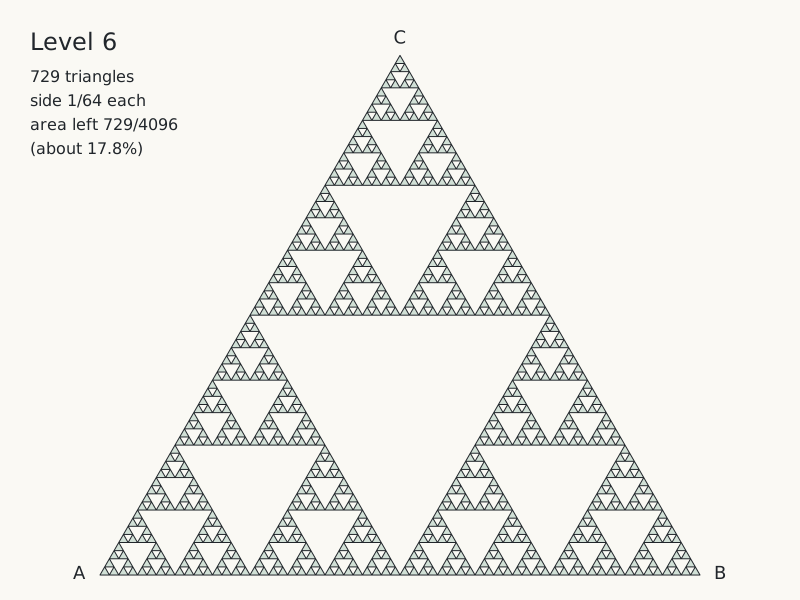
Rule: Cut a triangle into four, remove the middle one, repeat on what remains.
Narrow screen? Scroll the drawing sideways, or open it full size.
Full credit to copy
"Sierpinski triangle, level 6" by Drawn Mathematics, https://drawnmathematics.com/fractals/sierpinski-triangle/, licensed under CC BY 4.0, https://creativecommons.org/licenses/by/4.0/
Field-guide card
- Name
- Sierpinski triangle (also called the Sierpinski gasket or sieve)
- Classification
- Fractal Construction · classic fractal, dimension log 3/log 2, about 1.585
- Generating rule
- Join the midpoints of each triangle's sides, remove the middle triangle, and repeat on the three that remain
- Diagram
- Figure 1: level 6, 729 triangles, each side 1/64 of the original, drawn from exact corner coordinates
- How it was checked
- Exact counts and areas for levels 0 to 10; the odd numbers in the first 1,024 rows of Pascal's triangle matched cell by cell to level 10; all 10,000 dice-game dots inside the triangles left at level 12 How checks are done
These fields as CSV (sierpinski-triangle-card.csv)Where this file comes from: source, version and license (JSON)
Source data: Computed for this page from the definition of the Sierpinski triangle; names as listed in Wolfram MathWorld, Sierpiński Sieve
Roll a die, jump halfway
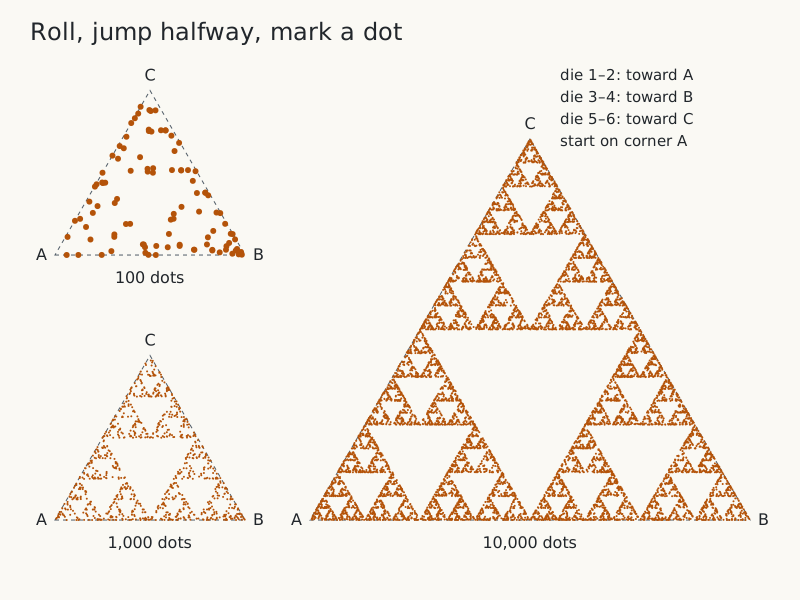
Mark the corners of a large triangle A, B and C, and start on corner A. Roll a die: on 1 or 2, move halfway toward A; on 3 or 4, halfway toward B; on 5 or 6, halfway toward C. Mark a dot there. Roll again from the new dot.
A hundred dots look scattered; 10,000 trace the Sierpinski triangle, with a hole in the middle, the same hole in each corner piece, and again at several smaller sizes. Wolfram MathWorld calls this game the chaos game.
Narrow screen? Scroll the drawing sideways, or open it full size.
Full credit to copy
"The dice game (chaos game) after 100, 1,000 and 10,000 dots" by Drawn Mathematics, https://drawnmathematics.com/fractals/sierpinski-triangle/, licensed under CC BY 4.0, https://creativecommons.org/licenses/by/4.0/
The drawing uses one fixed run of rolls. After 1,000 dots, 554 of the 729 small triangles in Figure 1 hold a dot (shared-corner dots count once); after 10,000, all 729 do. The counts for other sizes are in sierpinski-triangle-dice-game.csv (CSV; where this file comes from: source, version and license, JSON) Source data: Computed for this page: one run of the dice game from a fixed seed.
Cut, remove, repeat
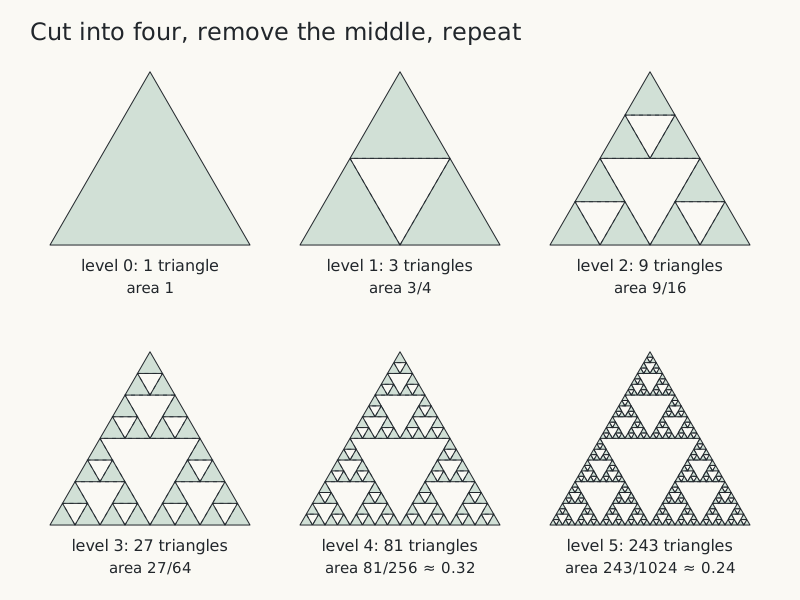
Join the midpoints of a triangle's three sides to split it into four half-size triangles. Remove the middle one. Do the same to each of the three that remain, and keep going.
Narrow screen? Scroll the drawing sideways, or open it full size.
Full credit to copy
"Sierpinski triangle, levels 0 to 5" by Drawn Mathematics, https://drawnmathematics.com/fractals/sierpinski-triangle/, licensed under CC BY 4.0, https://creativecommons.org/licenses/by/4.0/
After n rounds there are 3ⁿ triangles, each with a side (1/2)ⁿ of the original, covering (3/4)ⁿ of the area. Level 5 keeps 243 triangles and about 23.7% of the area. Their total edge length grows instead, by 3/2 each round, so level 10 has about 58 times the starting perimeter.
The Sierpinski triangle is what remains after infinitely many rounds: its area is zero, yet every edge drawn along the way stays in it. Each drawing here is a finite stage, and its caption says which. The triangle is named after Wacław Sierpiński. Wolfram MathWorld cites his 1915 description.
The numbers for levels 0 to 10 are in sierpinski-triangle-levels.csv (CSV; where this file comes from: source, version and license, JSON) Source data: Computed for this page from the definition of the Sierpinski triangle and exact values of every number in rows 0 to 1,023 of Pascal's triangle.
Why every dot lands on the triangle
A jump halfway toward A shrinks the whole triangle to half size, pinned at A, so the dot lands in the half-size copy at A. Jumps toward B and C do the same at their corners: these are the three copies the cutting rule keeps. So the last roll picks the half-size triangle that holds the dot, the roll before picks the quarter-size triangle inside it, and so on.
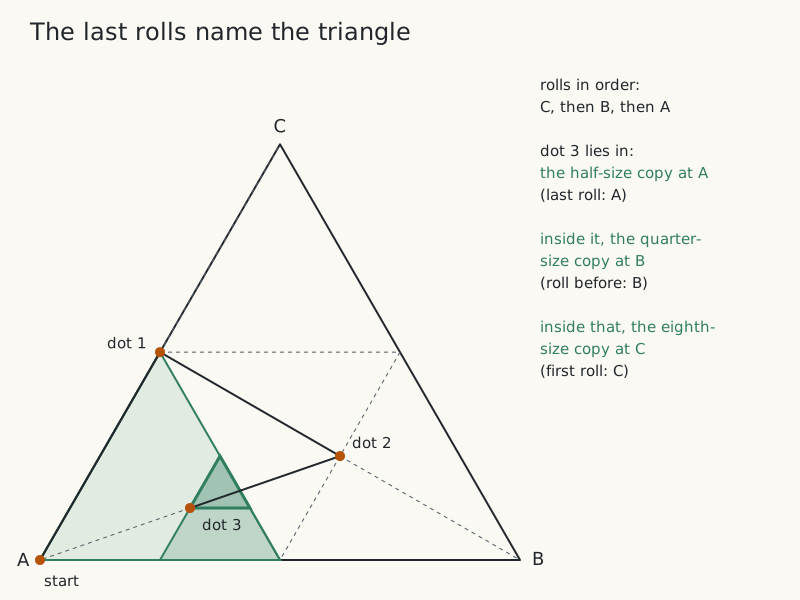
Narrow screen? Scroll the drawing sideways, or open it full size.
Full credit to copy
"The last rolls name the triangle that holds the dot" by Drawn Mathematics, https://drawnmathematics.com/fractals/sierpinski-triangle/, licensed under CC BY 4.0, https://creativecommons.org/licenses/by/4.0/
Starting on corner A, the dot never leaves the Sierpinski triangle, because each jump maps the shape onto one of its own copies. We reran the game with a short program: all 10,000 dots lie in the triangles left at level 12. With a fair die, every sequence of six corners turns up sooner or later (with probability 1), so each of the 729 level-6 triangles gets a dot.
Start at the center instead, and no dot ever lands on the shape: the tenth dot sits in the middle hole of a triangle whose side is 1/1,024 of the original, and each jump halves that hole. Wolfram MathWorld's version of the game throws away the first few dots.
Odd numbers in Pascal's triangle
In Pascal's triangle, each number is the sum of the two above it. Shade the odd numbers: the first 4 rows draw level 2, the first 8 rows level 3, and the first 32 rows level 5.
| Row | Numbers | Odd (O) or even (E) |
|---|---|---|
| 0 | 1 | O |
| 1 | 1 1 | O O |
| 2 | 1 2 1 | O E O |
| 3 | 1 3 3 1 | O O O O |
| 4 | 1 4 6 4 1 | O E E E O |
| 5 | 1 5 10 10 5 1 | O O E E O O |
| 6 | 1 6 15 20 15 6 1 | O E O E O E O |
| 7 | 1 7 21 35 35 21 7 1 | O O O O O O O O |
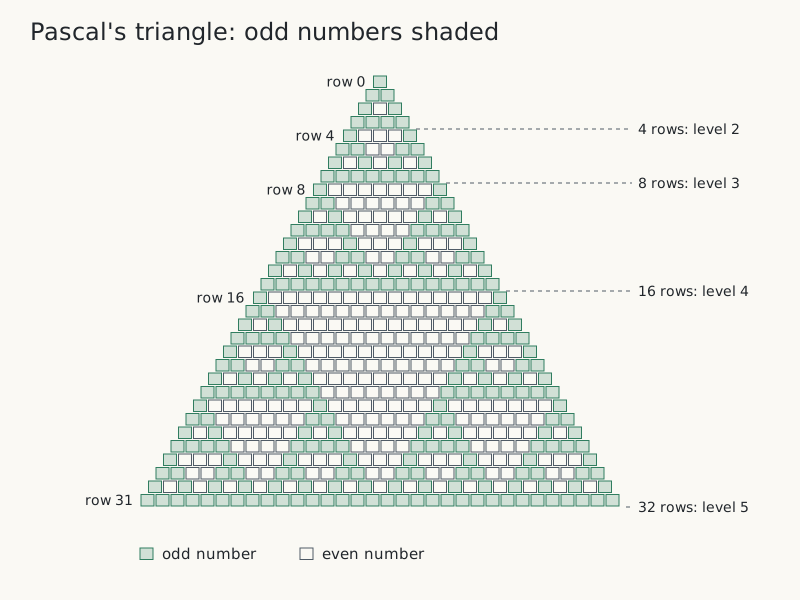
Narrow screen? Scroll the drawing sideways, or open it full size.
Full credit to copy
"Pascal's triangle, rows 0 to 31, odd numbers shaded" by Drawn Mathematics, https://drawnmathematics.com/fractals/sierpinski-triangle/, licensed under CC BY 4.0, https://creativecommons.org/licenses/by/4.0/
Only odd and even matter: odd plus odd is even, and odd plus even is odd. Row 4 is odd only at its two ends, so each end starts its own copy of rows 0 to 3, with even numbers between: three copies in all, as in the cutting rule. In row 8 the two lower copies meet, odd plus odd makes even, and row 8 is again odd only at its ends, so the step repeats at rows 16, 32 and on.
As a check, a short program computed every number in the first 1,024 rows exactly (the largest has 307 digits). The odd ones match level 10 cell by cell. There are 59,049 of them, which is 3¹⁰. Wolfram MathWorld lists the same pattern.
Three half-size copies: dimension about 1.585
Shrink a segment by half and 2 copies rebuild it; a filled triangle takes 4, and 4 = 2². The power of 2 is the dimension: 1 for the segment, 2 for the filled triangle. The Sierpinski triangle takes 3 half-size copies, so its dimension D solves 2D = 3: D = log 3/log 2, about 1.585.
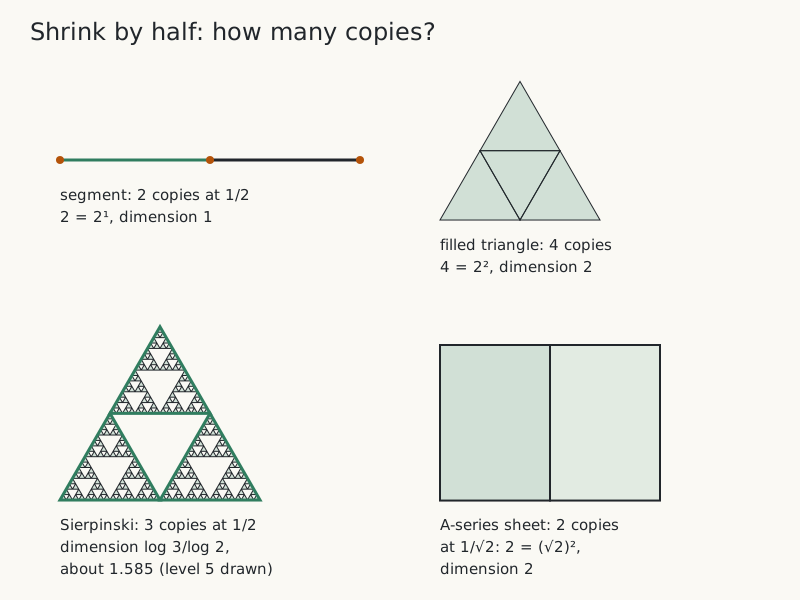
Narrow screen? Scroll the drawing sideways, or open it full size.
Full credit to copy
"Copies at reduced size and the dimension they give" by Drawn Mathematics, https://drawnmathematics.com/fractals/sierpinski-triangle/, licensed under CC BY 4.0, https://creativecommons.org/licenses/by/4.0/
A rectangle with sides in the ratio √2 to 1, the shape of A-series paper, halves into 2 copies at 1/√2 of the length, and (√2)² = 2, so its dimension is 2. A coastline's dimension is measured, not counted: Coastline Paradox: Seven Rulers, Seven Lengths for Britain fits one to rulers walked around a map of Britain, and it holds only across the ruler lengths used.
Draw it yourself:
With paper and a few simple tools
- Mark three corners of a large triangle on A4 paper: A, B and C.
- Start on corner A, roll a die, and use a ruler to mark the point halfway to A (1 or 2), B (3 or 4) or C (5 or 6).
- Roll again from the newest dot until you have 30 dots, then compare them with the 100-dot drawing.
- Write 16 rows of Pascal's triangle on graph paper as odd or even: the top cell is odd, and a cell is odd when exactly one cell above it is odd.
- Shade the odd cells and compare them with level 4 above.
Next: Dragon Curve: Fold a Strip, Open to 90°, and a Stage Appears · Two copies at 1/√2 make a whole sheet: A4 Paper Size: Built So Each Half Keeps the Same Shape
Sources
- [1] Weisstein, Eric W. "Chaos Game." From MathWorld--A Wolfram Resource. https://mathworld.wolfram.com/ChaosGame.html Read: used to check facts only; no text, figures or tables reproduced.
- [2] Weisstein, Eric W. "Sierpiński Sieve." From MathWorld--A Wolfram Resource. https://mathworld.wolfram.com/SierpinskiSieve.html Read: used to check facts only; no text, figures or tables reproduced.
- [3] Original data for this page: the Sierpinski construction for levels 0 to 10, every number in rows 0 to 1,023 of Pascal's triangle compared cell by cell with level 10, and one run of 10,000 dice-game dots checked against level 12 (method in the text); the counts are in the two CSV downloads. https://drawnmathematics.com/fractals/sierpinski-triangle/sierpinski-triangle-levels.csv Read: this page's own computation; method in the text, data in the CSV downloads.
Cite this page
Drawn Mathematics. “Sierpinski Triangle: A Dice Game Draws It Dot by Dot.” Drawn Mathematics. Published 2026-10-26. https://drawnmathematics.com/fractals/sierpinski-triangle/ (accessed: add the date you read it).
How each drawing is checked: Checking the constructionCorrections and redrawsHow to reach us